
Write something
Pinned

Apr 17 •
Welcome! You're in the right place!
An update for anyone who’s been following the Jewelers Advantage transition. Copyrighted content that was being displayed without my authorization has now been removed from the platforms where it appeared. The process was handled professionally by the teams involved, and I’m grateful for their responsiveness. In the weeks since this situation began, every major Industry Partner has confirmed they are continuing their relationship with Jewelers Advantage (owned and operated by Decagon LLC) on our new infrastructure. Active client projects are being delivered. The AI is advancing. The community is growing. For those of you who reached out with support, who joined the new community, who sent a message or liked a post at a moment when it meant more than you know, thank you. When I said: “Believe your eyes,” you saw what was happening, and you chose to stand with the work. And, NOW is your opportunity to see why the work we are doing at Jewelers Advantage is just so valuable… We’re just getting started, and have never been more motivated or inspired to innovate and elevate businesses like yours - with the most important technology this world has ever seen… In that spirit, if you have a friend or colleague that you would like to explore this new frontier with, please share this Community link. I want to help as many people as I can to be prepared for the massive opportunity ahead: https://www.skool.com/jewelers-advantage-ai-4685/about Let’s build the future together. Jesse Korby Founder & CEO Jewelers Advantage
1
0
Pinned
Mar 25 •
FREE AI Tools from Jewelers Advantage
Welcome! Here are 3 Free AI Tools my team and I built, that not only help you build your AI-powered Jewelry Business, but also help you complete the program! ✨MasterJeweler AI: Our flagship model, can be used with the Custom Jeweler Launch Checklist you download at the start of the program. This Launch Checklist contains a "Prompt Column" that helps you with specific stages of your step-by-step journey through our "AI for Jeweler's" curriculum focused on Custom Jewelry. By using these tools, you can launch a Custom Jeweler Funnel in 1-4 weeks, depending on your experience with AI - while remaining aligned with the BEST PRACTICE frameworks here at Jeweler's Advantage. 1. Download the PDF. 2. Use the Launch Links in the doc, to find our tools in ChatGPT. 3. Use the Custom Jeweler Launch Checklist with these tools. 4. Complete the AI4J Curriculum step-by-step with AI helping you - it's impossible to fail.
1
0

8d •
AI Powered Mood Boards for Custom Jewelry
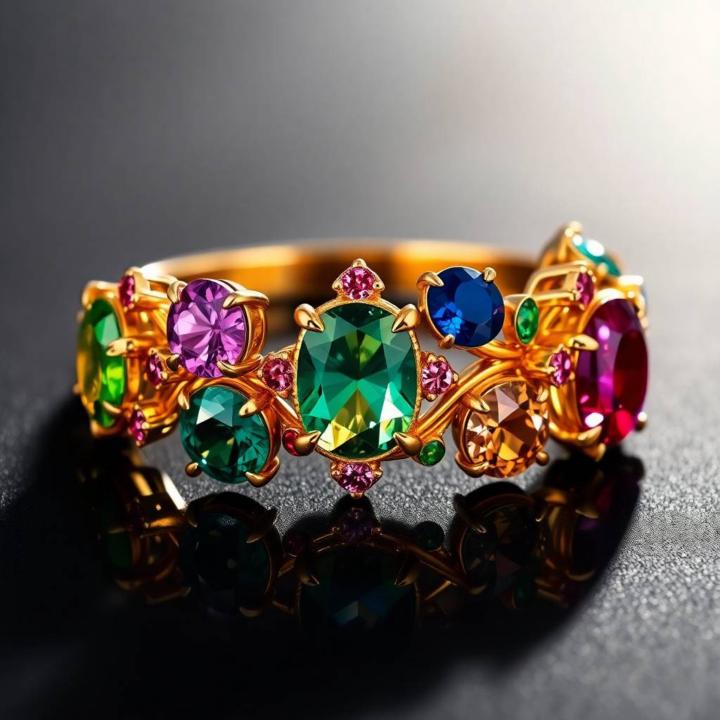
Assess Trends → Create Text Prompt → Generate Visual Directions → Curate for Quality → Build the Mood Board This is the future Mood Board workflow for Custom Jewelers. In less than 10 minutes, we went from real jewelry industry trends to a refined visual direction using AI. First, we assessed what’s happening in the market. Then we turned that insight into a focused text prompt. From there, Leonardo Flow State brought the trend to life with a wide range of images, giving us fast creative options to review, refine, and curate. The real advantage? When you have a Custom AI built for your brand, you can combine current industry trends with what makes your work special and unique. That means faster concepts, stronger client presentations, more inspired Custom Projects, and a design experience that makes you look like a sorcerer in the eyes of your client. And remember: Taking action is what actually makes this possible. Here is the Free Tool I used to kick this off, starting with the INDUSTRY NEWS Convo Starter in MasterJeweler: https://www.skool.com/jewelers-advantage-ai-4685/classroom/874ea21d?md=92fc2ea814d44b97a535578c3653383b
0
0
9d •
What happens when AI 3D CAD lands for Jewelry?
We’re all waiting for the big breakthrough moment where AI 3D CAD “just works.” Not just using AI around your CAD workflow… which is already smart, and worth doing now… but the moment AFTER this technology gets productized (and commoditized). The likely future looks like this: You upload an image. You talk to the AI like a human designer. It makes real-time CAD changes with you.And voilà! You have a 3D-print-ready file! With AI tools already beginning to connect into 3D environments like Blender, this feels less like a question of if and more like a question of when. So here’s the real conversation: How would that change your budgeting? How would it change the way you think about jewelry eCommerce? How would it shift your focus toward higher-leverage parts of the business? Because the Jeweler who starts answering those questions now will be ready when the tool finally arrives. And when it does, they won’t be scrambling… They’ll be walking right into their most capable form.
0
0

15d •
The Chat Thread Is Your AI Operating System
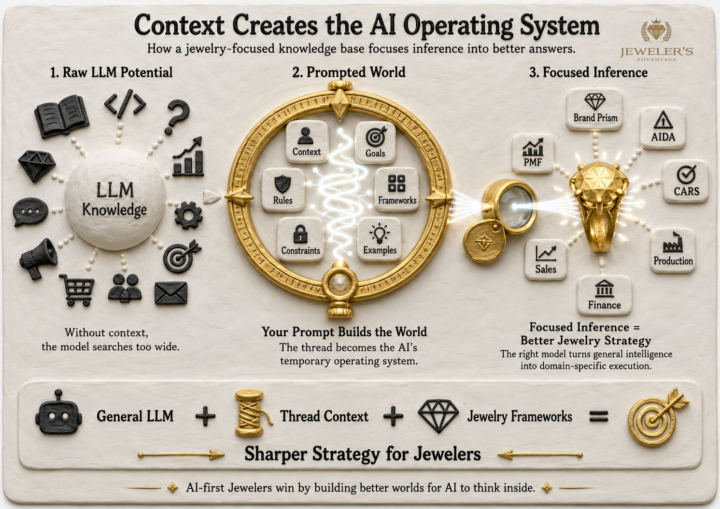
JEWELERS - here is a secret about how AI Works, for Top 1% Jewelers. Most people think prompting means “asking AI a question.” That is only the surface. When you start a chat thread with an LLM, you are actually creating a temporary world for AI to think inside. That world is made of: Context: who you are, what business you are in, what problem matters. Rules: what should be prioritized, avoided, measured, or protected. Language: the vocabulary and frameworks the model should use. Goals: what a good answer is supposed to achieve. Constraints: budget, brand position, production limits, customer type, timeline. Examples: patterns the AI can imitate and extend. In other words: A weak prompt asks for an answer.A strong prompt creates context.An expert prompt creates an Operating System. This matters because of Inference Time. Inference is the moment when AI calculates its response to your input. If you give the model no context, it has to search across everything it knows and guess what world you are operating in. For example, “jewelry marketing” could mean bridal, custom, hip hop, fine designer, repairs, eCommerce, local retail, influencer campaigns, or wholesale. Without context, the AI spends energy figuring out what you mean. With context, the AI can focus. It is like sunlight through a magnifying glass. The better the world you build, the sharper the answer becomes. For Jewelers, this is where a jewelry-focused model like MasterJeweler AI becomes powerful. It does not start from a blank page. It starts inside a Jewelry Business Operating System. That OS includes frameworks like: Brand Prism for identity. AIDA for the customer journey. CARS for operational roles.PMF for product-market fit. MMR for market-message resonance. Custom, Supplier, and M2O for production strategy. T1, T2, T3 and C1, C2, C3 for pricing logic. So instead of giving generic advice like: “Post more on Instagram.” “Use better photos.” “Tell your brand story.” “Run ads.” A jewelry-focused model should think:
0
0
1-30 of 30
powered by
skool.com/jewelers-advantage-ai-4685
The most effective AI Training & Tools available, for the Jeweler of the future...
Suggested communities
Powered by