
May 17 • General discussion
Case Study: The Murder of Brian Spinks
On the morning of the 3rd of January 2010, police officers entered an apartment in Bossier City, Louisiana, and found Staff Sergeant Brian Spinks lying dead on the floor.
He had been stabbed more than sixty times.
The apartment bore the marks of prolonged violence. Blood stained the carpet and walls. A kitchen knife lay nearby. There was no sign of forced entry, no indication that anyone had broken in or fled. Whatever had happened inside the apartment had happened at close quarters, between people already known to one another.
Spinks was twenty-five years old and serving in the United States Air Force. Friends later described him in practical, subdued terms: disciplined, organised, dependable. He had recently returned from deployment overseas. He telephoned family members regularly. He planned ahead.
His girlfriend, Kimethia Coleman, was in the apartment when police arrived.
At first, Coleman told detectives that an intruder named John had entered the apartment and attacked Spinks.
It was not merely the contradiction between those accounts that interested investigators, but the way the story appeared to change under pressure.
Retired Deputy U.S. Marshal Mark McClish, one of the best-known advocates of statement analysis, has argued that deceptive narratives rarely remain stable for long. Truthful witnesses may forget details or correct themselves openly. But deceptive accounts often require continual adjustment as physical evidence closes off earlier versions of events. Certain details grow sharper after challenge; others quietly disappear.
Detectives interviewing Coleman reportedly became increasingly focused on these shifts. The figure of 'John' remained vague and difficult to pin down. Details surrounding his presence altered as questioning continued. Meanwhile, the forensic evidence inside the apartment remained fixed: the knife, the blood patterns, the confined space in which the attack had unfolded.
McClish frequently notes that deceptive language often distances itself from harmful acts. Instead of directly describing violence, speakers soften or blur responsibility through passive phrasing. The action remains, but ownership recedes.
Investigators listening to Coleman’s interviews believed they heard similar patterns emerge around the killing itself. Peripheral details sometimes received long explanation, while the violence became linguistically compressed or indirect. Statement analysts often regard this imbalance as significant. People attempting deception frequently elaborate on safe territory while avoiding the psychological centre of the event.
The physical evidence created additional difficulties for Coleman’s account. More than sixty stab wounds suggested repetition and endurance rather than a momentary loss of control. Prosecutors later argued that the attack continued long after any immediate threat could plausibly have passed.
At trial, jurors heard recordings of Coleman’s police interviews alongside testimony describing the crime scene itself. The prosecution argued that her explanations evolved in response to the investigation rather than memory. The defence maintained that she had acted in fear and emotional distress.
Cases such as this often reveal the strange relationship between language and evidence. The apartment told one story in blood and physical arrangement. The interviews told another in fragments, revisions, omissions, and altered emphasis. Detectives were left to determine whether the spoken account aligned naturally with the scene itself — or whether it was adapting to it.
McClish has observed that truthful denials are usually simple and direct: “I didn’t do it.”
Deceptive subjects, he argues, often move sideways instead: “I would never hurt him.” “People can think what they want."
The denial shifts subtly away from the act itself.
What makes the Brian Spinks case unsettling is not mystery in the traditional sense. There was no unidentified killer waiting in shadow, no elaborate conspiracy gradually uncovered through decades of investigation. The horror lay in something far smaller and more intimate: a domestic space, a violent death, and a surviving witness whose account appeared unable to settle into stable form.
In the end, investigators concluded that the problem was not memory failing under trauma, but narrative failing under scrutiny.
And in statement analysis, that distinction matters.
2
1 comment
Case Study: The Murder of Brian Spinks
powered by
skool.com/how-to-spot-a-liar-6506
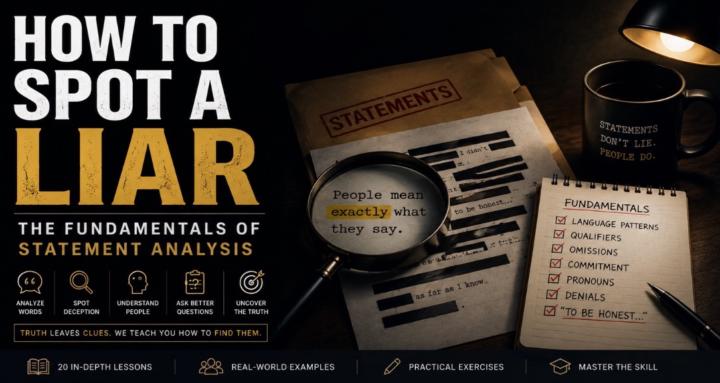
Master the fundamentals of Statement Analysis. Spot deception, weak denials, and hidden meaning in everyday language.
Suggested communities
Powered by