
Write something

Aug '25 •
Taut line
The Taut-line hitch, often misspelled as "taught-line hitch," is a classic adjustable loop knot. It's not typically used for life-support applications like climbing, but it is a very useful knot for a variety of tasks where you need to adjust tension on a line. Think about setting up a tent or a tarp, securing a load on a vehicle, or creating an adjustable mooring line for a boat. The primary function of the Taut-line hitch is to create a loop that can be easily slid up and down the standing part of the rope to tighten or loosen the line, but which holds fast under tension. How to Tie the Taut-line Hitch There are a few variations of this knot, but here's a common and secure method: * Wrap the rope around an anchor: First, take the working end of your rope and pass it around the object you want to tie to (e.g., a tent stake, a tree branch, etc.). * Make the first wrap: Bring the working end back alongside the standing part of the rope. Make a half-hitch around the standing part, wrapping it once. * Make a second wrap: Continue with a second wrap, again going around the standing part in the same direction as the first wrap. This second wrap should be "inside" the loop created by the first wrap. This is a key step that increases the knot's security. * Complete with a half-hitch: Finally, make another half-hitch, but this time, tie it on the "outside" of the loop, in the opposite direction of the first two wraps. * Dress the knot: Gently tighten the knot by pulling on both the working end and the standing line to make sure all the wraps are neat and the knot is snug. Key Characteristics * Adjustable: The biggest advantage of the Taut-line hitch is that you can slide it along the standing part of the rope to easily adjust the length and tension of the line. * Holds under tension: When the knot is under load, the friction from the wraps causes it to jam against the standing part, preventing it from slipping. * Versatile: It's a great knot for a wide range of non-critical applications where you need to make tension adjustments.
0
0
Aug '25 •
Blakes hitch
The Blake's Hitch is a popular friction hitch among arborists and climbers for its security and ease of use. It's unique because it's tied with the end of a rope, unlike other hitches like the Prusik, which require a separate loop. How to Tie the Blake's Hitch The basic method for tying a Blake's Hitch involves wrapping the end of your climbing rope around the main line. Here is a step-by-step guide: * Set up your climbing line: First, your main climbing rope needs to be anchored to a sturdy point in the tree, like a strong limb. The rope should be hanging down to the ground. * Make the wraps: Take the end of your rope (the working end) and wrap it around the main, or "standing," part of your climbing line. Make four wraps, moving upwards. * Cross over: Bring the working end of the rope down and across the front of the standing end. * Tuck the working end: Now, you'll thread the working end through the knot you've created. You'll need to tuck it behind the standing line and under the first two wraps you made. * Exit in the middle: The working end should exit the knot so that it's coming out from between the bottom two wraps and the top two wraps. * Dress the knot: Gently pull on both the working end and the standing part of the rope to tighten and "dress" the knot. This means making sure it's neat and tight, with all the wraps lying flat. * Add a stopper knot: This is a crucial safety step. Always tie a stopper knot, such as a Figure-Eight knot, on the end of the rope that extends from the Blake's Hitch. This prevents the hitch from accidentally coming undone or "rolling out" under load. Key Considerations * Rope Compatibility: The Blake's Hitch works best with specific rope diameters. It's essential to ensure your ropes are compatible for the hitch to grip properly. * Stopper Knot: The stopper knot is not optional. It is a critical safety measure that provides a backup in case the hitch fails. * Practice: Like any knot, the Blake's Hitch requires practice. Before using it for climbing, practice tying it and getting a feel for how it slides and grips the rope when it's under tension.
0
0
Aug '25 •
D..R.T
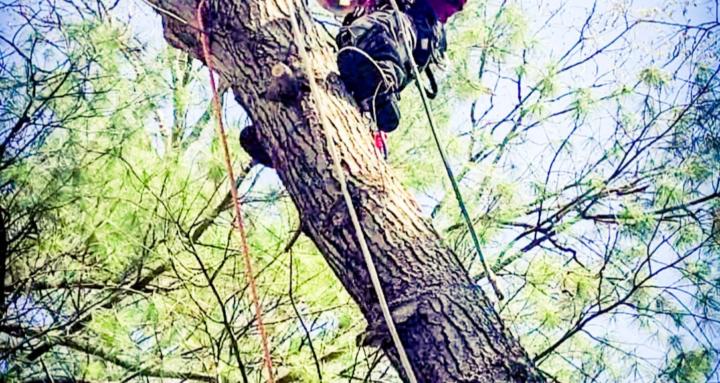
Double Rope Technique, or DRT, is a traditional method of tree climbing where the climber uses a rope that is anchored over a branch. The rope's two ends hang down, forming a 'V' shape. The climber ascends and descends by using one end of the rope while a friction hitch or mechanical device on the other end provides a way to climb. This technique involves the rope moving (or "running") over the branch union as the climber moves up or down.
0
0
1-3 of 3
powered by
skool.com/how-to-climb-a-tree-srt-or-drt-8976
All you need to know to safely ascend and decend in a tree. Either S.R.T or D.R.T also basic and advanced knotts both for climbing and rigging.
Suggested communities
Powered by