
Write something

Dec '25 •
The great hemp betrayal
THE GREAT HEMP BETRAYAL, Join me as i tear apart this piece of legislative toilet paper. Big Red’s Rant, Reality Check & Deep Dive Into the Backdoor Hemp Ban That’s About to Torch the Industry* INTRO: THE BIG RED DETONATION — WHERE I TAKE A GIANT SHIT ON THE GOVERNMENT, THE LOBBYISTS, THE SUITS, AND EVERY SLIMY HAND THAT HELPED PASS THIS BILL** Here it is, raw and unfiltered — the way it comes outta my Brooklyn soul when the government pulls some grimy midnight stunt behind the nation’s back. Let me tell you something straight: Washington didn’t just screw the hemp industry — they bent it over a Senate desk, whispered “shhhh,” and drove a legislative bulldozer right through the middle of it while the public was distracted by a shutdown they created in the first place. These clowns — these tie-wearing, donor-sniffing, lobbyist-fed suits — tucked one of the nastiest little policy nukes into a last-minute funding bill **like a thief hiding stolen jewelry in grandma’s Christmas stocking.** A whole hemp economy… Thousands of small farmers… Millions of consumers… Home growers… Mom-and-pop cannabinoid companies… Veterans using CBD for relief… People medicating without Big Pharma… All sacrificed so a bunch of morons in Washington could pat each other on the back and tell Wall Street cannabis interests, “Don’t worry baby, Daddy took care of the competition.” This shit right here is why people lose faith in government. This is why folks think lobbyists run the country — because they DO. You think this was about public health? You think this was about consumer safety? Nah, bro — get real. This was about **closing a market that the big money interests couldn’t control yet.** It was about **kneecapping hemp** before hemp kneecapped the overpriced, overtaxed recreational cannabis industry that’s choking on its own regulations. And don’t even get me started on the slimy packaging. Burying a massive hemp redefinition in a bill meant to end a government shutdown — that’s some cartel-level political maneuvering.
2
0

Nov '25 •
cANNABIS PLASTICITY EXPLAINED IN FULL
Cannabis genetic plasticity is one of the most powerful, least understood forces in the grow room. Most people talk strains, nutrients, lights, systems, whatever trendy nonsense is circulating online, but very few understand that cannabis isn’t just a plant following a static blueprint. It’s a reactive organism constantly reading its environment and rewriting how it chooses to grow. That’s the whole game right there. Genetic plasticity is the built-in flexibility that lets cannabis shift its growth, shape, chemistry, and expression based on whatever you throw at it. It’s the reason two clones can come out looking like cousins instead of twins. It’s the reason one grower pulls mids off elite genetics while another pulls straight fire out of a mid-pack cut. It’s the reason the plant never grows the same way twice, even in the same room, even in the same cycle, because small shifts in cues change how the plant interprets life. And if you really want to pull elite flower, you need to understand that the plant is basically a living conversation between genetics and environment. The DNA is the script, but plasticity is the performance. Some plants act scared, some act bold, some act lazy, some act dramatic, some throw colors, some throw frost, and some go full diva when conditions are right. The environment is the director. You’re the one yelling action. The same clone can grow tight, squat, bushy, hyperproductive under one set of cues and stretchy, lanky, softer under another. It’s not random. It’s plasticity responding to light intensity, spectrum, VPD, root oxygen, nutrient rhythm, microbial activity, temperature swings, mechanical stress, even how the grower touches the plant. Nothing happens in isolation. Everything the plant experiences is a signal. Every signal goes straight into the plant’s hormonal steering system. Auxin, cytokinin, ethylene, ABA, jasmonates, salicylic acid, gibberellins, all of them adjusting the plant’s behavior in real-time based on the vibe of the room. That’s why environment beats fertilizer every time. You can’t feed a plant into greatness. You have to signal it into greatness.

Nov '25 •
Cannabis Anatomy the living blueprint
THE LIVING BLUEPRINT Big Red Style Breakdown of Cannabis Anatomy and What Every Part Does From Seed to Harvest. There’s this quiet truth that sits behind every great cannabis grower but you never hear it spoken out loud because most people jump straight to nutrients lights or some magic product they saw on Instagram The truth is this Cannabis anatomy is the blueprint of the plant and if you don’t understand how the structure functions at every stage of growth you’ll always guess instead of predict You’ll react instead of control And you’ll never truly unlock the potential sitting inside those roots stems leaves and flowers So this is the deep dive The dive beneath the dive We’re unpacking the entire plant from the root cap to the trichome head what it’s doing at every moment in its life and why all the parts only make sense when you look at the system as a whole Cannabis isn’t a stack of buds with leaves attached It’s a coordinated evolving biological machine designed to capture light move water regulate chemistry build sugars respond to stress defend itself and finally produce resin so loud it knocks your eyebrows off Let’s start at the beginning where life starts for the plant where everything that comes later is already encoded but waiting for the right moment to activate SECTION 1 THE ROOTS WHERE LIFE BEGINS AND EVERYTHING IS DECIDED If cannabis had a brain it would not be in the flowers or the leaves It’d be in the roots The old school growers never got this but once you really look at cannabis anatomy you realize the roots decide the destiny of the plant The roots control the chemistry hormones water flow and nutrient transport The leaves are the solar panels The buds are the factories But the roots are the commander and chief making every important call 1.1 Root Cap and Root Tip The Explorers When a seed wakes up the very first thing that emerges is the radicle which becomes the taproot The tip of that root is coated in a protective cap that secretes mucilage basically plant snot but important plant snot This slime reduces friction allows the root to slide through the soil and coats each particle so microbes can stick and form communities

Nov '25 •
gibberillins explained
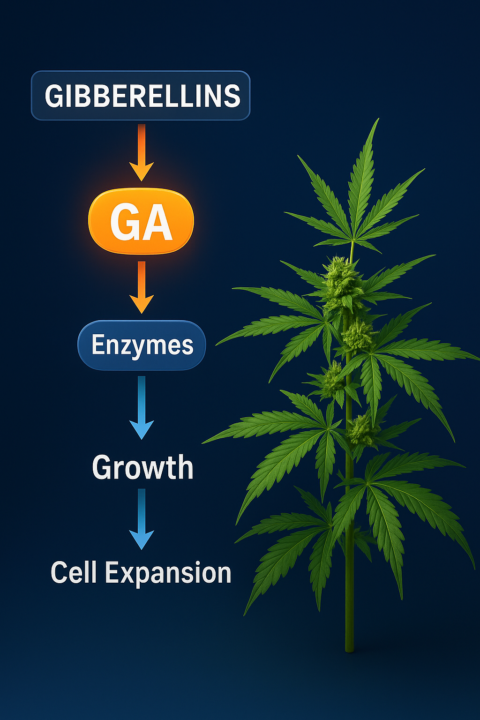
Gibberellins in Cannabis: The Long-Form Big Red Deep Dive (Part 1 — Foundations, Functions, and Hidden Influence) If you talk to growers long enough you notice nobody ever brings up gibberellins unless they’re either a hardcore plant nerd or they’ve messed around with feminized pollen projects. Auxins yeah everybody knows auxins. Cytokinins sure that’s the growth booster folks like to name drop when they’re feeling scientific. Ethylene gets a little love when herm talk comes up. But gibberellins? These things are like the quiet kid in the back of class who barely speaks yet somehow ends up changing the whole damn school. That’s what GA does in cannabis. Silent but influential. Background but essential. Sleepy but powerful as hell. You don’t see gibberellins on the bottle of any common nutrient line. You don’t walk into a hydro store and hear someone say yo my GA levels are off the charts right now. But whether you’re paying attention or not your cannabis plants are constantly negotiating with these hormones. Constantly detecting little shifts in the environment. Constantly adjusting growth momentum because of what gibberellins whisper inside the cells. Gibberellins are growth accelerators. Not sloppy growth, not panicked stretching, but momentum growth. They give the plant permission to expand with confidence. They loosen cell walls, pump up enzymatic activity, and unlock the starch reserves needed for seedlings to wake up and push through soil or rockwool. They’re like the green light at an intersection. They don’t force the car to move but they allow movement. Cannabis watches that light. And if the light stays green long enough you get a plant that tears out of the gate like it’s been waiting its whole life to run. Gibberellins: The Hidden Engine Behind Cannabis Stretch Every grower knows the stretch phase. Flip the lights to 12/12 and boom your plants start shooting upward like somebody put rocket fuel in the reservoir. Some strains chill and give you a gentle rise. Some triple in size. Some take off so fast you swear they’re growing while you’re standing there watching. What’s controlling that surge? Sure photoperiod shift plays a role. Auxins redistribute. The plant’s internal circadian rhythm resets. But the main hormone screaming go go go is gibberellin.
Nov '25 •
Cannabis leaves the engine for growth
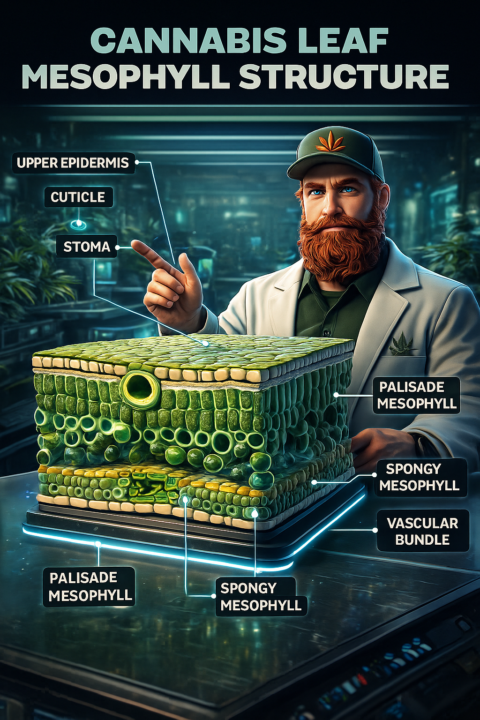
Cannabis Leaves: The Full Big Red Deep-Dive — Anatomy, Physiology, and the Mesophyll Engine Room Running the Whole Damn Show By Big Red, your friendly neighborhood red-bearded plant whisperer INTRO — LISTEN KID, IF YOU DON’T UNDERSTAND THE LEAF, YOU DON’T UNDERSTAND THE PLANT Let me tell you something straight up before we start carving this turkey Cannabis growers like to obsess over roots They chase after the newest bottled snake oil for their reservoirs They drool over LED fixtures like they’re staring at forbidden fruit And don’t even get me started on the growers who treat trichomes like they’re counting diamonds in a vault But if you don’t understand your cannabis leaves — their structure their flow their chemistry and their weird picky little needs — then you’re not even playing the same sport as the master growers You’re warming the bench while the plant runs its own game Everything cannabis does begins in the leaves They are the factory the lungs the digestive system the immune system the thermostat the hydration regulator the nutrient accountant And the king of this entire leafy empire?The heart of the photosynthetic underworld?The powerhouse behind your heavy yields and terpy resin? The mesophyll layer The layer nobody thinks about until Big Red grabs you by the mental collar and drags you into leaf physiology school Today we’re going to break this sucker down — from surface to core — and by the time we’re done you’re going to be looking at every leaf in your grow like it’s a micro-universe of botanical engineering Let’s get into it CHAPTER 1 — THE LEAF AS A WHOLE: A BIOLOGICAL STUDIO APARTMENT WITH TOO MANY JOBS Look at a cannabis leaf right now Doesn’t matter if it’s a little serrated fan leaf the size of a toddler’s hand or a tiny sugar leaf tucked into a bud Each one is a biological apartment complex stuffed with: - light capture systems - gas balancing systems - water distribution networks - nutrient transport highways - defensive perimeter - chemical reactors - structural supports - living tissue constantly making decisions
2
0
1-22 of 22
powered by

skool.com/grow-big-buds-101-2570
100% cannabis education A-Z through essays, lives , and how to videos galore. 40 plus years of grow experience between us. One breeder, One grower....
Suggested communities
Powered by