

23d •
A small look into my creative world.
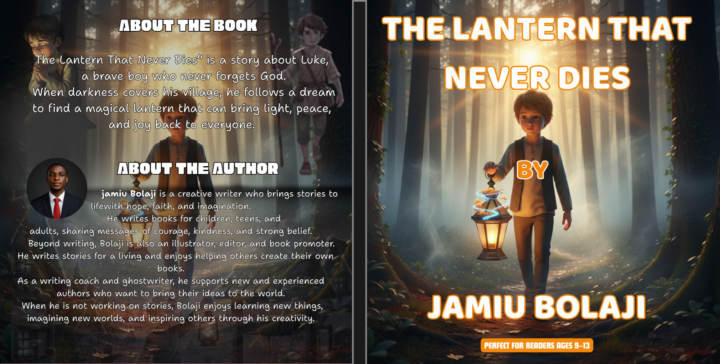
I recently completed another children’s book titled The Lantern That Never Dies, and I wanted to share a glimpse of it here. Working on this project reminded me why I love storytelling especially stories that carry meaning, light, and imagination. Although this is one of my children’s books, my work goes far beyond this genre. I write for children, teens, adults, and authors with unique ideas. Over the years, I’ve built a skillset that allows me to handle every part of the book creation process, including: Creative writing Ghostwriting Story development Book cover design Full-wrap cover layout Editing & polishing Book promotion and branding I focus on producing clean, intentional, and professionally crafted work the kind of stories people enjoy and remember. Tonight, I’ll be sharing the full-wrap cover design for this book. And soon I’ll be giving away the PDF version completely free for anyone who wants to read it to their children. No pressure just something I wanted to share with anyone who might enjoy it. If you’re curious about my projects, love children’s literature, or have a story idea you want to develop, I’m always open to creative conversation.
1
0

Aug 7 •
🧾 Boundaries, Contracts & Scope Creep: The Holy Trinity of Staying Booked (Not Burnt Out)
Let me say this louder for the ghostwriters in the back: If you don’t set boundaries, your client will. And they’ll set them in their favor, not yours. You’re not a writing robot. You’re not “on call. ”You’re a professional with a service, a process, and a limit. So let’s talk about the 3 things that’ll keep your peace (and your payment): ✅ 1. BOUNDARIES ARE A BUSINESS TOOL Boundaries aren’t “mean. ”They’re strategic clarity. They protect your time, your creativity, and your reputation. Here’s how to build them in: - ✅ Office hours → “I’m available M–Th, 10–4 EST. I respond to messages within 24 hours.” - ✅ Turnaround time → “All drafts delivered within 5–7 business days unless otherwise agreed.” - ✅ Feedback deadlines → “Revisions must be requested within 5 days of delivery.” - ✅ Communication policy → “All project communication stays in Slack/email/Notion—not texts or DMs.” ✨ Boundaries don’t push clients away. They attract better ones. ✅ 2. YOUR CONTRACT ISN’T OPTIONAL—IT’S YOUR SHIELD No more “casual” projects. No more “they seem cool. ”If there’s no contract, there’s no project. Period. Your contract should clearly state: - ✔️ Scope of work (deliverables + deadlines) - ✔️ Payment terms (when & how they pay) - ✔️ Revision policy (how many + what counts) - ✔️ Termination clause (what happens if either of you backs out) - ✔️ Ownership terms (who owns the final content) No contract = No clarity = Endless headaches. And yes, you CAN enforce a contract even if you're just starting out. ✅ 3. SCOPE CREEP IS YOUR ENEMY (AND YOU LET IT IN) Here’s how it happens: You agree to 1 blog post →They ask for 2 extra emails →They want you to “just tweak” their About page →Now they’re asking if you do YouTube scripts too… All for the same price. 🚫 Stop it. Here’s what to say: “That’s outside the scope of our original agreement, but I’d be happy to add it as an additional service. Would you like me to send a quote?”
0
0

Aug 7 •
📦 How To Set Expectations & Deliverables (So You Don’t Get Dragged Into Extra Work You Didn’t Get Paid For)
Most beginner ghostwriters struggle with one thing: They don’t know how to say no. Not because they’re weak—But because they never clearly defined what “yes” included in the first place. Here’s the truth: If you don’t set the expectation, the client will. And their version always includes more than you planned. Let’s fix that. Here’s how I set expectations and deliverables before writing a single word: ✅ Step 1: Define What They’re Actually Buying Don’t sell vague deliverables like: ❌ “I’ll write some content for you” ❌ “I’ll help you tell your story” ❌ “I’ll ghostwrite your book” Be specific: ✅ “You’ll receive one 1,000-word blog post based on a 30-minute interview call. Includes 2 rounds of revisions. Delivered in 5 business days.” This removes all ambiguity. ✅ Step 2: Put It in Writing (Every Time) Use your proposal, invoice, or contract to spell out the scope. - How many deliverables? - What’s included (and NOT included)? - When will they receive it? - What counts as a revision? - What’s the final format (Word doc, PDF, Google Drive)? If it’s not written down, it doesn’t exist. ✅ Step 3: Use Simple Language Don’t try to sound fancy. Bad: “Client shall receive proprietary copywriting assets developed in collaboration…” Better: “You’ll get 2 email drafts and 1 repurposed carousel post. Each includes 1 revision.” Clients aren’t impressed by jargon. They’re impressed by clarity. ✅ Step 4: Repeat the Plan Back to Them on the Kickoff Call One line I always say on client calls: “Just to confirm: you’re getting [x deliverable], I’ll deliver it by [date], and it includes [revisions/edits]. Sound good?” This saves you from the “I thought you were also going to…” convo later. ✅ Step 5: Reinforce With a Summary Email After every agreement or kickoff call, I send a recap email. It’s short. It’s clear. It sets the tone. Example: Subject: Your Project Details 👇🏾 Hey [Client Name], Just recapping what we confirmed: ✅ 2 blog posts/month (1,000–1,200 words each)
0
0

Aug 7 •
🛠 How I Manage Revisions as a Ghostwriter (Without Getting Burnt Out or Underpaid)
Revisions can make or break your ghostwriting business. Do them right? You look professional, collaborative, and high-value. Do them wrong? You end up rewriting the whole project for free, stressed, and questioning why you charged so little. Here’s the thing most beginner ghostwriters don’t realize: 👉🏾 Your revision process is part of your offer. Not a “favor.” Not a maybe. Not an “I’ll fix whatever you want forever.” It’s a boundary. It’s a system. It’s how you stay in control while keeping your clients happy. ✅ Step 1: Set Expectations Early Before you ever type a word, your client should know: - How many revisions are included - What counts as a revision vs. a new direction - What happens if they want more 📌 Example: “This package includes 2 rounds of revisions. Anything beyond that will be billed at [$X/hr or flat fee].” Say it in the contract. Repeat it on the kickoff call. Put it in your welcome email. Clarity prevents conflict. ✅ Step 2: Ask for Focused Feedback When it’s time for edits, don’t just say: “Let me know what you think.” That’s how you end up with vague responses like: ❌ “It’s not really clicking. ”❌ “I’m not sure, it just doesn’t feel right.” Instead, give structure: Prompt them with questions like: - Does this sound like your voice? - Are there any sections you’d like expanded or cut down? - Is the message clear from start to finish? - What tone would you like more or less of? You’re not just asking for edits. You’re guiding the revision process like a professional. ✅ Step 3: Use Tools to Track and Organize Revisions Whether it’s: - Google Docs (with comments + suggestions) - Notion - Grammarly’s version history - Track Changes in Word Keep everything clean, organized, and documented. Bonus tip: Turn off edit access until feedback is submitted.
0
0

Aug 7 •
📚 How To Build a Book or Content Outline That Doesn’t Waste Time (or Words)
Most beginner writers spend weeks “figuring out what to say.” Then they open a Google Doc…and just start writing from the top like it’s an English class essay. That’s why their content is all over the place. No structure. No flow. No outcome. Just vibes and a title. Let’s fix that. Here’s how I build every single ghostwritten book and content asset—using an outline that sells the idea before writing the first sentence. ✅ STEP 1: Start With the End in Mind Before you outline anything, answer this: What’s the goal of this book or content? Bad answers: ❌ “To inspire people ❌ “To share my story” ❌ “To show people who I am” Good answers: ✅ “To attract speaking opportunities” ✅ “To help my audience solve a problem” ✅ “To turn readers into coaching clients” When the goal is clear → the outline writes itself. ✅ STEP 2: Identify the 3–5 Core Outcomes Books and signature content don’t need 17 points. They need 3–5 core pillars that everything else flows from. Example for a Book/Framework: 1. My Story 2. The Problem My Audience Faces 3. My Framework/Process 4. Real-Life Examples or Case Studies 5. Call to Action (Next Step / Offer) Now you’re not just writing words. You’re writing with strategy. ✅ STEP 3: Break Each Section Into Questions or Prompts You don’t need to write paragraphs yet. Start by asking better questions inside each section. Examples: - “What was the turning point in your journey?” - “What’s the #1 mistake your audience is making?” - “What’s a belief they need to break before they’ll see results?” - “What story demonstrates your method in action?” This turns your outline into an interview guide, a voice prompt sheet, and a content roadmap all in one. ✅ STEP 4: Assign CTA-Driven Outcomes to Each Chapter or Section Every part of your outline should move people toward clarity or action. 📌 Ask yourself: What should the reader do, feel, or understand by the end of this section?
0
0

1-6 of 6
powered by

skool.com/ghostwritingwithminolta-8844
Learn to write content that sells using AI. For women ready to turn their story into $2K/month income with strategy, templates, and support.
Suggested communities
Powered by