
Write something
Pinned

Jan 21 •
Welcome to Modern Coaching Systems
This is my build-in-public lab. I'm documenting how I actually build: - programming systems - exercise libraries - client rosters - load tracking - decision rules - and backend logic for a semi-private gym The goal is simple: better programming and individualization with less backend friction, using modern tools, without turning coaching into generic, cookie cutter online shit. This isn't a course, polished curriculum or some content machine. It is my real systems, how I'm thinking about my facility and clients, and mistakes I'm making along the way. How to use this space: - Systems Log -> a place where I build real stuff / my learning - Artifacts -> screenshots, schemas, rules, workflows, templates, etc - Questions -> ask thoughtful questions, I'll answer what I can help with If you're here because you want to have better coaching and not get as bogged down on the backend, then you're in the right place. -Ryan
2
0
Mar 31 •
Making AI Create Not AI Slop Captions
I've recently been working on creating a system for content creation for my gym because I need structure and a way to it every time that's as frictionless as possible, otherwise I won't do it. Captions are notoriously bad an noticeable for AI generation. They all sound the same. "Not X. Not Y. Just Z." Groupings in 3s Em Dashes EVERYWHERE and so on. I had remembered seeing from Leila Hormozi maybe? a post or email about how you can spot AI language and there was some specific terms in there "formulaic structure", transition words, rhythmic and perfect structure. So, I looked into it definitionally, what are the defining characteristics of AI generated captions that we can so EASILY tell are painfully AI? I came up with some and tried playing around with some prompting. Here are the highlights and a sample prompt you can use and adjust based on your needs: - Write a caption for the following post. Before you output anything, apply every rule below without exception. -No em dashes. If you write one, stop and rewrite that sentence as two sentences or restructure it entirely before continuing. -Do not mirror the grammatical shape of consecutive sentences. "Not because X, but because Y" is a violation. Two sentences in a row that echo each other structurally is a violation. Stacked fragments, "Not X. Not Y. Just Z.", are a violation. If two consecutive sentences rhyme in structure, rewrite one of them. -Do not group ideas in threes. If you notice a set of three parallel points, cut one or break the pattern. -Cut all transition words. However, additionally, furthermore, therefore, ultimately, essentially. The ideas connect without signposting or they get restructured until they do. -No dramatic one-line paragraphs. A single sentence standing alone for effect is an AI writing pattern. Fold it into surrounding prose. -No formulaic pivots. "But here's the thing." "Here's the truth." "But here's what you need to know." Cut them. Make the point directly. -The hook states something true. It does not ask a question. Stating something specific, slightly uncomfortable, or surprising stops people. A question as a hook is the most overused pattern in social media writing.
Feb 10 •
Systems Log #5 - Building an AI Prompt System for High-Quality Blog Output
Documenting how I built an AI prompt system (using Claude + ChatGPT) to generate high-quality blog posts that match my voice and avoid generic AI output.
0
0
Jan 23 •
12x Variable Warm-ups
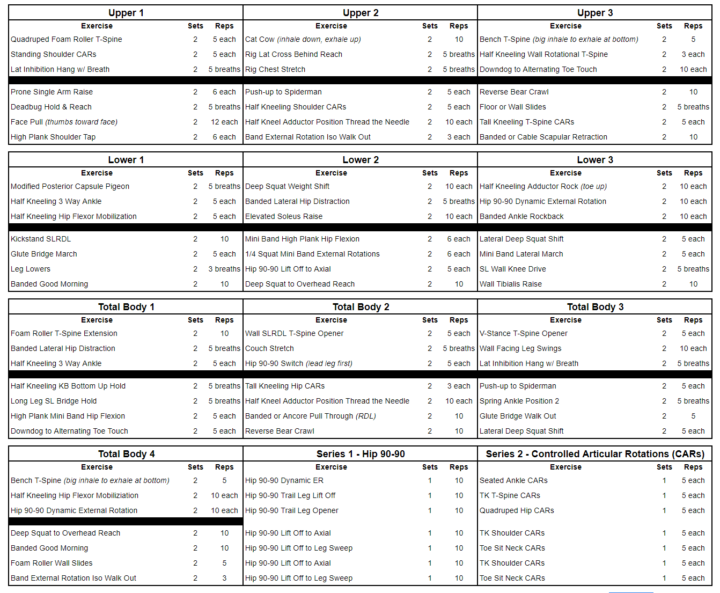
Going through my laptop to clear some stuff out, I found a warm-up sheet I wrote a long time ago. It's 12 warm-ups that I made for my online clients to use as I was sick of writing warm-ups every program. I categorized this into three different types of lifts I was writing most often: Upper Only Days (Upper 1-3) Lower Only Days (Lower 1-3) Total Body Days (Total Body 1-4) You'll also see I added some Series work in for both Controlled Articular Rotations (CARs) and Hip 90-90 positioning. These do have a video for each series on YouTube that I just add in TrainHeroic as a single exercise block for clients to warm-up with. I'll add a link to the playlist if anyone has any interest in using them or visually seeing the exercises. As a disclaimer, it is old, I didn't watch any of the videos recently, but hopefully it can be helpful to someone. https://youtube.com/playlist?list=PL92JzT1BsX-klh1UZ6ugwbCNZM4m7tXcz&si=6I03yW9riHCe-ifV
1
0
Jan 23 •
Systems Log #4 - Conditioning Data Backend
Documenting how I’m structuring conditioning data to support better decisions around capacity, progress, and programming without adding backend complexity.
0
0
1-8 of 8
powered by

skool.com/exercise-programming-8878
Better programming, systems, and individualization for coaches and semi-private gym owners using modern tools without turning coaching generic.
Suggested communities
Powered by