
Pinned

Mar 9 •
Welcome to the Essential Emotions 101 community!
✨ Let’s Get to Know each other! ✨ We’d love to welcome you to our community! 🎉 Click the bell to allow notifications 👉 😊 Please take a moment to introduce yourself with a post here in the comments, or not. 😊 Not sure what to say? Here's a few ideas to inspire you. 1️⃣ Are you ready to take a hold on your emotions? 2️⃣ What’s your favorite essential oil? Or if you don't know yet what scents do you love—citrus, floral, sweet, spicy or woody? 3️⃣ Do you have a burning question about essential oils that you’ve never found an answer to? We can't wait to hear from you! 💚
0
0
Apr 19 •
My first baby looked like a tiny tanned being, yes, slightly yellow.....
If you’ve ever seen a newborn baby with a yellowish tint to their skin or the whites of their eyes, you’ve seen the liver talking. It’s one of the first visible signs that a brand-new body is still learning how to do its job. And while most people associate that yellowing with babies, it shows up far more often than you’d think — in adults, too. What That Yellow Actually Means That yellow color is caused by a substance called bilirubin. It’s a yellow pigment your body naturally produces when it breaks down old red blood cells. Normally, your liver filters bilirubin out of the blood and sends it through bile into your digestive system, where it exits the body. Simple enough — when everything’s working well. But when the liver is overwhelmed, underdeveloped, or struggling, bilirubin starts to build up in the blood. And when there’s too much of it, it shows. Your skin turns yellow. The whites of your eyes turn yellow. Sometimes even the inside of your mouth. That’s jaundice — and it’s the body’s way of waving a flag that the liver needs attention. In newborns, it’s incredibly common. Up to 60% of full-term babies develop jaundice in their first week of life because their livers are still maturing. It usually resolves on its own. But the same signal shows up in adults under very different circumstances — and that’s when it becomes important to pay attention. When Adults See Yellow Yellowing skin or eyes in adults can appear after surgery — especially procedures involving anesthesia, which the liver has to process. It can show up during or after heavy medication use, since many drugs are metabolized through the liver. It’s seen in people dealing with hepatitis, gallstones, or bile duct blockages. It can follow periods of heavy alcohol consumption. And sometimes it appears during or after illness, when the body has been under significant stress and the liver is working overtime. In every case, the message is the same: the liver is telling you it’s overloaded. Why the Liver Deserves More Credit
1
0
Apr 9 •
To ferment or not to ferment
We hear it all the time: processed food is bad for you. And in most cases, that’s fair. When we’re talking about foods that have been stripped of their nutrients, pumped full of preservatives, and engineered to sit on a shelf for months—yeah, that’s not doing your body any favors. Fermentation is one of the oldest food preparation methods in human history. At its simplest, it’s what happens when beneficial bacteria and yeast break down the natural sugars in food, producing things like lactic acid, enzymes, and probiotics in the process. The food is technically “altered from its original state”—but the result isn’t something less. It’s something more. More nutrients. More beneficial bacteria. More digestibility. More life. A clinical study from Stanford School of Medicine found that people who ate a diet high in fermented foods for just 10 weeks saw a significant increase in gut microbial diversity and a measurable decrease in inflammatory markers—including interleukin-6, a key driver of chronic inflammation. Why does that matter? Because gut microbial diversity is one of the strongest indicators of overall health. Low diversity has been linked to obesity, diabetes, autoimmune conditions, and chronic inflammation. So what counts? You’re probably already seeing these foods everywhere, and for good reason. Sauerkraut, kimchi, yogurt, kefir, kombucha, miso, tempeh—and yes, sourdough. These aren’t health fads. They’re foods that cultures around the world have relied on for centuries. The beneficial bacteria they carry can help crowd out harmful microbes in the gut, support digestion, boost nutrient absorption, and even produce B vitamins and vitamin K on their own. . But when food is processed through fermentation—through the intelligence of nature itself—we gain something. Something our bodies were built to receive. Sometimes the best thing you can do for your gut is trust the process—the fermentation process, that is
Poll
1 member has voted
0
0
Apr 9 •
Linktree
If you're curious to find out more about cptg essential oils, why not book a call https://linktr.ee/BetwixtBetweenHolisticLiving
0
0
Mar 28 •
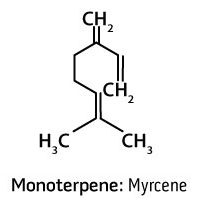
Monoterpenes
One of the properties of Essential Oils is their ability to cause oxygenation 🥰 EO's are characterized by high amounts of monoterpenes. Let me explain 🥰 We need oxygen to make energy, right? Oxygen lives in the bloodstream & travels to our organs & body tissues which energizes every part of our body. The more oxygen we have inside our cells the more energy for our body to carry out its day to day proper functions. Simples 🌱 you gotta love nature, it more often than not has the answer ✨🙏❤️
0
0
1-11 of 11
powered by

skool.com/essentialemotions101-5952
Discover your emotions, what triggers them and how you can help yourself master them.
Once you master your emotions you master your life.
Suggested communities
Powered by