
Pinned

Jul 7 •
🌳 Welcome to Symbolic Literacy
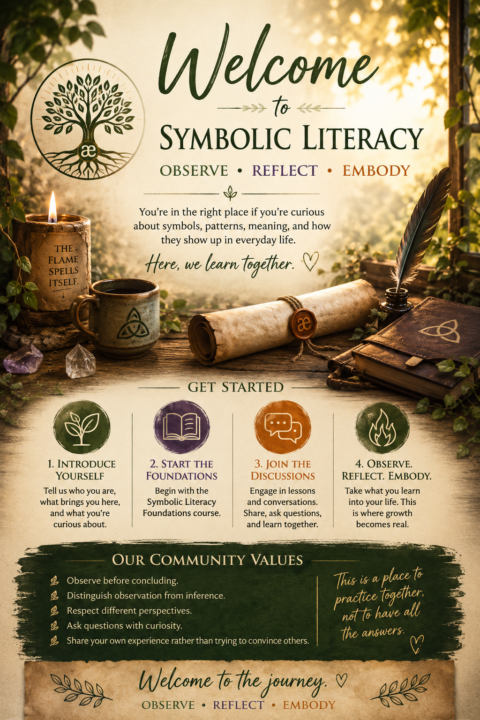
** START HERE** Welcome! I'm glad you're here. Symbolic Literacy is a practice of learning to observe with curiosity, reflect with intention, and embody what we learn in everyday life. You don't need prior knowledge or special beliefs to participate—only a willingness to notice, ask questions, and explore. 🌱 Where to begin Introduce yourself in the Introductions section. Start with the Symbolic Literacy Foundations course. Join the community discussions as you complete each lesson. Observe. Reflect. Embody. There is no rush. 🌿 A few community values Observe before concluding. Distinguish observation from inference. Respect different perspectives. Ask questions with curiosity. Share your own experience rather than trying to convince others. This is a place to practice together, not to have all the answers. Welcome to the journey. - What brought you here, and what are you curious to explore? - What are you noticing about how you already observe, interpret, or make meaning from your experiences? - 🌿 Observe. 📜 Reflect. 🔥 Embody
Pinned
Jul 28 •
📧 Join the Symbolic Literacy Email List
Would you like to receive welcome scrolls, lesson updates, and occasional community news by email? Sign up here: https://eroswell23-unbound-oracle-jcue8q.subscribepage.io Email signup is optional, and you can unsubscribe anytime. This gives you a direct way to receive new lessons and updates without depending on social media notifications. 📯📜
0
0

Pinned
Aug 11 •
☀️ Sabian Symbols of the Day
A Symbolic Literacy Practice The Sabian Symbols are a set of 360 symbolic images - one for each degree of the zodiac. They originated in 1925 through the collaboration of astrologer Marc Edmund Jones and clairvoyant Elsie Wheeler. Jones brought the astrological structure: the 360 degrees of the zodiac. Wheeler supplied the symbolic images associated with those degrees during a one-day session in San Diego, with the zodiac degrees presented to her in randomized order. Later, Dane Rudhyar expanded the philosophical interpretation of the symbols and treated them as a developing sequence of symbolic phases rather than isolated fortune-telling statements. For our purposes, the history matters because the Sabian Symbols sit at an interesting intersection: structure + image + interpretation And that is exactly where Symbolic Literacy lives. 🪟 How the degree works Each zodiac sign contains 30 degrees. When a planet is at, for example, 18°57′ Leo, it is moving through the 19th degree of Leo. So we read the Sabian Symbol for: Leo 19° That small distinction matters. 🌀 How we will use them here We are not using a Sabian Symbol to declare: “This is what today means.” We are using it as a symbolic prompt. The practice is: Observe → Reflect → Embody First, look at the image itself. What catches your attention? What feeling, memory, question, association, or resistance appears? Then reflect. Where might that image echo something already happening in your lived experience? And finally, embody. Is there anything worth carrying forward into the day? Or does the symbol simply remain an interesting image? Both are valid. ✨ There is no single correct interpretation Two people can look at the exact same Sabian Symbol and notice completely different things. That does not mean one person is wrong. It means they are looking through different histories, experiences, associations, and perspectives. That difference is part of the practice. Here, we are learning to strengthen our ability to engage with symbols without immediately surrendering our own discernment to someone else’s interpretation.
1
0

6h •
🚪✨ We’re LIVE!
Open Door is happening now on Zoom. Come in, get comfortable, and join us for an open space to talk, listen, share, connect, and get to know each other. No formal agenda. No pressure. Just a room to arrive in as you are. 🌿 🕚 11:00 AM Central 📍 Zoom Come as you are. 💛 https://us05web.zoom.us/j/83236650165?pwd=PaxzOMVjLz4oeTZ8STRmBhdEB6nK3k.1
0
0
7h •
🌿 Rest does not always look productive from the outside.
Sometimes nothing appears to be happening. No visible progress. No dramatic breakthrough. No outward motion. And still, beneath the surface, something may be tending the ground. Sorting. Integrating. Repairing. Reorganizing. Keeping a little warmth alive. Rest can be the place where the parts of us that do not need conscious supervision continue their work quietly. Not every process requires our constant participation. Sometimes the most useful thing we can do is stop interfering long enough to notice that life already knows how to continue without being pushed every second. Maybe rest is not the absence of activity. Maybe it is activity we are not required to manage. 🌿 Rest. 🔥 Let the hidden groundskeeper tend the hearth.
0
0

1-30 of 225
powered by
skool.com/eroswell23-4800
No memorization required. Curiosity required. Explore symbols, patterns, dreams, archetypes, and systems.
Suggested communities
Powered by