
Write something

May 28 •
How to imagine and believe the Earth is infinite.
1. Flat Earth and global Earth theories are true at the same time. (Think atoms vs. waves) Both exist both are true. 2. Consciousness is reality. Whatever the conscious or collective conscious believes determines physical reality. Even math breaks down to chaos and a mental construction not a physical one. If enough agree on a solution it becomes accepted. 3. Size is relative and eyes are deceiving. If we stood on a single atom, the next atom could look a million miles away. But zoom out and we're just walking on a floor made of atoms. See what we just did there? What looks like an edge is only a horizon. Meditation: Take a space you're not in right now. If you're in your room, or kitchen, picture the living room. Greet it, acknowledge its wisdom. Ask that space to go back — before your house existed, it was just jungle or forest. Then before that, what was here before there was ever Earth, when it was just space? Darkness? Did tiny asteroids pass through? Big ones? And before that — was the empty space always empty, or was it land once, another planet sitting where your feet stand now? Infinity says that at some point everything will land in the space in question, with periods of absence in between. It will tell you it's forever changing and the moment you greeted it it was also already gone, saying goodbye, or just the same but new. Now feel where your feet stand and imagine the earth beneath them goes on forever. All of a sudden divinity makes real sense and becomes present. Flip the switch off and where you stand becomes a global island again but only because the peripheral lights are turned off. Meditation cont'd: now imagine you stand on a single atom... it should appear round and a very long distance to the next atom. One you cannot jump to. Come back and realize those atoms suddenly touch and form the ground you stand on again. Did this work? Please comment below.
May 7 •
Where do you source carbon in bulk and other organic material from?
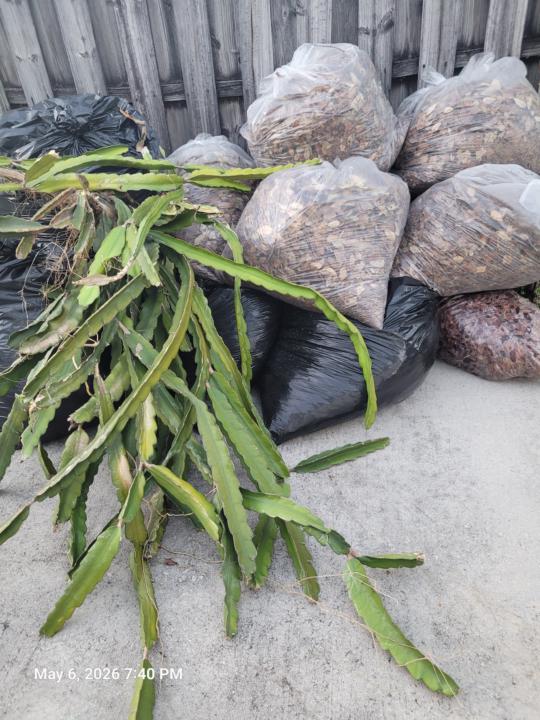
It's the night before yard waste pick up here. I look for pillow soft looking bags. That's how you know they are filled with something consistent whether it be leaves, grass, top soil, or a mix. The focus is on leaves but the grass is gold. In urban areas like where I live, the grass clippings are replacement for manure that has to get mixed with the large amounts of carbon. It's been a couple of weeks since I began a new Plant Nation Garden Model in a highly urban location where I have yet to see it be done before. If you can find a source for carbon, obtain it. Maybe your city will bring it by the truck load (mine did once) maybe they offer piles of fine and course mulch free for pick-up (get your five gallon buckets.) Sawdust from woodshops. One you and I both have is yard waste pick up. That day of the week everyone puts out what they've collected from their yards. Sometimes, you get rewarded with an awesome find. This week an enormous dragon fruit plant was discarded. I plan on planting it but it is also easy to sell it in parts or do both!
May 6 •
Before we go further, you should know about HJ.
HJ Kuntry Carter lives in Tallahassee. Tallahassee Magazine wrote about him in 2012 — read it when you have a minute. [Kuntry Roads - Tallahassee Magazine https://share.google/VTsXlU4g1zRMZipNZ] The short version: he turned down the Nashville machine, walked out of an RCA meeting, and instead spent ten years driving the back roads of America selling his albums county by county. More than 30,000 names on 3-by-5 index cards — every person who bought a record, where he met them, when. The cards are still in a storage unit in St. Marks. He also put out the fire at the Wescott building at FSU, back when he was a Tallahassee city fireman. That's the man. When you meet HJ, he says one word. Compost. That's it. That's the whole introduction. And then you start working. He and I hauled truckload after truckload of leaves and manure together before he ever set foot in our classroom garden. By the time I brought him to the school where I was teaching Agrinauts, the trust was already built — in the back of pickup trucks, in piles of leaves, in the smell of manure cooking down. So when he started digging a shallow trench using the grub hoe/pick axe, like it was a pen on paper in the garden and I thought what is this guy doing, what did I get myself into, he's destroying the garden — I kept going anyway. Because I'd already learned: you trust the compost man. Eventually that trench became something else. Standing right next to it, we could see it the way you'd see a river system from three thousand feet up — except we were the giants, and it was right at our feet. Muddy. Messy. Alive. We had an unbelievable reserve of leaves. Using gravity, we pulled them down from the pile, raking with hands the size of giants', and they filled the whole space — a clean even spread on top. But we knew the water was still moving underneath, in the same stamped impression we'd made. The women working alongside us as volunteers from the university, felt it immediately. Finally, this is the work we came here for. The men kept questioning it. I was quietly questioning it too, but I kept going.
Apr 22 •
The ground beneath you or a future client is waiting to be remembered.
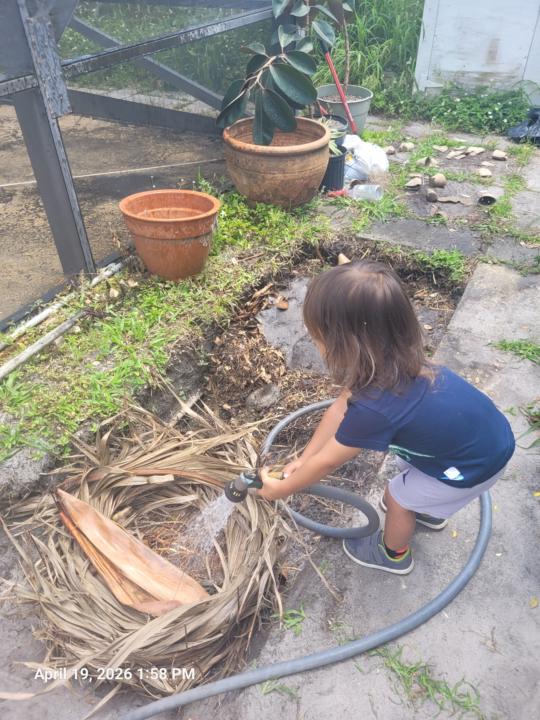
There is a patch of earth somewhere on your property — you know the one. The corner where nothing quite grows. The strip by the fence that's been dead sand for as long as you've lived there. The yard you inherited from whoever came before. You walk past it. You mean to get to it. Seasons pass. If you've wandered through the world of hügelkultur online, you've seen it performed as spectacle: towering berms, imported hardwoods, crews and diagrams and a vocabulary that seems to require initiation. You close the tab. The work feels like it belongs to someone else — someone with more land, more time, more knowing. But that version is a costume. The thing underneath the costume is older and quieter and already half-done. Soil wants to happen. Fungi are threading through fallen wood wherever wood falls. Roots are reaching for minerals wherever minerals lie. Water is carrying life downward through the smallest openings the earth will give it. This is not a project you begin. It is a conversation you enter — one the land has been holding without you, waiting to be joined. You do not build soil. You gather the conditions, and then you step back. A shallow trench. Whatever wood the last storm gave you — palm fronds, fallen branches, the neighbor's curbside pile. Leaves raked from where they didn't want to be. Cardboard from the recycling. Water, patience, a little shade. My son helps lay our first. He is three. My daughter sorts rocks from roots through the sifter with impeccable accuracy. She just turned one. The gesture is that simple, and the gesture is that old. In six weeks the ground softens. In six months it will grow you something worth eating. In a year it will hold a community of microbes that money cannot purchase, because it is not a product — it is a place, and places are made slowly, by the hands that tend them. This is what we are doing here at Agrinauts. Not selling a technique. Remembering a practice. And building it in a form small enough, and honest enough, that a child can carry it and an elder can teach it and a neighbor can look over the fence and ask how.
May 2 •
The dirt lesson that teaches kids more than any worksheet ever could
Ever notice how kids will happily stare at a screen for an hour but tune out the second someone hands them a textbook about "soil composition" or "the nutrient cycle"? It's not that they don't care about how food grows — it's that the lesson feels disconnected from anything they can touch, move, or change with their own hands. Most curriculums try to teach soil health through diagrams and vocabulary words, and the concepts slide right off because there's no muscle memory attached. Kids learn ecosystems by being part of one, not by labeling parts of one on a worksheet. That's why the Agrinaut sifting cycle works the way it does. We hand kids a screen, a pile of raw dirt, and a simple Sift, Separate, Reintegrate, Refill rhythm they run through start to finish. They sift the soil and feel the weight of what's living versus what's not. They separate the rocks into one bin and the organic material — roots, leaves, broken-down compost — into another. They reintegrate the finished organic matter back into the bed where it'll feed the next round of crops. Then they fill the voids left behind with fresh material so the cycle keeps turning. By the end, they haven't just learned what soil is — they've physically rebuilt it. Picture your kid coming home and explaining, unprompted, why a handful of dirt is actually alive. Picture them noticing leaves breaking down in the yard and saying "that's going to feed something next spring." Picture them growing up understanding that nothing in nature gets thrown away — it gets reintegrated. That's the kind of mindset that turns into future farmers, scientists, engineers, and stewards of the land. And it all starts with letting their hands get dirty in a structured, intentional way instead of pushing another worksheet across the table. Here's the 4-step cycle you can reinforce at home or in the garden this week: 1. Sift — run a scoop of dirt through a screen and let your kid see what's hiding inside 2. Separate — sort what they find into rocks (out) and organic material (keep) 3. Reintegrate — work the organic material back into the soil bed 4. Refill — top off the empty spots with fresh compost or soil so the cycle continues 5.
0
0

1-8 of 8
powered by
skool.com/erikas-group-9722
Leaves fall to the ground, so we must make it rain leaves. Natural, obvious actions. A set of tools you'll make your own — guided by the Agrinauts.
Suggested communities
Powered by