

4d •
What Makes You STEAM?
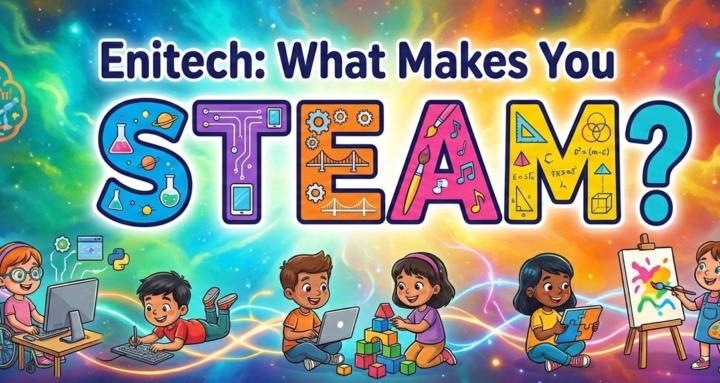
When I asked this question to a classroom of 7th and 8th graders, less than half of them knew the acronym. Then I asked "what makes you steam?" Most responses were related to being emotionally upset. Here is clarification of the acronym. S – Science This involves the study of the natural world. Scientific Inquiry. It’s about asking "Why?" and "How?" through observation and experimentation. I love the idea of neurodivergent learners, using science as an opportunity to explore sensory-rich environments (like chemistry or biology) in a fun and natural way. T – Technology Technology isn't just about using computers; it’s about using tools to solve problems. This includes everything from Coding and Robotics to digital media and assistive devices. I want to focus on "Tech Literacy," ensuring individuals feel empowered by the tools of the future rather than overwhelmed by them. E – Engineering Engineering is the application of science and math to design and build structures or systems. I like to consider this as the "hands-on" phase. Whether it is building a bridge out of recycled materials or designing a 3D-printed part, engineering teaches Persistence and Spatial Reasoning. A – Arts This is the ENITECH LLC "Secret Sauce." The Arts include visual arts, music, drama, and design. - The Bridge: Art provides a low-pressure, subjective space where there is no "wrong answer." - The De-escalator: Creative expression helps regulate the nervous system, allowing individuals to "reset" before tackling more rigid technical tasks. - The Communication Tool: For individuals who are non-verbal or struggle with social communication, the Arts offer a new way to share their "What Makes You STEAM?" story. M – Mathematics Math is the language of logic and patterns. I want to move beyond rote memorization and focus on Applied Math. By seeing math in action—measuring ingredients for a chemical reaction, calculating the turn of a robot, or finding the geometry in a piece of art—students realize that math is a tool for creation, not just a mathematical question on a test.
4d •
Rigid Instruction vs. Dynamic Thinking
Standard classroom curricula usually follow a strict, linear path: Step A must lead to Step B. This "rigidity" ignores the fact that many neurodivergent individuals are divergent thinkers. They see the "big picture" or find "side-door" solutions. When forced into a narrow instructional box, their natural creativity is stifled, and they become disengaged. We can assist them by going with their flow.
1
0
4d •
What is your role?
Are you joining us as a parent, an educator, or a behavioral health specialist?
1
0
4d •
How do you handle the sensory noise? 🎧
Loud sounds are a nightmare for sensory-sensitive individuals. The buzzing lights, the loud groups, the 'messy' glue. It’s why so many individuals with Awesism shut down before the lesson even starts.
1
0
4d •
Why 'A' is the Secret Weapon in ste'A'm 🎨
A lot of people ask me, Ms. K, why add Art to STEM?' The answer is simple: Art is a de-escalator. When a math problem gets too hard, the brain's 'fight or flight' kicks in. But when we transition to an Art-based project, the pressure drops. Art allows for 'beautiful mistakes,' which builds the resilience needed to go back and finish the math.
1
0
1-7 of 7
powered by
skool.com/enitech-4-enithing-5926
RBT creates STEAM for neurodivergent Individuals. Bridging behavior and brilliance through the 💕 of ARTS. Join me to discover "What Makes YOU STEAM!"
Suggested communities
Powered by