
Write something
Pinned

Dec '25 •
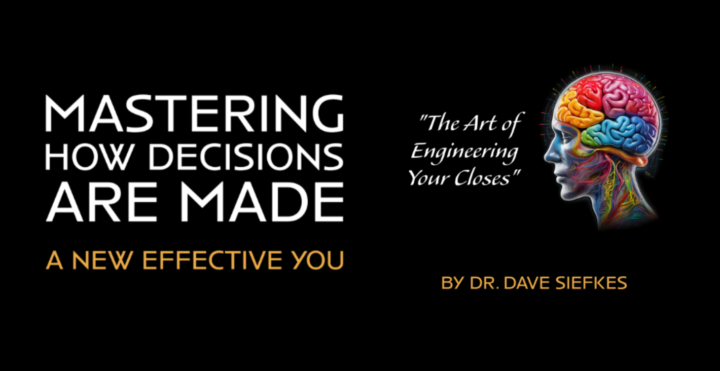
CHAPTER 1 - MASTERING HOW DECISIONS ARE MADE by Dr. Dave Siefkes
CHAPTER 1 — THE MOMENT EVERYTHING CHANGES. MASTERING HOW DECISIONS ARE MADE… A New Effective You. There is a moment in every person’s life when something shifts. It is not usually loud or dramatic. It does not arrive with fireworks or applause. It comes quietly, almost silently, in a single instant of clarity. You realize that everything you want… every goal, every breakthrough, every success you admire in others… all of it depends on one thing. Your decisions. This moment touches everyone eventually. Some encounter it early, when they see someone else rise from nothing and wonder how they did it. Others experience it later, after a series of disappointments, when patterns become too obvious to ignore. No matter when it arrives, this moment is powerful. It is the moment you stop believing that life is happening to you and start understanding that life is responding to you. People think the big events in life change everything. They don’t. It is the decision you make right before the event that changes everything. The decision to try, to ask, to commit, to speak up, to take the step, to walk away, to believe in yourself, to act when others freeze. Every result you have ever experienced started as a decision… a decision made by you or made for you because you didn’t make one. Most people never realize this. They blame circumstances. They blame timing. They blame other people. They blame luck. They blame the economy. They never look at the pattern beneath it. They never ask the one question that opens the door to everything. How are decisions actually made? The moment you ask that question, the real transformation begins. You start to see that decisions are not random. They are not mysterious. They are not unpredictable. Decisions follow rules. They follow emotional paths. They respond to the way the brain interprets risk, reward, trust, clarity, identity, and certainty. When you understand these forces, you gain something most people never achieve. You gain the ability to guide decisions. Your own. And others.
29d •
Illinois Swaps Stadium Locations for Bears and Sox
That got your attention… Check out the images. I personally like the Arlington Heights location, but it seems the politicians messed that one up. Dave Make your comments please.
0
0

Sep 15 •
This is not really a land ad. It is a conversion funnel disguised as a land ad.
They’ve stacked the psychology very deliberately: - Pain: “Every month you pay rent, someone else is building equity.” - Identity shift: “You’ve been renting long enough.” - Emotional reward: “It’s time to own something real.” - Affordability anchor: $200/month, not the total purchase price. - Friction removal: no bank approval, no credit check. - Ownership reassurance: “Deed in your name.” - Social proof: “Over 3,000 buyers.” - Low-commitment CTA: “Claim Your Lot” rather than “Buy Land.” And notice what they still don’t lead with: acreage, exact location, zoning, road access, utilities, taxes, HOA, flood zone, wetlands or even total price. That omission is part of the design. They are selling the idea of becoming a landowner first. The actual parcel comes later in the funnel. The line I especially like from a marketing-analysis standpoint is: “IT’S TIME TO OWN SOMETHING REAL.” That moves the product completely out of the real-estate-comparison category. They aren’t asking you to compare Parcel A with Parcel B. They’re competing against renting, doing nothing and feeling like you don’t own anything. And $200/month is doing enormous work. The prospect isn’t mentally asking, “Is this land worth $18,000?” They’re asking, “Could I find $200 a month to own land?” That’s a very different buying decision. DiscountLots continues to be a terrific case study in what we called their friction-removal program. They may sell dirt, but their real product is making the sentence “I own land in Florida” ridiculously easy to say yes to. THOUGHTS? Comments?
1
0

Aug 30 •
THE CAMERA THAT WATCHES THE UNIVERSE CHANGE
What the Vera C. Rubin Observatory teaches us about discovery… I was watching a new Umbra video on YouTube about the Vera C. Rubin Observatory. The video had been posted only two days earlier. It already had more than 227,000 views. That caught my attention. The telescope is extraordinary. The camera is almost unbelievable. But the real lesson is not simply that somebody built a more powerful camera. The real lesson is how they intend to use it. Rubin is not going to take one magnificent photograph of the universe. It is going to photograph the same sky… Again. And again. And again. For ten years. Because a single photograph shows us what is there. Repeated photographs show us what is happening. That is where discovery begins. THE STORY Nearly 8,700 feet above sea level, on Cerro Pachón in Chile, sits the Vera C. Rubin Observatory. At its center is the 8.4-meter Simonyi Survey Telescope and the largest digital camera ever built. The LSST Camera has: ● 3.2 billion pixels ● 189 individual science sensors ● A weight of nearly 6,750 pounds ● A field of view covering an area of sky equal to approximately 45 full moons Rubin can take roughly a thousand images during a night of observation. Over a few nights, it surveys the visible southern sky. Then it returns and photographs it again. Every new image is compared with earlier images. Did something move? Did something brighten? Did something disappear? Did something explode? Did something appear that was never recorded before? The system can generate as many as seven million alerts in a single night, calling attention to changing stars, supernovae, active black holes, asteroids and other events. Rubin is expected to collect about 10 terabytes of information every night and approximately 30 petabytes of raw image data during its ten-year Legacy Survey of Space and Time. This is not simply a telescope taking beautiful pictures. It is a discovery production line. It observes. It returns. It compares. It detects change.
1
0

Aug 29 •
THE UNSEEN CONNECTION
How to Observe More, Assume Less and Connect Better Every conversation has two conversations. The one we hear. And the one we see. Words tell us what someone is saying. But their eyes tell us where their attention is going. They look at us. They look away. They glance at a watch. They look toward someone else when the group laughs. Most of us notice these things without even realizing it. Then we do something dangerous. We decide what they mean. Immediately. Someone looks away, so they must be bored. Someone checks a phone, so they must want to leave. Someone avoids direct eye contact, so they must be nervous or dishonest. Then it hit me. We don’t have an observation problem. We have an interpretation problem. That is what I wanted to explore with THE UNSEEN CONNECTION. Not how to become a human lie detector. How to become a better observer. Because human beings are not slot machines. One signal does not always produce one meaning. Someone can look away because they are bored. Or because they are thinking. Or nervous. Or distracted. Or trying to remember something. Or because a waiter just dropped an entire tray of glasses behind you. LOL. Context matters. The real skill isn’t learning a secret code. It is learning to notice without rushing to judge. Observe more. Assume less. Connect better. The problem with “body language hacks” People love shortcuts. Especially shortcuts that make us feel like we know something other people don’t. “If they do this, it means that.” “If they look there, they are lying.” “If they cross their arms, they are closed off.” It sounds useful. It also makes great social media content. The trouble is that people are more complicated than any single list of signals. Body language is information. It is not a confession. A single glance is a clue. A repeated pattern is more useful. A respectful question is better still. That is the difference between observing someone and pretending to read their mind.
1
0

1-30 of 76
powered by
skool.com/creative-infusion-team-9335
Creative Infusion Team brings bold thinkers together to spark guerrilla marketing, sharp strategy, AI and unstoppable momentum for your business.
Suggested communities
Powered by