
Write something

3d •
What's the dumbest fitness thing you believed before you knew better?
I'll go first, because fair is fair. I constantly avoided barbells. I was intimidated. I was afraid I'd hurt myself loading a bar I didn't know how to use. I was embarrassed by the idea of standing in the squat rack with just the bare bar while everyone around me was moving serious weight. And on top of all of that, I figured barbells were "just for bodybuilders"; so, I told myself I didn't need them anyway. That last part was doing a lot of work. It let me dress up the embarrassment as a principled decision. It took me an embarrassingly long time to realize I had invented a distinction that doesn't exist. "Bodybuilding" isn't a professional category. It's not competing on a stage in a Speedo with a spray tan. It's the literal description of what I wanted to do: build a better body. I'd been avoiding the most effective tools in the gym because of a word I'd misunderstood ... and because loading that bar with quarters (25s) felt like admitting something. The nutrition one is worse. I knew food mattered. I wasn't ignoring nutrition; I was just eating. Eating everything, tracking nothing, assuming volume was the variable that mattered. It isn't. I was optimizing for quantity and ignoring quality, then wondering why my outputs weren't what I expected. "Eat more" and "eat well" are not the same instruction. I learned this the slow way. What's the belief you held longest before something corrected it? Drop it below — the more specific, the better. Bonus points if it took you longer than it should have.
0
0
29d •
Unpopular opinion: most of us don't have a time problem.
I'll say the quiet part out loud: most of us don't have a time problem; we have a prioritization problem that we've reframed as a time problem because it's easier to defend. I know this because I made this argument for years. I work a 9-5, and then a 6-9, leaving only Friday evenings and weekend free. My days are genuinely packed. The meetings are real. The deadlines are real. The clients are real. The exhaustion at 5pm, let alone 9pm(!), is real. What was not real was my belief that there was no available time. The 9-5 is remote, which means I have some flexibility mid-day. What actually happened to that flexibility: the couch. Reddit. Slack scrolling. YouTube rabbit holes. And then WoW in the evenings before I crashed into bed. Sometimes all of those at once. I'm not saying that to shame anyone. I'm saying it because I was doing the exact same thing and telling myself I didn't have time to work out. The actual reframe that worked for me: I stopped asking "when do I have time" and started asking "what am I currently doing with the time I have." The audit was uncomfortable. The result was useful. Three 30-minute sessions per week. That's 90 just minutes. In a 168-hour week. That's 0.54% of available time. If 0.54% of your week is genuinely not available, your problem is not fitness ... it's something else worth examining. What's the honest answer when you audit your own time? I'm curious where the hours actually go.
1
0
Apr 29 •
I optimized everything in my life except the most obvious thing.
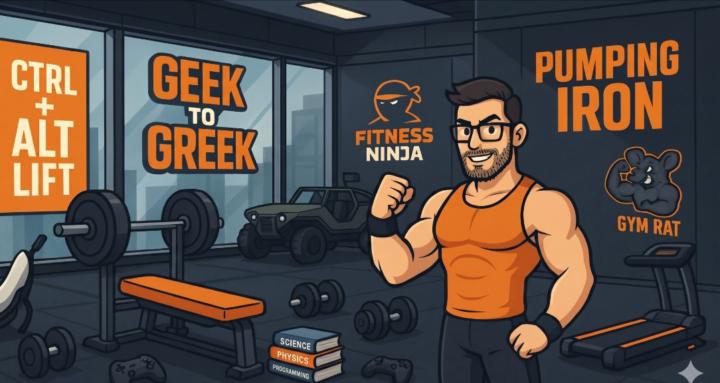
For most of my career, I was the guy who automated the boring stuff, refactored the messy codebases, and built systems that scaled. I took pride in that. I still do. But for about fifteen years, I had a blind spot so obvious in hindsight that I'm mildly embarrassed to type it out: I never once applied any of that logic to my own body. I knew how to debug systems. I knew how to identify where inputs weren't producing expected outputs. I understood progressive overload in principle — the concept that you apply incremental stress, measure the response, and iterate. I taught this kind of thinking at work. And yet. My workout routine for the better part of a decade was whatever felt right that day, fueled by Google searches and whatever YouTube algorithm happened to surface at 11pm. I ran a 5-day bro split for two years — chest/tri, back/bi, the whole thing. I had almost nothing to show for it. Because my routine and my diet both sucked, and I didn't have a system to tell me that. The turning point wasn't dramatic. There was no inciting incident. It was more like a slow compile error that I finally stopped ignoring — a creeping awareness that I was spending serious energy optimizing my professional life and treating my physical health like a side project I'd get to eventually. I started treating fitness the way I treated engineering problems. Define the goal. Map the inputs. Find the feedback loop. Remove the variables I couldn't control. Measure what mattered. It worked. Not in a dramatic before-and-after-photo way — in the boring, sustainable way that good systems work. Slow, measurable, consistent progress. Strength went up. Body composition improved. Energy stabilized. The gym stopped feeling like a place where everyone else knew the rules except me. That's what I built this community to teach: the same analytical mindset you already have, applied to the one system you've been under-engineering. You already know how to think about this. You just need someone to show you how to apply it.
1
0

1-3 of 3
powered by
skool.com/cpz-fitness-4218
From desk-bound to damn-strong.
Geek 2 Greek is a community of nerds and geeks alike who want to level up their mind, body, and confidence.
Suggested communities
Powered by