Write something

🔥
Dec '25 •
Resurrecting Old IP: A Winter Project That Might Actually Change Everything
I’ve been chewing on a big idea the last couple days, and I want to capture it here for the handful of you in this little corner of Skool. This is where I tend to work things out in real time, and this one feels important. For the first time in a long time, I’m seriously considering resurrecting my old intellectual property — the stuff I poured myself into years before glamping ever took over my life. It’s funny how ideas circle back when you’re actually ready for them. Back in the Monument Publishing days, I produced an enormous amount of material: homeschool speech and debate curriculum, books on family life, the Love in the House series, even Wendy’s Love in the Kitchen cookbook. After I sold the company, the only speech & debate product I retained was Jeub’s Guide to Homeschool Speech & Debate. Everything else shifted hands, and I moved on (to glamping). But lately I’ve been thinking: What if Chris Jeub Ltd becomes the home for all of that again? What if I build a new publishing arm for myself — but built for 2025, not 2010? Not a re-creation of Monument Publishing (no more boxes of books, no more camps, no more massive production cycles), but a lean, AI-powered publishing engine that makes it easy to resurrect old IP, update it, repackage it, and release it back into the world. The idea didn’t come out of nowhere. Rob Benjamin, the creator of AI Automation School, posted a question about “productizing” workflows in the age of AI — and suddenly something clicked. I realized I already have a treasure chest of content… I’ve just never had the tools to turn it into a true system. Now I do. Think about it: - AI can rebuild manuscripts from old PDFs. - AI can update voice, clean up structure, and even generate companion materials. - AI can lay out books, generate covers, format chapters, create web pages, automate email sequences, and run the entire marketing arm. - And once the workflow exists, I could republish old projects in weeks instead of years.
0
0
🔥
Dec '25 •
Teaching Kids Speech & Debate
I spent the last two days in Grand Junction with my son, Zech, and his debate partner, Beniah. They won 1st place in Team-Policy debate! This could be a big year for the 14th Jeub kid. He's on track to winning his second "Founder's Award," an award given at nationals for students who qualify in each speech category, the wildcard, and a debate format. Only one other Jeub kid has gotten the award (Tabitha, my 8th), and Zech is on track to win it twice. And no one has done particularly well in debate, so Zech looks like he'll take that glory, too. A big part of my life was spent publishing curriculum and running camps all over the country. I sold Monument Publishing, the leading curriculum publisher for homeschool speech and debate, in 2002. I'm now "just a dad" lugging his kids across the country to tournaments. Gotta say, it's kind of nice not peddling books and online memberships. Want to know something else? A shy student who took my speech and debate class three years ago at a homeschool co-op won 1st place in Lincoln-Douglas debate, a separate category that my son competed in. "It all started with you," her proud mom told me tonight. Pretty special. Funny how the adventures you take part in in life often comes back around to bless you. This community of speakers and debaters is quite something, and I'm proud to have been a significant part of this community. [Pictured: Beniah (left) and Zech (right)]
0
0

🔥
Nov '25 •
AI and the New Talent Stack
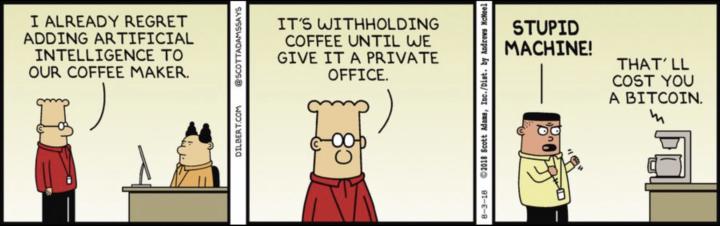
Scott Adams, creator of the popular Dilbert comic, popularized a simple but brilliant idea: success doesn’t require being world-class at one thing. It requires being pretty good at several things—and combining those abilities into a “talent stack” that gives you an edge most experts don’t have. That idea has always resonated with me, because it’s exactly how my life has played out. I’ve never felt like a true “master” in any single discipline. But I’ve always been pretty good at a lot of things: - Accounting - Marketing - Bookkeeping - Writing - Persuasion - Organizing - Human relations - Communications - Empathy - Psychology - Education - Teaching - Construction - Building And honestly, I could keep going. People have called me a jack-of-all-trades. And they’re right. My success in business, writing, teaching, and relationships hasn’t come from being the best in any one domain—it’s come from being strong across many. But something new is happening now, and it’s changing the game completely: AI is upgrading every single part of my talent stack. Not replacing it. Not diminishing it. Amplifying it. And the best example is happening right in front of me as I’m writing this article. I’ve written books. I’ve run a publishing company. I’m a pretty good writer. But when it came time to publish something intended for bookstores or national circulation, I always hired editors—professionals who could take my drafts and polish them to a level I couldn’t reach on my own. Not because I lacked ideas, but because writing at a professional level requires clarity, objectivity, and distance… things humans struggle with when we’re tangled in our own thoughts. Now, when I sit down to write an article like this, I effectively have a professional editor at my elbow. AI helps me shape thoughts, refine structure, and tighten language. It bridges the gap between what I mean and what readers will actually understand. It gives me the one thing writers rarely have: an unbiased mind.
0
0
🔥
Nov '25 •
AI Is Your Time Machine
For as long as humans have measured their days, time has been viewed as the one resource that cannot be stretched, paused, bought, or reclaimed. We can learn new skills, regain lost money, and rebuild strength, but time has always marched in one direction. Yet the rapid rise of artificial intelligence challenges this assumption. For the first time in history, ordinary people can multiply their effective time by outsourcing the very processes that used to consume it: remembering information, exerting mental energy, and grinding through long hours of research or problem-solving. In this sense, AI functions as a modern time machine—not by bending the laws of physics, but by changing the mechanics of human productivity. Human capability has always been shaped by three core variables: memory, mental energy, and time. Memory determines what we retain and how quickly we can access it. Mental energy dictates how long we can focus and how efficiently we can work. Time limits everything else; it is the container that holds all other human efforts. Traditionally, improving any of these three required years of discipline. To grow in knowledge, one had to study. To gain skill, one had to practice. To conserve mental energy, one had to rest, plan, and pace oneself. Progress was real but slow. The internet dramatically changed the memory equation. Instead of storing facts in our heads, we learned to store them online. Search engines externalized memory; a person could retrieve answers in seconds that once took hours of flipping through reference books. But while the internet provided access to information, it did not remove the effort required to sift through results, interpret data, or make decisions. The mental energy cost remained. Searching the web still drained focus and demanded time. Knowledge was accessible, but it was not yet effortless. AI is the next leap in that evolution. It does not merely store information; it organizes, interprets, and applies that information. When someone uses AI to complete a task—whether it’s analyzing a document, drafting a response, solving a technical problem, or clarifying a complex process—they bypass the slow steps of searching, verifying, understanding, and synthesizing. In effect, they borrow a second brain, one that never tires and never forgets. Memory becomes infinite. Skill acquisition accelerates because the barrier to entry collapses. A person no longer needs to “know everything” in order to do something; they simply need to know how to ask.
0
0

🔥
Nov '25 •
The Unexpected Journey I Just Started
I’ve been experimenting with something new these past few weeks: building a digital clone of myself. Not in the sci-fi sense, but in the “capture my brain, my history, my experiences, and my frameworks so they can work with me instead of sitting unused in a notebook somewhere” sense. And the deeper I go, the more I realize I’m not just creating a clone — I’m creating sub-clones of the different parts of my life. I’ve lived several “mini-careers” across the years: glamping, speech & debate, large family life, recovering from online smearing, solopreneurship… each one with its own lessons, scars, and wins. And honestly? I’ve never been able to focus on all of them at once. I’m human. I tilt toward survival mode, or glamping mode, or writing mode — but never all five at the same time. AI changes that. Not by replacing me, but by extending me. Now, I should be upfront: I’m a spiritual guy. I’ve followed God for nearly four decades. So yeah, I’ve had to grapple with the power of AI and the temptation people have to see it as some kind of higher being. But that’s not how I see it. AI isn’t God — not remotely close. It’s just a tool. A powerful one, sure, but still just a tool. A tool that helps me finally organize decades of experience and turn them into something useful for more people. And that brings me to this community. When I launched this Skool group, I honestly thought it would be a simple book club. Light reading, good conversation, nothing too heavy. But as soon as I started building this clone and these sub-clones… well, it hit me that this space is going to be more than that. At least for me. It’s becoming a place where I explore who I am, why I’ve lived the life I’ve lived, and what I’m actually supposed to do with the work God put in my hands. Maybe that resonates with you. Maybe not. But if you’re here, you’re catching me at the ground floor of something that’s turning into a much deeper journey than I expected. This is the ground floor of something new. If you feel like you’re carrying more life than you can hold, or you’ve got a story that deserves structure, jump into the comments. Let’s help each other build out the best versions of ourselves.
1
0

1-7 of 7