
Write something

4d •
New? Start here.
Welcome to Build & Automate! Here's how to get the most out of this community: 1. Head to the Classroom and complete "Get Started with Claude Code" -- install it, set up CLAUDE.md, and connect your first MCP server 2. Post in General discussion -- introduce yourself and tell us what you're building 3. Browse the Tutorials & Guides for build logs, walkthroughs, and real configs 4. Got stuck? Post in Support -- I respond to everything Introduce yourself below -- what are you building with Claude Code?
0
0
24d •
The $6/day agent that replaced my marketing stack
I run an autonomous AI agent on my Mac. It handles: - YouTube analytics every morning - Social post drafts based on top performers - Publishing to X and Bluesky - Community management and member syncing - Daily digest to Discord at 9pm 24 scheduled tasks. $6/day. Zero manual work. Built with Claude Code + Agent SDK + MCP servers. The full setup guide is in the classroom.
0
0
24d •
What Claude Managed Agents means for solo builders
Anthropic just shipped Managed Agents. - No more babysitting pm2 processes - Built-in error recovery and session management - Scales from laptop to cloud without code changes - Works with existing MCP servers I run a self-hosted agent that handles YouTube, social, blog, and community. About $6/day fully autonomous. Managed Agents could simplify this even further. Breakdown coming to the classroom.
0
0
Apr 5 •
The near-zero cost content engine that posts across 5 platforms while you sleep
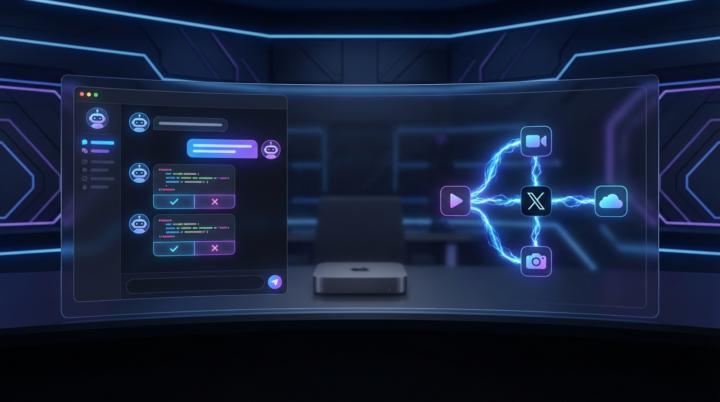
I replaced my entire content workflow with an AI agent built on Claude Agent SDK + Discord.js, running on my Macbook Pro. Here's what it does every day — without me touching anything: Scans X for viral tweets in the AI/automation space and drafts quote tweets with tactical breakdowns Generates videos — Edge TTS for voiceover, Remotion for rendering, Whisper for word-level captions. Total cost per video: ~$0.02 Writes and formats posts for X, Bluesky, YouTube, Instagram — each matching the platform's format Sends everything to Discord for approval — I tap a checkmark from my phone and it publishes Self-heals when scripts break — if a task fails at 3 AM, it captures the error, spawns a fresh instance to diagnose and fix it, then retries The full stack: - TypeScript agent built on Claude Agent SDK — one persistent session, never dies - Discord.js as the control plane (approve from anywhere) - node-cron scheduler running 17 tasks daily - MCP servers connecting YouTube, X, Gmail, Airtable, Google Search Console - Edge TTS + Remotion for free video generation - Whisper.cpp for caption sync on Apple Silicon - pm2 for process management — auto-restarts on crash Total monthly cost: near zero, if you exclude my Claude Code Max subscription I already pay for. The only variable cost is Gemini for image generation — pennies per image. Edge TTS, Whisper, and Remotion are all free. Compare that to hiring a content manager ($3-5K/month) or even a VA ($500-1K/month). This runs faster, doesn't take days off, and gets better every week because it learns from what content performs. The key insight: this isn't a chatbot you talk to. It's a persistent agent session that runs 24/7, executes scheduled tasks, and maintains full context across every interaction. More like a junior employee than a tool. I'm building out a full course module on this — the Agent SDK setup, Discord integration, scheduler, risk classifier, and the memory system that lets it learn across sessions.
0
0
Apr 1 •
Thank you for helping Kjetil
Kjetil helped me set up my own AI agent from scratch. I joined Build & Automate a few weeks ago and Kjetil personally helped me set up an autonomous AI agent on a $10/month Hetzner server. What I got: - OpenClaw running 24/7 with Discord as my control interface - YouTube tools connected (MCP server) - Multiple AI models available (DeepSeek, OpenAI, Claude, Gemini) - n8n for workflow automation The whole thing was set up in a couple of days. I would have spent weeks trying to figure this out on my own. This is not a course where you watch videos, Kjetil actually builds it with you.
1
0
1-11 of 11
skool.com/build-automate
Build autonomous AI agents with Claude Code & OpenClaw. Real configs, build logs, and a practitioner community that actually ships.
Powered by