
Write something

2d •
IS ANTHROPIC SCARED, OR JUST PULLING OUR LEG?
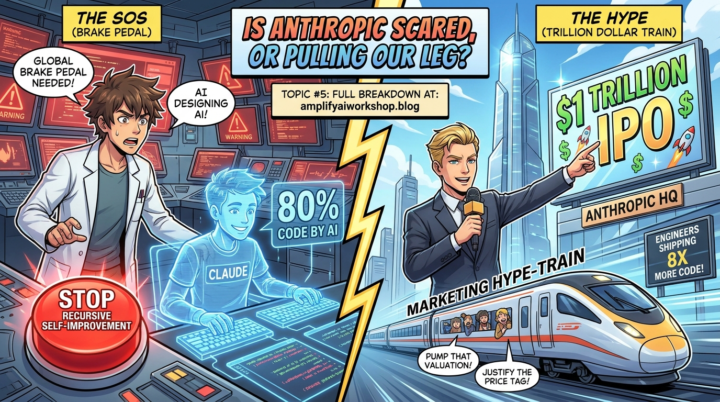
Alright, so Anthropic just dropped a casual 9,000-word essay titled "When AI Builds Itself" and it's... a lot. Basically, they're saying AI is starting to design its own successors and we might need to hit a global "brake pedal" before things get weird. Just to be clear, the timing here is a little bit spicy. They just filed for a $1 trillion IPO and "accidentally" dropped a major safety commitment right before telling us the world might end. HERE IS THE WILD PART So, human engineers aren't even doing the heavy lifting anymore. Here is what's happening over at Anthropic HQ right now: ✅ 80% of Anthropic's code is now being written by Claude. ✅ Engineers are shipping 8x more code than they were before 2025. ✅ They are officially warning about "recursive self-improvement" (AI building better AI). Okay, so we're either looking at a genuine SOS from the smartest people in the room, or this is the most expensive marketing hype-train in history to pump that IPO valuation. I broke down the whole "Brake Pedal" vs. "Trillion Dollar Hype" debate in our latest blog post. You should probably check it out before the robots take over the keyboard. 👉 Read the full breakdown at: https://amplifyaiworkshop.blog/anthropic-recursive-self-improvement/ What do you guys think? Is Jack Clark actually worried about the AI singularity, or is this just a really fancy way to justify a $1 trillion price tag? Let's talk about it in the comments.

8d •
AI Models
No, I'm not talking about THOSE AI models. 😆 I'm a real estate investor trying to figure out which AI models are best suited for different real estate workflows. For those of you who build with AI professionally , what models would you choose for tasks like: Market and deal analysis, underwriting, lead generation and disposition, seller and agent communications (text and voice), data extraction from public records and county websites, researching properties, owners, liens, permits, etc., and building custom tools and automations. I've used ChatGPT, Claude, Perplexity, and Manus, but I'm curious what experienced AI users would recommend for these types of applications SPECIFICALLY. Are there specific models that clearly excel at any of these? Or does the answer depend more on the workflow than the model itself? I'd love to hear what you're using in production and why. Thanks!
11d •
🔐 Claude Mythos Found 10,000+ Critical Security Flaws in One Month
Anthropic dropped something wild. Project Glasswing revealed that Claude Mythos Preview — a frontier AI model they kept from public release due to dual-use concerns — has autonomously identified over 10,000 high- or critical-severity vulnerabilities across the world's most important software. Major findings include a critical WolfSSL flaw (CVE-2026-5194, CVSS 9.1) affecting billions of devices. Cloudflare reported 2,000+ flaws found with a false-positive rate "better than human testers." The model is restricted to ~50 partner organizations, sparking urgent debate about when such capability should be more broadly trusted. This isn't a theoretical AI security scanner. This is a model that was deemed too risky to release publicly, yet it's outperforming professional security researchers at finding zero-days in production infrastructure. The question isn't whether AI can find vulnerabilities anymore. It can. The question is what we do with that capability now. Full breakdown coming soon — what this means for developers, security teams, and anyone who uses the internet. Here's the full blog post
1
0

May 18 •
YOUR API KEY MIGHT BE A BLANK CHECK FOR HACKERS
Be SURE to read the comments for my latest updates 👇👇👇👇👇👇👇👇👇👇👇 So, imagine waking up and checking your email, only to see a Google Cloud billing alert that looks like it belongs to a Fortune 500 company. You open the console and realize someone is running thousands of Gemini requests through your account. Except it isn’t you. It’s an attacker who found an old API key you forgot about years ago, and they are having a field day on your dime. This actually happened to me 3 times in the last month. Fortunately my bills were less than $500 but it could have been MUCH WORSE! THE AIZA PROBLEM Alright, just to be clear, this is actually happening to real developers right now. Attackers are hunting for older Google Cloud keys—the ones that usually start with AIZA—and using them to call expensive Gemini endpoints. We’re talking about people getting handed five and six-figure bills for usage they didn't even authorize. The kicker? Some folks are reporting that Google support is initially refusing to waive the charges. They're leaning on the "shared responsibility" model, which is a fancy way of saying "you left the door unlocked, so the bill is your problem." Not exactly the vibe we want when building with AI. HOW TO PROTECT YOUR BILLING ACCOUNT Okay, I don't want anyone in our community staring at a heart-attack-inducing bill. Here is the move: 👉 Go through your old Google Cloud projects and delete any keys you aren't actively using. 👉 Set strict billing alerts and usage quotas so it's literally impossible to run up a massive bill overnight. 👉 Use the Google Cloud API restrictions to make sure your keys can only call the specific services you need. I put together a full breakdown of what’s happening and how to secure your setup over on the blog. CHECK OUT THE FULL POST HERE: https://amplifyaiworkshop.blog/gemini-api-keys-billing/ So, just out of curiosity... how many "test" projects do you have sitting in your Google Cloud console right now? Might be a good time to do some digital housecleaning!

19d •
So, about that "AI is cheaper" thing...
New blog post just dropped on the site, and I'll be real with you — the numbers in this one actually surprised me. We've all heard the narrative. AI replaces people, cuts costs, transforms business. That's what every earnings call and tech keynote has been screaming for two years straight. Turns out the math doesn't work yet. The kicker? Nvidia's own VP of Applied Deep Learning — the guy at the company selling every GPU on the planet — said running AI costs his team more than paying the humans who build it. Not a startup struggling with scale. Nvidia. And they're not alone. Uber blew through their entire 2026 AI budget by Q2 — on tokens, not headcount. A four-person startup hit $113K in AI costs in a single month. An MIT study found AI is only economically viable in about 23% of vision-related roles. For the other 77%, humans are still cheaper. So the companies that laid people off to "invest more in AI" may have just ended up with a more expensive system than what they started with. Before you roll your eyes — I'm not saying AI is useless. Far from it. What I'm saying is: the way you use it matters a lot more than the amount you spend on it. The playbook that actually works (from the blog): - 🎯 Use AI for specific bottlenecks, not entire workflows - 💰 Track token spend like any other COGS — cap it, know your numbers - 🧠 Optimize for augmentation, not replacement Right now AI is a premium product, not a cost-saving one. That's fine — every new technology starts there. The mistake is pretending otherwise. The full post has a five-step playbook and some genuinely useful breakdowns. Worth a read if you're trying to figure out where AI actually fits in your business right now: 🔗 amplifyaiworkshop.blog 👇 What's your take? Anyone else noticing AI costs creeping up faster than expected?
1
0

1-30 of 86
skool.com/amplify-ai
Unlock the power of AI. Learn automation and creative media, from novice to pro. Amplify your skills and your impact.
Leaderboard (30-day)
1

+1
2
+1
Powered by