

2d •
Pedro joined the bootcamp as a non-technical founder.
No coding background. No engineering degree. No prior experience building anything with AI beyond using ChatGPT to write emails. Just a clear idea of something he wanted to build — and the willingness to show up for 11 evenings and figure it out. Here's what he shipped. The project: An AI content agent that generates strategic playbooks for first-time entrepreneurs. Not a demo someone else built that he watched. A functional, deployed AI agent — his — that takes a founder's context and produces a structured go-to-market playbook tailored to their situation. The first playbook the agent generated targets AI-native founders navigating their go-to-market strategy. The stack: His own personal design system pulled from GitHub. Cloud development environment. Built entirely using Claude Code and vibe coding — describing what he wanted in plain English and letting AI handle the syntax, the structure, and the execution. Zero lines of code written manually. Everything deployed and running in production. His words when he finished: "I feel like I've become a technical person." The ability to go from idea to deployed output — using the tools available right now — in an evening. Pedro has that ability. He didn't have it before the bootcamp. He has it now. The right curriculum — taught by practitioners who build with these tools in production, not academics who describe them. The right format — evenings, so your whole day stays intact and the only thing you're giving up is the hours that weren't building anything anyway. The right community — people at different stages, different backgrounds, all working on hard problems together and sharing what they find. The question for those who haven't joined a cohort yet — what's the idea you've been sitting on? The tool, the agent, the automation you keep thinking about but haven't built yet? Drop it below. 👇 Someone in this community has probably already built something close to it — and can tell you exactly how long it took and what it cost.
0
0
7d •
Sasha came into the AI intensive as a non-technical founder
The shift that Sasha described — and that we hear from almost every founder who comes through — isn't just about the tools. It's about the relationship with the technology. Before: AI is something happening to the industry. A vague obligation sitting on the to-do list with no clear first step. After: AI is something you understand well enough to direct. To build with. To deploy for specific purposes. To protect against when necessary. That shift — from passive observer to active builder — is what the program is designed to create. And based on what Sasha and every other cohort member has shared, it happens faster than almost anyone expects going in. For everyone in this community who recognizes that feeling Sasha described "I know I need to do something about AI." That is not a vague anxiety. That is a accurate read of the moment we are in. The founders who close that gap in the next 12 months will have an operational and competitive advantage that compounds continuously. The ones who keep waiting for the right time will find the gap harder to close, not easier. The program runs evenings only — 6 to 9 PM, Monday through Thursday So your entire workday stays untouched. Three weeks. Eleven sessions. Everything deployed. Non-technical background is not a barrier. Sasha is the proof. 📅 July 6–24 · Mon–Thu · 6:00–9:00 PM PDT 📍 In-person SF Mission + Zoom worldwide Wherever we are in the program — you're welcome to join from that point forward. Registration link is in the community resources tab.
0
0
14d •
Next Cohort is coming up! 🎉
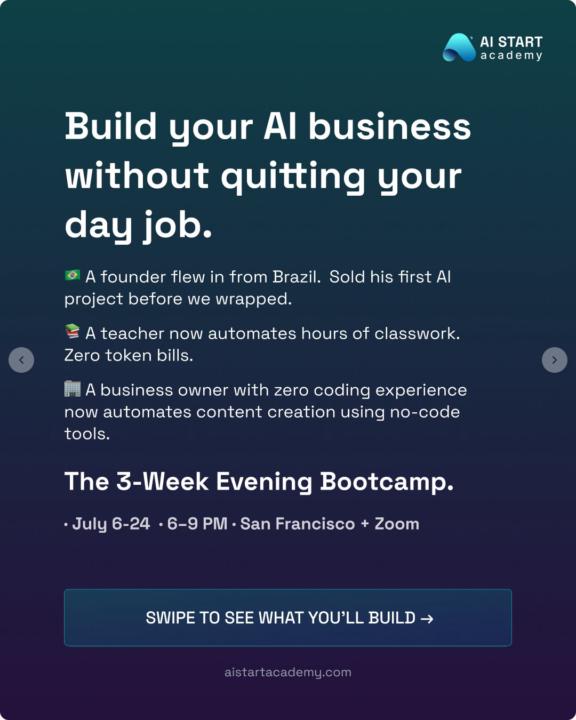
AI Automation Agency Bootcamp — 3-Week Evening Edition July 6–24 · Mon–Thu · 6:00–9:00 PM PDT In-person San Francisco + Zoom worldwide What you walk out with: Real, running AI systems you built yourself. 🌐 A vibe-coded website deployed from scratch — Claude Code, no developer needed 🤖 A self-hosted AI agent on your own machine — OpenClaw, zero token bills 🎙️ A voice agent live on a real phone number — VAPI + ElevenLabs + Twilio 🧠 A RAG chatbot trained on your own documentation ⚙️ n8n automation workflows — multi-agent, fully orchestrated 🎬 A digital avatar producing content instead of you — HeyGen 👤 A virtual digital employee deployable on a website — Happyverse 🔐 Cybersecurity framework + threat-response playbook 🏢 A complete agency offer — niche selected, pricing built, CRM set up, first-client outreach sent live on Demo Day 11 evenings. 33 hours. Everything deployed. The only thing standing between you and this: A laptop with 8GB+ RAM. That's it. No coding background. No prior AI experience. No technical degree. Week 1 covers every foundation you need — from how LLMs actually work to the tech principles that make everything else click. If you showed up curious and showed up consistently in this community — you are ready for this program. Practically speaking: Every session recorded and posted within 24 hours if you miss one. Async support between sessions in the cohort channel. 30 days of instructor access after the program ends. Lifetime community access — you're already here. Certificate of completion — same as the 7-day intensive. 📅 July 6–24 · Mon–Thu · 6:00–9:00 PM PDT 📍 1769 15th St San Francisco · 5 min from BART Registration link is in the community resources tab. Feel free to ask any questions 🙌
1
0
19d •
We asked students what they felt after Day 1 of AI Bootcamp
💬 "I finally understand how AI actually thinks." 💬 "The human brain connection made everything click." 💬 "I didn't expect to feel this inspired on Day 1." 💬 "The community is unlike anything I've been part of. 💬 "I came in without a technical background. I left feeling like I belong here." Our students left the room inspired, challenged, belonging. And that's the best feedback! We start AI Bootcamp with foundations. The history of AI. The mechanics of how it processes information. The connection between neural networks and how the human brain actually works. By the end of the first evening students who arrived uncertain are having conversations about LLMs, embeddings, and agents they couldn't have had that morning. Founders next to teachers. Cybersecurity pros next to career-switchers. All at different starting points. All working toward the same thing. Become a part of AISA Community ---- next cohort starts July 6th. No technical background needed. Just curiosity and the drive to show up. Registration link in the community resources tab. Questions? Drop them below — we'll answer everything openly.
1
0

21d •
AI Automation Agency Bootcamp — 3-Week Evening Edition. July 6–24
The schedule — so you know exactly what you're signing up for 👇 Week 1 — Foundations & First Automations Mon · Intros, AI Agentic Systems & Business Audit Tue · AI Fundamentals — LLMs, prompting, agents, embeddings Wed · Tech Foundations — databases, cloud, coding principles Thu · AI Workflow Automation — n8n + RAG chatbot Week 2 — Build & Secure Mon · Voice Agents — VAPI + ElevenLabs + Twilio Tue · Claude Code — deploy your first AI-coded website Wed · Cybersecurity I — SQL injection, XSS, breach databases Thu · Cybersecurity II — threat-response playbook + vulnerability assessment Week 3 — Self-Host, Productize & Launch Mon · OpenClaw I — install and harden your self-hosted agent Tue · OpenClaw II — advanced configuration Wed · Content Automation — HeyGen avatars, Happyverse video agents Thu · Agency Launch + Demo Day — pricing, CRM, first-client outreach sent live The only requirements: A laptop with 8GB+ RAM. Your curiosity. No coding background. No prior AI experience. Week 1 covers everything you need from the ground up. If you can use a laptop you can complete this program. Every session recorded and posted within 24 hours if you miss one. Async support between sessions in the cohort channel. 30 days of instructor access after the program ends. Lifetime community access — this community. Certificate of completion — same as the 7-day intensive. 📍 1769 15th St, San Francisco · 5 min from BART 🗓 July 6–24 · Mon–Thu · 6:00–9:00 PM PDT Seats are limited. Registration link is in the community resources tab. Questions about the program? Drop them in the comments below — we'll answer everything here so the whole community benefits from the conversation. 👇
2
0
1-15 of 15
skool.com/aistartacademy
AI Automation Agency Bootcamp in the Heart of Silicon Valley. Learn to build, deploy, and sell AI agents. Founders, students, operators welcome.
Powered by