
Write something

May 5 •
Permission to post. Need a VA?
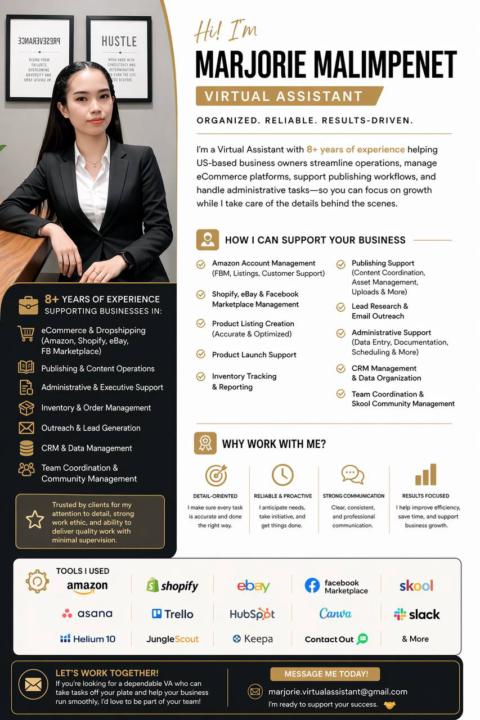
Hi! I’m Marjorie 👋 — Senior Virtual Assistant with 8+ years supporting US-based businesses in eCommerce, publishing, and admin systems. I help keep your backend organized, accurate, and efficient so you can focus on growth. Core support: Amazon, Shopify, eBay, Facebook Marketplace, product listings & launches, inventory tracking, publishing, lead research, CRM, admin systems, team coordination, and Skool community management. What to expect: structured workflows, detail-driven execution, proactive communication, and independent, reliable support. I’m currently looking for a long-term full-time or part-time position where I can take ownership of operations and deliver consistent, high-quality work. 💼 Rate starts at $5/hour (flexible depending on scope and workload) 🔗 Connect with me on LinkedIn: https://www.linkedin.com/in/marjorie-malimpenet-2bb81a17a/
0
0

Mar 19 •
Hello, everyone
https://seasalt.ai/ja/seavoice/ One of the projects I worked on is an AI voice agent platform called SeaVoice. The goal of this system is to automate business phone calls using conversational AI, replacing traditional IVR systems with natural voice interactions. From a technical perspective, the system is built as a real-time conversational pipeline. When a user calls the system, the audio stream first goes through a streaming Automatic Speech Recognition (ASR) service that converts the caller’s speech into text. That transcript is then processed by a conversational AI layer powered by a large language model. To improve response accuracy and reduce hallucinations, we implemented a Retrieval-Augmented Generation architecture. The system retrieves relevant information from a vector-based knowledge base and injects that context into the LLM prompt before generating a response. This allows the AI agent to provide accurate answers related to company services, FAQs, or product data. Once the response is generated, it is passed to a neural Text-to-Speech engine, which converts the text back into natural-sounding audio that is streamed to the caller. The system also includes a dialogue management layer that maintains conversation state so the AI can handle multi-turn interactions and follow-up questions. One of the biggest challenges we faced was reducing latency in the voice interaction pipeline, since ASR processing, LLM inference, and TTS generation can introduce delays. To address this, we implemented streaming transcription, asynchronous model inference, and incremental TTS playback so the system could start responding before the full pipeline finished. Overall, this project involved integrating multiple AI components—including speech recognition, large language models, vector search, and neural speech synthesis—into a scalable architecture capable of supporting real-time voice conversations.
0
0

Mar 6 •
Hot Take: AI Just Made Information Almost Worthless
Let me explain. 30 or 40 years ago, information had enormous value. If you wanted to learn a language, you needed a teacher. You needed to buy a dictionary or go to the library. If you wanted to open a business, you had to figure things out almost blindly. Information itself was the product. But now? AI can generate almost any information instantly. Ask ChatGPT: “How do I start a restaurant?” You’ll get a full step-by-step plan in seconds. So the real competitive advantage is no longer knowledge. It’s experience. AI can tell you what usually works. But it hasn’t: • survived real mistakes • developed intuition • learned from failure • built judgment That still comes from doing. Which raises an interesting question. In a world where AI gives everyone access to information… Does experience become the most valuable asset? Or will AI eventually replace that too?

Feb 20 •
If AI Can Replace 80% of What You Do… That’s Actually Good News.
Do you agree with this? And most importantly: Are you already acting like that’s true? 🤔 Most professionals hear “AI can automate 80% of your work” and immediately panic. But what if that’s the opportunity? What if that means you finally get to double down on your real 20%? Your judgment. Your taste. Your positioning. Your ability to make decisions and take responsibility. AI can draft. AI can summarize. AI can structure. AI can generate variations. But it cannot assume liability. It cannot truly understand long-term strategy. It cannot feel the weight of a decision. That part is still yours. — For me personally, this has been very real. In content creation alone, AI has saved me an absurd amount of time. It helps me: - Structure lessons faster - Refine explanations - Generate examples - Draft email variations - Clarify ideas Not to create my English courses for me. Not to replace my thinking. But to remove friction. And yet — if I’m being honest — I’m still probably using AI at 30–40% of its potential. Which means I’m leaving leverage on the table. So here’s the challenge: If AI can replace or assist 80% of the operational layer of your work… Are you consciously reinvesting that freed time into your 20%? Or are you just doing the same work slightly faster? Big difference. AI + 80/20 thinking is not about becoming an AI expert. It’s about becoming more of what makes you valuable. Be honest: Are you using AI to go deeper into your craft? Or just to move quicker through your inbox? 👀 Let’s discuss.


Mar 15 •
Move over Gamma here comes CoPilot
PowerPoint designers might not like this post… Because Copilot Agent just changed the game. Move over Gamma. Microsoft quietly dropped something inside Microsoft 365 that can build a full presentation in minutes. Most people don’t even know it’s there. Here’s the move: 1️⃣ Open ChatGPT or Claude. Ask it: “Create a 12-slide presentation outline on [your topic].” 2️⃣ Copy the outline. 3️⃣ Go to Microsoft 365 → Copilot → Agents. 4️⃣ Paste the outline and say: “Turn this into a PowerPoint presentation.” 5️⃣ Pick a theme or color palette. Then Copilot will ask you a few questions to refine the deck. Answer them. Now here’s the part that feels illegal… Go grab something to eat. 🍔 Because when you come back… You’ll have a fully built PowerPoint with: • charts • visuals • research • talking points • structured slides The type of presentation someone used to charge $2,000+ to create. And it took you five minutes. AI isn’t coming. It’s already doing the work. The real question is… Who’s still working the old way? You’re welcome.
1-24 of 24
powered by

skool.com/ai-for-professionals-6753
Practical AI for professionals, creators, and educators who want real results, clear thinking, and clean execution. No hype.
Suggested communities
Powered by