
Write something

Nov '25 •
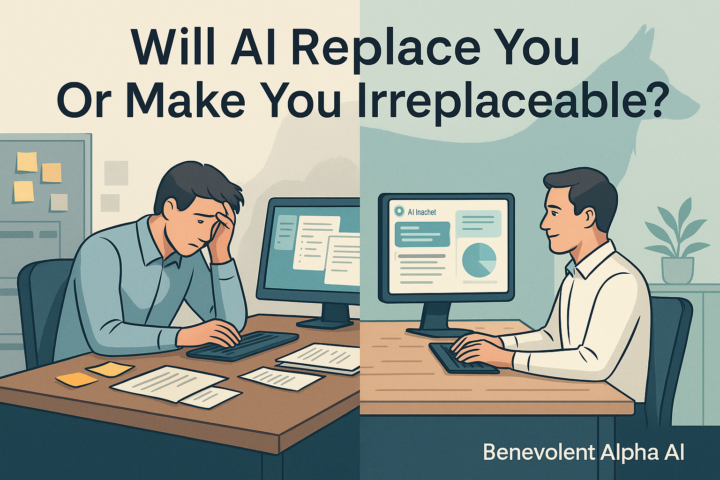
Are you about to lose your job to AI?
You are not competing with AI in the abstract. You are competing with the person in your role who learns to work with AI faster than you do. Most risk sits in knowledge work which runs on words, numbers, and decisions. If your day looks like email, meetings, documents, spreadsheets, slide decks, chat threads, or support tickets, you are in the impact zone. WHO IS MOST AT RISK 1. Individual contributors who move information, not outcomes If you spend large blocks of time copying data between systems, summarizing meetings by hand, reformatting reports, or writing routine messages, AI already performs a big share of that workload. The colleague who learns to design prompts, test workflows, and review AI output for quality will ship more in fewer hours. That colleague becomes the new standard. Everyone else starts to look slow and expensive. 2. Managers who only coordinate If your value comes from scheduling meetings, relaying updates, collecting status reports, and approving routine work, AI will eat large portions of this job. Leaders who stay relevant do something different. They use AI to scan large amounts of information, highlight risk, pressure test plans, and prepare better decisions. They move from traffic cop to decision partner. 3. Executives and founders who delegate AI learning When senior leaders tell themselves, “My team will handle AI,” they give up strategic ground. They struggle to judge what is real, what is hype, and where money and time vanish. Executives who stay involved ask sharper questions. Which workflows now rely on AI. Which decisions depend on AI summaries. Where are the guardrails for privacy, bias, and security. That awareness becomes part of core strategy, not a side project. WHAT TO DO IF YOU ARE AN INDIVIDUAL CONTRIBUTOR Start with one week of honest observation. Write down every task. For each task, ask three questions: • Does this involve text, numbers, schedules, rules, or research. • Does this repeat weekly.
0
0
Nov '25 •
Start Here: Make AI Your Everyday Superpower (Without Becoming a Tech Nerd)
If you are here, you already know AI is going to affect your career and your future. This community is not about starting an AI agency or becoming a “prompt influencer.” It is about using AI as a practical advantage in your real life and work. Most people use AI like a slightly smarter Google. In here, the goal is to make you more effective with AI than 90% of users. What this community is for In this community, you will learn how to use AI to: - Solve real problems, not toy examples - Ask better questions and get clearer answers - Learn faster and retain more - Cut busywork and simplify workflows - Future proof yourself from being replaced by AI or by people who use it better We will mostly work with tools like ChatGPT and Perplexity, plus models from Grok, NotebookLM, and others. As the space changes, we will explore new models, specific tools, and agentic workflows, but we will stay focused on what is proven, practical, and worth your time. How this will be different Most AI “experts” move fast, show canned demos, and stay on the surface. Here, we will: - Break down what is actually happening under the hood in plain language - Use real examples: drafting posts, working on my book, analyzing complex legal docs, planning projects, and more - Show both the good outputs and the bad ones, and how to fix them - Focus on prompts, patterns, and habits you can reuse every day What you will get - Clear starting points, even if you feel “behind” - Vetted prompts with explanations, not magic spells - Step-by-step walkthroughs of real workflows - Live problem-solving with your own use cases - A community of people serious about learning, not chasing shortcuts What I ask from you - Be honest about where you are starting - Bring real problems and examples from your life and work - Test what you learn and share what happens - Help others once you start to get wins To get started, reply to this post and share: 1. What you do 2. How you are using AI today 3. One problem you want AI to help you solve in the next 90 days
0
0

1-2 of 2
powered by
skool.com/ai-for-everyone-2378
AI can be a superpower for anyone. Start simple, build confidence, and grow into an everyday AI power user with us.
Suggested communities
Powered by