
Pinned

2d •
RecapFlow : June 2nd Coaching call analysis
📝 SUMMARY This week's call featured Patrick Chouinard hosting in Brandon Hancock's absence, delivering a mix of project updates, technical deep-dives, and enterprise AI strategy discussions. Key threads included maximizing slash goal loops for development tasks, the complementary strengths of Claude versus Codex, Patrick's Hermes home lab project, and Dmitry Avramenko's major bank contract win using the Evonix platform. A significant portion explored the critical distinction between agents, skills, and deterministic workflows in regulated corporate environments, with consensus that most business users actually need reliable skills rather than fully autonomous agents. 💡 KEY INSIGHTS Slash /goal requires explicit, verifiable success conditions to avoid burning tokens on vague objectives. It excels at small, measurable tasks with numeric or binary validation targets, not large multi-feature builds. Claude produces imaginative UI/UX but struggles with validation, while Codex behaves like a senior engineer with clean code and strong validation but poor visual output. The most effective approach combines both: Claude for creative work, Codex for code review and validation. Most business users requesting an "agent" actually need a deterministic skill or workflow. True agents determine their own next steps, creating unpredictability that is difficult to control in production environments. Skills should remain atomic and role-specific, with agents acting as orchestrators rather than universal toolboxes. Loading multiple MCP servers can consume roughly 20 percent of context window before work begins, so minimize them aggressively. Token cost unpredictability represents a growing enterprise risk, as model updates can silently increase costs two to three times for identical workloads. Per-step cost tracing, or Tokonomics, is becoming mandatory for ROI justification. Deterministic Python or Chromium code often outperforms agentic web browsing for scraping regulatory sites, offering greater reliability, lower cost, and easier maintenance when sites change.
0
0
Pinned
2d •
AI Developer Accelerator — Coaching Call - June 2nd
AI Developer Accelerator — Coaching Call - June 02 VIEW RECORDING - 112 mins (No highlights) Meeting Purpose Discussing advanced AI agent development, corporate adoption challenges, and best practices. Key Takeaways - Corporate AI Requires Justifiable ROI: The initial "go AI" mandate is over. Companies now demand clear ROI, making token cost management and deterministic, auditable workflows (via skills) essential for adoption. - Skills Over Agents for Corporate Use: For client work, prioritize deterministic skills over unpredictable agents. Skills provide auditable, repeatable results, while agents are best used as personal development tools or as orchestrators for other agents. - Agentic Development Requires Validation: Tools like /goal are powerful but require precise validation criteria (e.g., a specific test case) to prevent token waste. Use them for quantifiable tasks, not subjective ones. - Strategic Tooling is Critical: Combine tools for optimal results. Use Claude for creative tasks (e.g., UI), Codex for detailed validation, and token-saving utilities like RTK (Rust Token Killer) to manage costs. Topics Corporate AI Adoption & ROI - The initial corporate mandate to "go AI" has shifted to a demand for measurable ROI. - Dmitry's Experience: A major bank contract for an agentic AML platform proves the value of a deterministic, auditable approach. Methodology: Uses a "Technique Engine" with adversarial reviews and deterministic workflows (via the Dboss framework) to ensure high-quality, auditable output. Strategy: Build deterministic Python code for web scraping instead of using an agent's browse function. This is more reliable and cost-effective, as the code only needs to be fixed once if a site's DOM changes. - Elijah's Client Strategy: Initial Approach: Record conversations and screen shares to analyze business needs and build point solutions. Community Advice: Focus on Skills: Deliver deterministic skills for specific tasks (e.g., research, proposal prep) rather than full agents. This provides clear value and avoids the complexity of agents. Engage End-Users: Work directly with the people doing the day-to-day work to identify real problems, as their needs often differ from executive directives.
0
0
Pinned

Mar '24 •
🚀 Welcome to AI Developer Accelerator (Start Here)
👋 Hey there! Ready to supercharge your dev skills with AI? You're in the right place. Watch the intro video below for a walkthrough of our community and a peek at our AI-enhanced future. 🛠 CLASSROOMS: - Full Stack Development with AI: Where code meets cognition. Sharpen your skills and build AI-- powered apps. - CrewAI: Your squad for all things AI. Share ideas, collaborate on projects, and celebrate successes together. - Code Bugs & Project Issues: Debug like a pro. Get help on tricky bugs and offer your wisdom to others. - Monetize Your AI Dev Skills: From AI code to income: Collaborate, innovate, and monetize your dev skills! - YouTube Tutorial Requests: Please let me know what you want to learn more about when it comes to Fullstack Developement and AI. 📜 RULES: - Promotions are a no-no. Let's keep the focus on learning and growing. - We appreciate quality contributions. Enhance your posts with visuals and use ChatGPT for refining your content. - No talking about politics or religion. Go to X if you want to talk about that. - See something off? Help us maintain the community spirit by reporting any issues to me. 🥇 FIRST STEP: Introduce yourself with a post about your AI journey and what you're working on in the General Discussion group. **Bonus points for sharing a screenshot of your current app!** 🎯 ACTIONS: Be proactive, engage in discussions, and collaborate on group projects. 👩💻👨💻 Let's code, innovate, and thrive together!

3d •
Sharing what new have built during last 5 months.
Hi all, I kind of dropped off from the community during last few months as I got a good gig at a large bank to build an AI AML platform for them. But I will be dropping in again .. Sharing how my SDLC agentic harness look like and how I make sure quality of code I produce is high. I am still doing all this inside Claude Code. Can give a demo or presentation if community is interested.
Jan 27 •
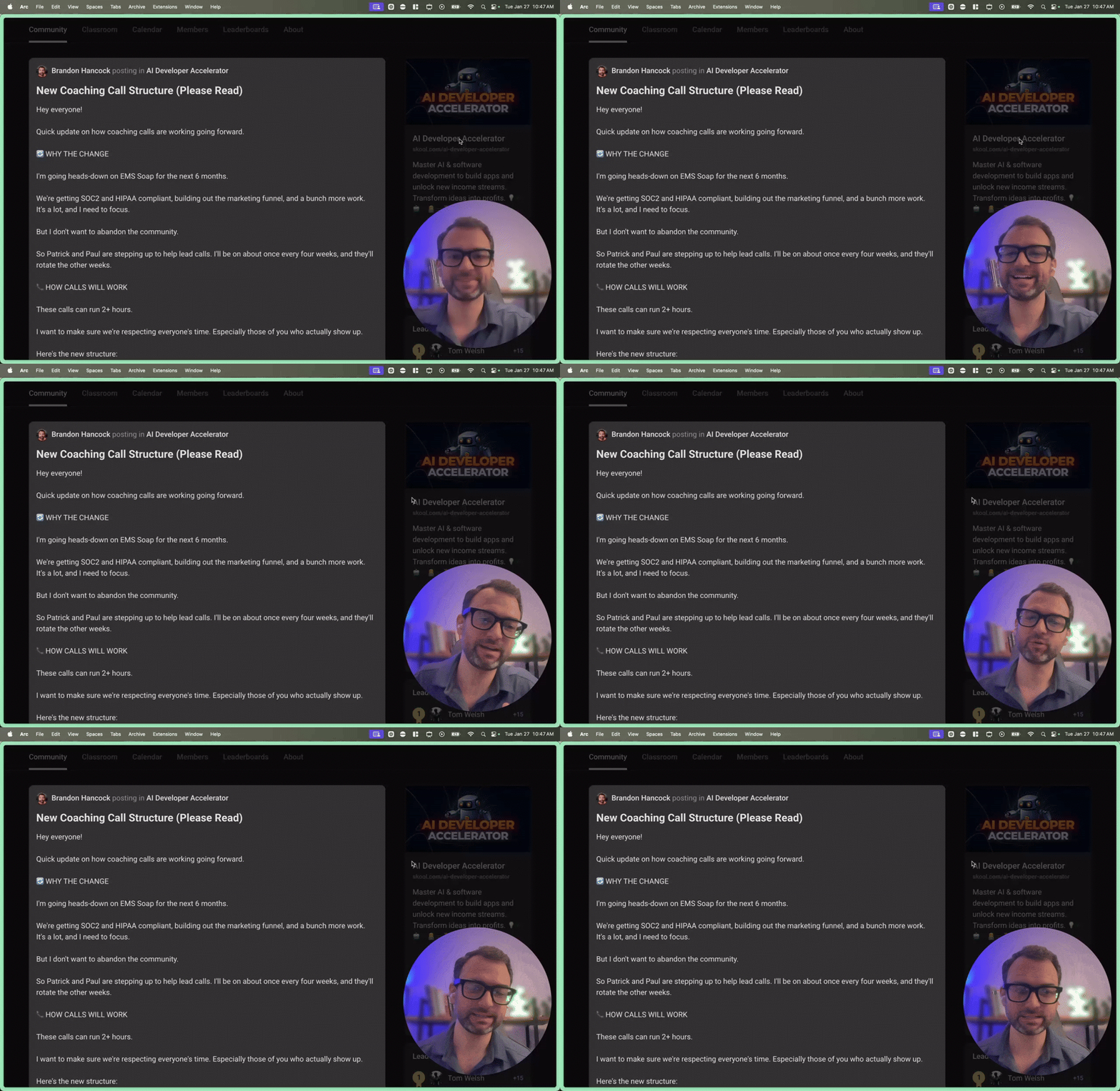
New Coaching Call Structure (Please Read)
Hey everyone! Quick update on how coaching calls are working going forward. 🔄 WHY THE CHANGE I'm going heads-down on EMS Soap for the next 6 months. We're getting SOC2 and HIPAA compliant, building out the marketing funnel, and a bunch more work. It's a lot, and I need to focus. But I don't want to abandon the community. So Patrick and Paul are stepping up to help lead calls. I'll be on about once every four weeks, and they'll rotate the other weeks. 📞 HOW CALLS WILL WORK These calls can run 2+ hours. I want to make sure we're respecting everyone's time. Especially those of you who actually show up. Here's the new structure: 👉 Reply to this post with your questions before the call 👉 If you submit a question and you're on the call, you go first 👉 We work through questions in the order they came in 👉 Then we open it up for everyone else If you can't make the call but want your question answered, drop it in the comments. We'll get to it. But priority goes to people who are there. The goal is simple: if you're taking the time to show up, you shouldn't have to wait behind questions from people who aren't even on the call. 🔗 NEW ZOOM LINK (save this) https://us06web.zoom.us/j/81995207847?pwd=Xe6u6LmIQOmCP5VTnOwWYjDBfZNKGB.1 📅 WHEN Tuesdays at 6PM ET (same as always) Looking forward to seeing you on the calls!
1-30 of 1,839

skool.com/ai-developer-accelerator
Master AI & software development to build apps and unlock new income streams. Transform ideas into profits. 💡➕🤖➕👨💻🟰💰
Leaderboard (30-day)
1

+5
2

+4
3
+3
4

+3
5

+2
Powered by