
Write something

Nov '25 •
Robots are spreading across US workplaces
Robots are spreading across US workplaces, slowly, and with bugs. Robot Automation is rising, but reality checks remain. New reporting shows more US businesses piloting robots for retail, logistics, and manufacturing tasks. Join the AI Agent Innovation Academy Skool Community Group FREE: https://www.skool.com/ai-agent-innovation-academy-5694/ Learn how you can program robots today: https://www.skool.com/ai-agent-innovation-academy-5694/classroom #Robotics Programming with Python #Applied Robotics and AI Integration
Nov '25 •
Robot dogs are now available on Amazon Prime 2-Day Delivery
PuppyPi is a high-performance AI vision robot dog designed for AI education. It is equipped with the Raspberry Pi 5 and fully supports both ROS1 and ROS2 environments. With Python programming, PuppyPi offers efficient AI computation and a wide range of robotic applications. We provide access to all source code and detailed documentation to help you create your own AI robot dog! PuppyPi Robot Dog with ChatGPT Large AI Models AI Embodied Intelligence ROS Robotic Dog Vision Scene Voice Understanding SLAM Mapping Navigation Bionic Quadruped Robot, Ultimate Kit & RaspberryPi5 8GB https://amzn.to/3LKa9RR
1
0
Nov '25 •
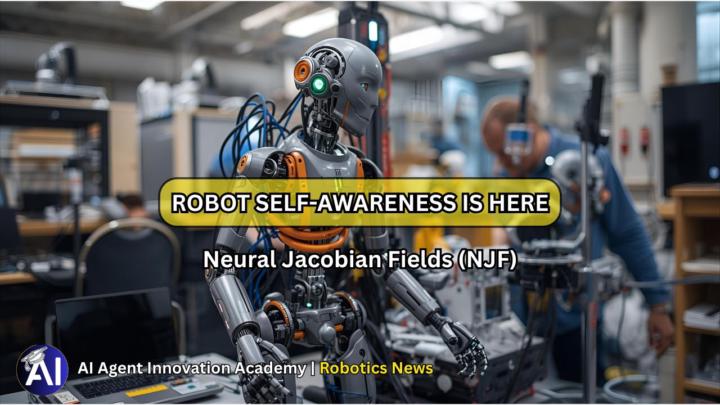
Robot Self-Awareness is Here!
ROBOTICS BREAKTHROUGH: Robots Learn to Understand Their Own Bodies Using Only a Camera 🤖 Researchers at MIT’s Computer Science and Artificial Intelligence Laboratory (CSAIL) have unveiled a groundbreaking system called Neural Jacobian Fields (NJF) that enables robots to develop a form of self-awareness, learning how their own bodies move and interact with the world, using nothing more than a single camera. How It Works: - A robotic arm, equipped with just one external camera, performs random movements while the AI observes and learns. - The NJF algorithm builds an internal model of how the robot’s joints and limbs move, effectively teaching the robot to predict how its body will respond when it takes certain actions. - Once trained, the robot can perform precise movements, like picking up or manipulating an object, guided solely by visual input, without pre-programmed instructions or expensive sensors. This innovation drastically simplifies robotics development by removing the need for complex sensor systems and manual calibration. Robots that can learn their own physical properties purely through vision could soon become: 🔹 Cheaper and more adaptable, since they no longer require costly motion sensors. 🔹 More autonomous, able to adapt to new environments and tools without reprogramming. 🔹 Safer and more flexible, capable of learning delicate tasks like assisting in healthcare or working alongside humans in manufacturing. This breakthrough marks a key step toward self-modeling robots, machines that can perceive, learn, and refine their own understanding of motion. It bridges the gap between artificial intelligence and embodied intelligence, paving the way for smarter, more capable robots in homes, workplaces, and scientific research. Professionals who understand both machine learning and robotic systems will be at the forefront of this transformation, shaping how humans and machines collaborate in the years ahead. If you want to keep learning about the kinds of innovations driving the future of robotics, join our FREE AI Agent Innovation Academy Community Group on Skool for daily AI and robotics insights:
2
0
1-3 of 3
powered by

skool.com/ai-agent-innovation-academy-5694
At AI Agent Innovation Academy, we are pioneering tech courses. Our mission: Empower learners with cutting-edge skills. Join the dynamic world of AI.
Suggested communities
Powered by