Write something

8h •
Mastering Skool about pages :-)
«(Side note: I noticed the footer "powered by The Abambres Imaginarium" in Bukola Saves Lives ❤ — the same as the KAOS* Accelerator page. It's fascinating to see one creator, company, agency or incubator successfully deploying two completely opposite psychological frameworks: chaotic gamification for one, and profound emotional vulnerability for the other. Both are brilliant in their own lanes).» @Bukola Folashade SolomonAdeyemi 😉
1
0
24d •
STORY ALERT 🔴 The Draft That Was Always Right
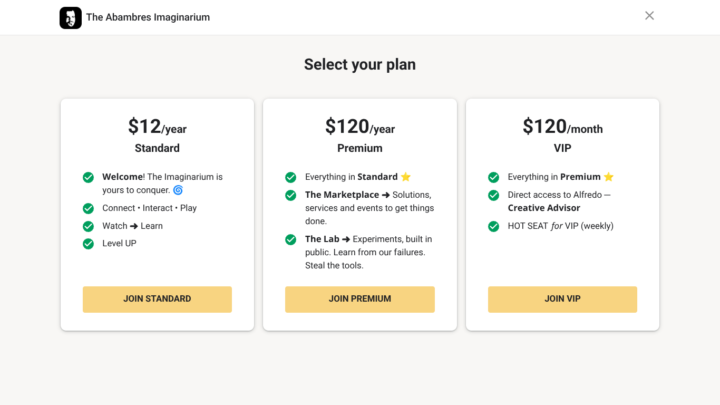
There's a note in my drafts from months ago. Buried under newer versions, cleaner iterations, and late-night second-guessing. It says: "Standard unlocks Community. Premium unlocks Classroom. VIP unlocks Direct access." That's it. Three lines. Written before the architecture sessions, before the layer debates, before the naming wars between "Pioneer" and "Member" and "Explorer." The model was always there. I just didn't trust it yet. What happened between that draft and today wasn't discovery — it was conviction. The weeks of building, pressure-testing, rewriting, and shipping weren't about finding the answer. They were about earning the right to believe in it. The Imaginarium was always yours to conquer. I just needed to conquer it myself first. Curious? Check 👉 https://playground.abambres.com
2
0

Jun 10 •
The Imaginarium ─ Plans and Tiers.
Getting ready... https://www.skool.com/abambres-9123/plans
3
0
May 5 •
LAB™ 001 — THE ACCIDENTAL ACCELERATOR | BUILD REPORT v1
THE SPARK We set out to add two grant funders to an existing skill. We ended up designing the architecture for a product line. WHAT HAPPENED It started with a simple task: research the Startup Foundation's grants and figure out where they fit in the grant-writer skill. What looked like a 20-minute job turned into a full session that rewired how we think about skills entirely. The first pivot came early. We assumed the Startup Foundation's Project Grants were for-profit seed money — turns out they're explicitly not-for-profit. That distinction forced a real question: which TAI projects are actually non-commercial enough to qualify? Connectoria surfaced immediately as the answer. One funder entry became a decision-making tool. The second pivot was cleaner. We separated Starttiraha (Finland's startup stipend) from the grant universe entirely and built it as its own skill — different authority, different logic, different documents, different timing. The distinction matters: grants fund projects, Starttiraha funds you. Mixing them in the same skill would have created confusion every time the skill ran. The third thing — the one that matters most — happened almost by accident. While discussing how to make skills shareable for the Skool community, we landed on a design principle: a skill should be able to read the context of whatever Claude project it's running inside. If you're inside the TAI project and say "use context," the skill pulls from project memory, files, and instructions automatically. If a stranger drops the same skill into a blank project, it asks everything from scratch. Same skill, different runtime behavior. That's the Context-Aware Skill Protocol. We named it in the session. It didn't exist before today. KEY BREAKTHROUGH Skills built for ourselves can be shipped to the world — but only if they're designed without our context baked in. The personal layer (TAI framing, INVERSUS™ angles, Alfredo's track record) lives in the project. The universal layer (the method, the workflow, the logic) lives in the skill. Two layers. One product.
2
0
Apr 26 •
STORY ALERT 🔴 2:28am. April 2026 ─ The Declaration
I'm going FULL SUN ☀️ Two years after arriving "home". The metamorphosis completes. Between now and the end of June (midsummer) — everything gets measured against one question: Does this free me, or does it cost me? If it costs — scale down, time-box, or drop it. If it frees — go all in. Tervetuloa Kotiin. Alfredo
2
0
1-7 of 7