
Jan 13 •
Tools
Crochet Hooks As its name suggests, the crochet hook has a notch at one end for catching loops of yarn and drawing them through stitches. Aluminum, plastic, wood or bamboo crochet hooks are the most commonly used. In the U.S. a numbering and letter system is used for determining hook sizes, while in other countries a metric designation, which represents the actual diameter of the hook, is used. In most packaging you will see the metric sizing shown first, followed by the U.S. sizing in parenthesis. The most commonly used hooks sizes range from 2.25 mm (B-1) to 19 mm or S, the largest. Most hooks come in 6" lengths. For fine work, such as crocheted lace and doilies, steel crochet hooks are used. They have a different sizing range, using numbers from 3.5 mm (00), the largest, to .75 mm (14), the smallest. Knitting Needles Straight knitting needles, which come in aluminum, plastic, wood or bamboo, are the most commonly used. There is a point at one end of the needle, and a knob at the other, which prevents stitches from slipping off. As with crochet hooks, in the U.S. a numbering system is used for determining needle sizes, while in other countries a metric designation, which represents the actual circumference of the needle, is used. In most packaging you will see the metric sizing shown first, followed by the U.S. sizing in parenthesis. Knitting needles come in varying sizes, from 2.25 mm (1), the smallest, to size 19 mm (35) and larger; they are sold in pairs, and come in 10" or 14" lengths. For large projects like afghans, or sweaters that can be worked in a tube without a seam, "circular knitting needles" can be used. These are long flexible needles with points at both ends. For smaller projects that do not have seams (socks and mittens) "double-pointed knitting needles" are used. These come in sets of four and as their name suggests, there is a point on each end. https://www.craftyarncouncil.com/standards/hooks-and-needles
Jan 14 •
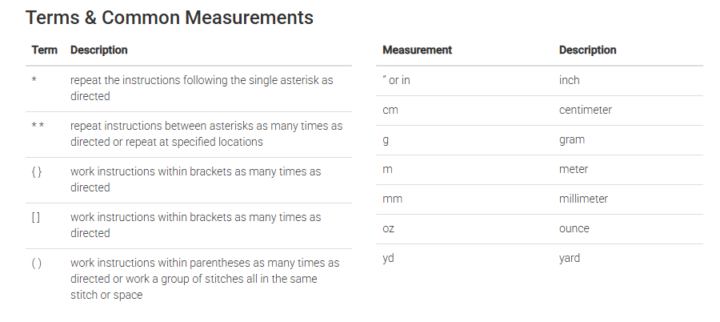
Terms & Common Measurements
Attached are some terms and common measurements that you need to know when reading a pattern.
3
0
Jan 14 •
Knitting & Crochet Abbreviations
Knowing what the abbreviations mean in a pattern is an important part of learning to knit & crochet. Clicking the link below will give you a list of knitting and crochet abbreviations commonly used by yarn industry designers and publishers. In addition, designers and publishers may use special abbreviations in a pattern, which you might not find on this list. Generally, a definition of special abbreviations is given at the beginning of a book or pattern. These definitions reflect U.S. knitting & crochet terminology. https://www.craftyarncouncil.com/standards/knitting-abbreviations https://www.craftyarncouncil.com/standards/crochet-abbreviations
3
0
Jan 13 •
Care Symbols
Universal care symbols are being used to reduce language on yarn and clothing labels. These symbols indicate how best to care for an item that will be made from the yarn. When giving a hand knitted or crocheted item as a gift, it’s so helpful to include a label from a ball or skein of yarn used for the project so that the recipient will know how to care for the item. https://www.craftyarncouncil.com/standards/care-symbols
3
0
Jan 13 •
Yarn Labels
Yarns have labels that provide lots of information about the yarn you have selected, such as the type of yarn it is, the amount or yardage in the ball or skein, fiber content, care instructions and recommended needles or hook to obtain the gauge. On the label you will also see reference to yarn color names, numbers or dye lots. If a yarn has a dye lot number, it is always recommended that you purchase enough of the same dye lot to finish a project because there can be subtle color differences in yarns dyed in different batches. Increasingly, many yarns will say "No Dye Lot Yarn" which means the fibers were dyed prior to being spun so there should be no color differences. Many labels also include free patterns.
2
0
1-7 of 7
powered by
skool.com/a-river-of-yarn-8378
A learning community created for knitters, crocheters, & fibre lovers who want to grow their skills, confidence, and creativity—one stitch at a time.
Suggested communities
Powered by