Activity
Mon
Wed
Fri
Sun
Aug
Sep
Oct
Nov
Dec
Jan
Feb
Mar
Apr
May
Jun
What is this?
Less
More
Memberships
Swing Network
39 members • Free
7 contributions to Swing Network
Sep '25 •
Dance History Lesson 01
Hey guys!! I LOVE dance and history and psychology!! So I'm re-reading one of my favorite books on all of those things and decided to do a series of short videos chronicling dance and its role in society throughout time :D Most of my info comes from Barbara Ehrenreich's Book: Dancing in the Streets: A History of Collective Joy. Check it out for more info or drop me a DM!! This one cover pre-history and my favorite theory for the ultimate question: why do we dance? Spoiler: It's not 42 xP What do you guys think? Why do we dance?? Stay curious and KEEP DANCING!!


2 likes • Sep '25
I'm talking out of my ass, but I feel like a lot of it has to do like you mentioned with social cohesion. It gives a reason to meet periodically for ritualistic purposes. This helps with everything from keeping a healthy gene pools, oral tradition to help pass down knowledge(practical and social), viral health, trade. There is a good amount of 'peacocking.' I feel like the war example that you give can be generalized to work-song, while our ancestors mainly didn't toil in the way that we think of as post-industrialised peoples I can't imagine that work-song and the dance it invokes didn't occur in the past. I feel like a bit must be tied, as you suggested, with rhythm being born with us. Our heartbeat and breath. And of course that humans get dopamine hits from pattern recognition. I think generally it's just an emergent quality, like consciousness(although I'm not sure if this a non-answer or not).
Sep '25 •
🎵It's like rain on your shag practice day🎵
Winter is coming... our little shag group got rained out of park today! We had only started to go through material for 30min when bam! ⚡️🌧Rainstorm 🌧 😭😭😭 Where are you practicing/taking classes this week? 👠🕺
Poll
2 members have voted
1 like • Sep '25
@Amber Matarazzo there's many ways to tackle it, (and it's pretty similar to beginner classes to be fair) Keep in mind I'm just one person. It depends on what are your philosophies as a teacher (flow, self-expression, partnership, foot work, creativity, more attention to followers, etc), what is your goal in giving these classes, what you think your scene needs, what do you like, what makes you a more advanced dancer, and a bit of framework based on answers above. Also important to remember the terms intermediate and advanced are going to really vary from scene to scene and teacher to teacher (the only consistency I feel is that intermediate dancers have some experience with swing-out), so tailor my response to your scene. All of the things you mentioned above are valid avenues to explore. Keep in mind that you can only really teach things you already know yourself and can demonstrate with a bit of consistency. It would be advisable to have a lead who can also do this (especially since you're new to teaching, it doesn't matter so much that your not as advanced with leading yet). The plus side is that dancers who are ready for higher level classes can generally emotionally regulate a bit better and already have some familiarity moving their bodies, many people consider it therefore easier to teach these classes. Moves: Probably the easiest for obvious reasons. You can work on quality of moves. Different ways to do the same move. Twists on a move. Different entrances exits. combining moves in different ways, Timing/syncopation for a move, creating moves to showcase a concept( ex: redirection) etc. You can pretty easily do a whole series on tuck-turns for instance (but don't do this). Footwork: pretty self explanatory I feel. Rhythms, kicks, ball changes, leg shapes, exactness, stamps, stomps, taps, crosses, holds, etc. Musicality: moods, how do you dance to a faster song with a chill vibe, what happens in the musical structure, breaks, syncopation sharp vs staccato, call and response, accents on different beats, etc etc.
Aug '25 •
In lighter news
This is unironically one of my favorite clips of all time. Such a cool zeitgeist.

Aug '25 •
Late night thoughts about Savoy Ballroom & social transformations
The Savoy Ballroom wasn’t just a dance hall, it was one of the first places in the U.S. where black and white communities came together on equal footing, judged only by their rhythm and creativity. Imagine walking into a space in the 1930s where segregation outside was the norm, but once you stepped on “The Track,” the only question was: “Can you dance?” My question is: Can cultural spaces like music venues, clubs, or festivals be more powerful drivers of social change than politics? Does art and expression drive social change more than politics?
1 like • Aug '25
I think cultural spaces are inherently bigger drivers of social change than politics. I think this is largely because cultural spaces and politics are inseparable. Was the status quo of the time of segregated dance floors, not political just because it's the norm? I think you see the opposite to be true in limited cases. The Civil Rights act of 1964 being an obvious counter example. Also it begs the question what does social change or driver mean? If it's the Avant Gaurd then surely cultural space, if it's laws of a society than surely it's politics.
Aug '25 •
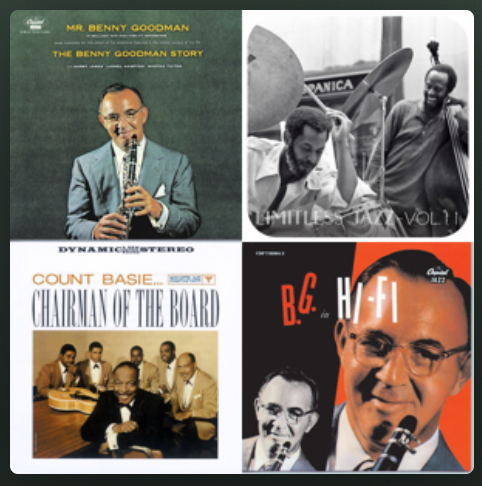
Here are 30 songs every swing dancer should know
Bonus points if you can remember who the song is by https://open.spotify.com/playlist/5Jewjbzr0eabLGko17anGe?si=49cafce2cbdd46a4
0 likes • Aug '25
2 songs by the Andrew sisters, 3 songs by Glenn Miller, and 20 by Benny Goodman, but no mention of Ella, Lil Armstrong, or Chick Webb?? Lookin' a little sus Mr. Aroldo. 😉
1-7 of 7
@zane-payer-7335
American living in Berlin, Germany. Dancing Lindy, Shag Blues, and a little everything else. Some more text
Active 300d ago
Joined Aug 31, 2025