Activity
Mon
Wed
Fri
Sun
Aug
Sep
Oct
Nov
Dec
Jan
Feb
Mar
Apr
May
Jun
Jul
What is this?
Less
More
Memberships
Sprint University
7.1k members • Free
The Ivy Wizard Circle (Free)
291 members • Free
Gamify SAT
22.7k members • Free
J.E.D.I. Training: Digital SAT
577 members • Free
DSAT Hackers
3.1k members • $47/month
SAT Masterclass Lite
3.8k members • $229/month
The Big Brain Club
266 members • $2/month
129 contributions to Gamify SAT

2 likes • 2d
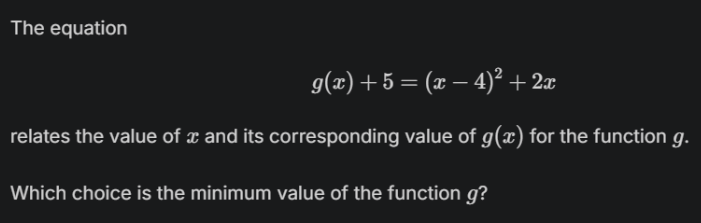
Two...
1 like • 9d
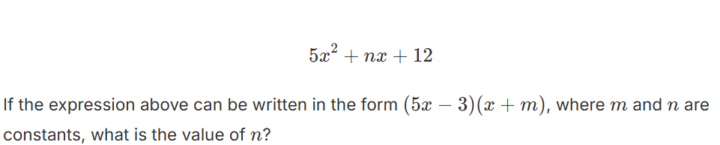
-23.....

12d •
Daily SAT Question 6/28
Wow, I guess we're almost done with the month of June already. Answer to yesterday's was A. The second sentence is explaining a different way that the physics can work, in contradiction to what was said in the first sentence. "That said" means a contradiction.
1 like • 11d
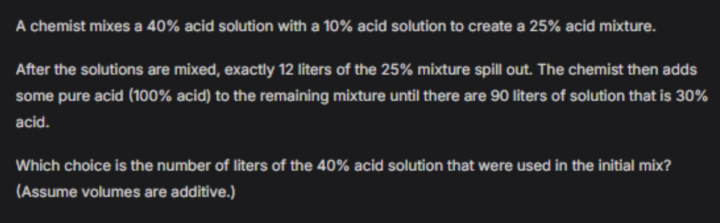
50.
1 like • 16d
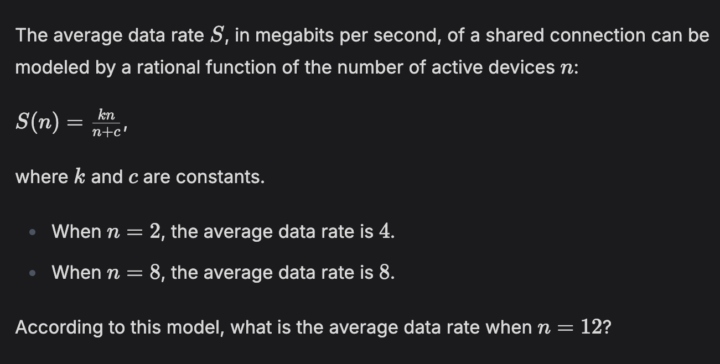
Nine. A regression helped tremendously. Replace S(n) with y and n with x. Make a table using the given values....
18d •
Daily SAT Question 6/22
You guys kinda messed up on yesterday's, again. The answer is actually D, because the part after the blank has no subject. This is one of those hard grammar questions were it looks extremely easy but you realize it was basically a trick lol. Nice job to @Shiny Av and @Alan P for getting it, though. New question: While researching a topic, a student has taken the following notes: - In a 2023 study, 180 intermediate English learners were split into two groups for six weeks. - Group A listened only to speakers using General American English. - Group B listened to speakers using four dialects: General American, Indian, Nigerian, and Scottish English. - On an end-of-course listening test featuring unfamiliar speakers, Group B averaged 78 out of 100, while Group A averaged 70 out of 100. - On a self-rated speaking fluency scale from 1 to 5, Group B averaged 3.1, while Group A averaged 3.6. The student wants to emphasize that broader dialect exposure was associated with higher listening comprehension but lower self-rated speaking fluency. Which choice most effectively uses information from the notes to accomplish this goal? A) Compared with learners who heard only General American English, learners who heard four dialects scored higher on a listening test with unfamiliar speakers (78 vs. 70) but rated their speaking fluency lower (3.1 vs. 3.6). B) Compared with learners who heard only General American English, learners who heard four dialects scored higher on a listening test with unfamiliar speakers (78 vs. 70) but rated their speaking fluency at 3.6 (vs. 3.1). C) Compared with learners who heard only General American English, learners who heard four dialects scored higher on a listening test with unfamiliar speakers (78 vs. 70) and, as a result, rated their speaking fluency lower (3.1 vs. 3.6). D) Compared with learners who heard only General American English, learners who heard four dialects scored higher on a listening test with unfamiliar speakers (78 vs. 70) but rated their speaking fluency lower (3.1 vs. 3.5).
1 like • 17d
A. Option C says that because group B scored higher they rated their speaking fluency lower but any causal relationship is never inferred from the notes whereas A just states the fact straight as it without assuming any additional or unnecessary correlations or information....
1-10 of 129

@yudhistha-orie-8499
The free digital S.A.T. class by Scalar Learning Channel.
Active 6h ago
Joined Jun 18, 2025
Powered by