Activity
Mon
Wed
Fri
Sun
Aug
Sep
Oct
Nov
Dec
Jan
Feb
Mar
Apr
May
Jun
Jul
What is this?
Less
More
Memberships
LO Accelerator
1.2k members • Free
Weather the Storm Academy
102 members • Free
Business Ownership Academy
1.4k members • Free
AI SEO | Rank & Rent Lead Gen
3.9k members • Free
AI SEO Operators
3.8k members • Free
SaaS University (GoHighlevel)
7.3k members • Free
AI SAAS Builders (Workshops)
5k members • Free
SaaS in a Weekend
303 members • Free
SaaS Titans
1.5k members • Free
11 contributions to Contractor Skoolkit

21d •
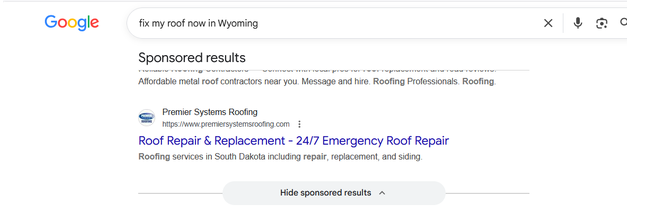
Can You Spot The Google Ads Mistake In This Screenshot?
In this article, I'm going to show you a real example I recently came across that demonstrates just how easily a Google Ads contractor campaign can become misconfigured and, more importantly, how those mistakes can be fixed. Have a look at the screen shot attached . Google Ads has been around for more than 20 years and is arguably one of the most advanced and robust marketing systems ever created. But that's not all. It's also one of the most documented, taught, and explained marketing platforms in existence. Because of that, what continues to surprise me time and time again is that despite the massive amount of educational material available— advertisers still make mistakes that cost them time, money, and potential customers. You can clearly see that my search term was: "Fix my roof now in Wyoming." The intent is clear, and although the location is statewide, it's still very specific. So you can probably already spot the obvious problem this advertiser has... What it's offering is "Roofing Services in South Dakota." Now, it's true that South Dakota is right next to Wyoming. But if I'm a homeowner searching for someone to fix my roof NOW in Wyoming, I sure as hell want to see a company that serves Wyoming. And even if this roofing contractor is capable of sending a crew into Wyoming quickly, someone searching in Wyoming should still see an ad that's relevant to Wyoming. An honest mistake? Maybe. But the reality is that the ad isn't matching the searcher's location, which can lead to fewer clicks and, even worse, people clicking the ad only to discover it's actually a company based in South Dakota. This creates friction, lowers trust, and ultimately hurts campaign performance. So how should they solve that? The answer is to be diligent with your Google Ads geo-targeting settings. Google provides a reporting section that shows exactly where your ads appeared and where your clicks came from. A savvy advertiser should review this report at least once a week and check whether the campaign is generating traffic from locations that are outside the intended service area.
1
0
26d •
Google Created This Lead Generation Tool Almost 10 Years Ago For Small Local Businesses—Yet Most Of Them Still Don't Know It Exists
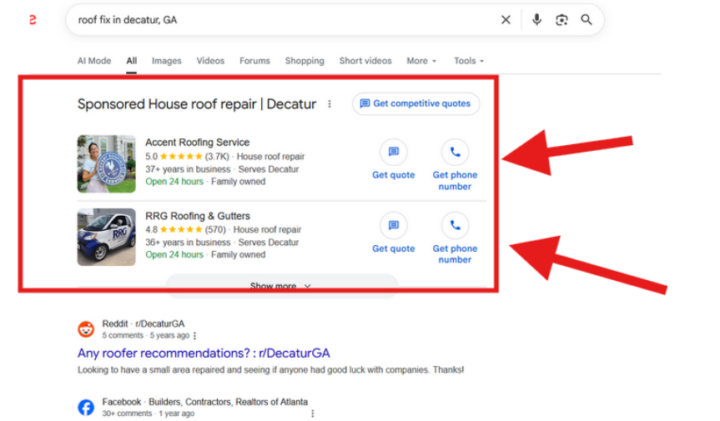
Many contracting businesses don't know about this, and they really—REALLY should. Google first introduced this feature back in 2017, nearly a decade ago, after spending roughly two years testing and refining it. The rollout was a success, and today it has become one of the most powerful lead-generation channels available to small and medium-sized local service businesses. This one is especially relevant for local service professionals. Traditional Google Ads can be incredibly powerful, but they're also competitive. You need to write good ad copy, set up your campaigns correctly, monitor performance, optimize keywords, and continuously refine the account. On top of that, you're usually paying per click—not per lead. That means if your landing page isn't converting, you can easily spend a significant amount of money on clicks without generating many actual leads. And unfortunately, that's a reality many businesses experience. But what if I told you there's a way for small and medium-sized local businesses to bypass a lot of that complexity? What if you could appear at the very top of Google, pay for leads instead of clicks, and let Google handle much of the heavy lifting for you? Have a look at the picture attached. This is an example search I performed in Decatur, GA. Take a look at the top two results. You'll notice something interesting right away. These businesses aren't appearing through traditional Google Ads. They're showing through Google's Local Services Ads (LSA) platform, which sits above the regular search ads and organic results. This is what's called LSA (Local Services Ads). It's connected to your Google Business Profile (formerly Google My Business), which you're probably already familiar with through Google Maps. LSAs are displayed in a way that allows searchers to either call the business directly or send a message with just a few clicks. One of the major advantages is that you don't need a dedicated landing page to generate leads.
0
0
30d •
Did Google Ads Burn Through Your Budget Without Hardly Producing Any Good Leads?
If so, let's figure out what went wrong. I'm opening up my schedule for a free, no-strings-attached audit of your current or past Google Ads campaigns. We'll review your keyword targeting, ad copy, search terms, negative keywords, campaign structure, landing pages, lead quality, conversion tracking, and overall strategy. Within 20 minutes, you'll know exactly what went wrong, what was actually working, what may be wasting your budget, and what needs to be improved to generate more qualified leads and booked jobs. We'll also record the audit on video so you can refer back to it later and implement the recommendations yourself if you'd like. And if it's a particularly interesting account with some valuable lessons, we can even share the audit in the group (with your permission, of course) so others can learn from it as well. Whether you're a roofer, contractor, HVAC company, electrician, plumber, or another home service business, the goal is the same: generate profitable jobs, not just clicks and leads. And if your campaign didn't do that, there's usually a reason why. If you're interested, comment below or send me a DM, and we'll schedule a quick intro call.
Jun 9 •
How We Turned A Failing Google Ads Campaign Into One That Generated Over $350,000 In Less Than 10 Months — Using 5 Replicable Steps You Can Apply Yourself
Business owners who rely heavily on traditional marketing methods or word of mouth eventually become interested in transitioning into digital marketing and Google Ads to create a more predictable flow of inbound leads. This is going to be a bit long but that's because I'm literally spilling out how this actually works. The problem is that many of them either decide to do it themselves, end up getting poor advice, or work with people who don’t really understand how Google Ads works beyond the basics. Yeah, I know it sounds a little far-fetched, but I’ve seen it happen time and time again, and that’s exactly where one of our partners was when they came to us. They were already an established home-flipping company in Michigan, generating solid revenue every year. But like many growing businesses, they wanted to build a system that could consistently generate inbound leads without relying entirely on referrals, outbound outreach, or constantly adding more staff. They knew Google Ads had potential, so they made what seemed like a smart move: They hired someone internally to manage the campaigns. Unfortunately, that’s where things started going sideways. The person they hired had very limited real-world Google Ads experience. For nearly a year, the account ran with poor targeting, weak keyword structure, no proper conversion tracking, and no clear optimization process. And worst of all, Google’s automated recommendations were being applied constantly without understanding the consequences. The campaigns started mixing Search and Display traffic together, which is a big No-No and often becomes a massive waste of budget flying under the owner's radar. The result? A glorified money burner. The company started getting flooded with low-quality leads, irrelevant locations, weak inquiries, and traffic that had little to no buying intent. ROI was non existent....... . Eventually, they shut the campaigns down entirely. Things started to turn around when they came across one of our posts about Google Ads audits and campaign troubleshooting.
1
0

Jun 5 •
How One Small Google Ads Change Can Keep Tire-Kickers Away And Improve Lead Quality
If you've researched Google Ads before, you've probably heard about negative keywords. A lot of contractors who choose the Google Ads route will probably have these things in mind (if any): - Finding good keywords - Writing ad copy - Building landing pages - Bidding strategies But one of the biggest factors behind profitable Google Ads campaigns is actually filtering OUT the wrong traffic. This is where negative keywords become extremely important. Negative keywords basically tell Google: "Do NOT show my ads for these searches." And in contractor marketing, this matters A LOT. Because Google can sometimes match your ads to searches that sound related on the surface, but are actually completely irrelevant to your business. For example, if you're targeting: - Roof repair - HVAC installation - Kitchen remodeling Google may still show your ads for searches like: - Roof repair DIY - HVAC technician jobs - Kitchen remodel ideas - Free roofing materials - How to install flooring yourself And every irrelevant click costs money. This becomes even more aggressive when using features like Broad Match keywords and Automated Keyword Expansion. Without proper negative keywords, campaigns can slowly drift away from actual buyers and start attracting completely different audiences. Another thing people don't realize is that bad traffic can hurt campaign performance beyond just wasted spend. The wrong kind of searches can negatively impact your CTR, which in turn can lead to higher CPCs, which affects your cost per lead and... you get the picture. That's why checking your Search Terms Report regularly is extremely important, at least on a weekly basis. This report shows the ACTUAL searches people typed before clicking on your ads. And this is where you start discovering whether irrelevant searches triggered your ads. In many cases, building strong negative keyword lists is a MUST if you want your Google Ads campaigns to generate profitable jobs instead of bleeding budget.
0 likes • Jun 6
@Deacon Nick There's actually no such thing. negative keywords arise right from the get go, if you have not planted it before. If one does not know any (which is easy to compile with training programs and AI research) then they will have to do by default from the traffic they get
1-10 of 11
@yogev-lifchin-6361
Musician, Producer, Strategist thinker, Avid World Traveler & an all-around nice guy. What can I do for you?
Active 3d ago
Joined May 19, 2026
Powered by