Activity
Mon
Wed
Fri
Sun
Aug
Sep
Oct
Nov
Dec
Jan
Feb
Mar
Apr
May
Jun
Jul
What is this?
Less
More
Owned by Vivian
School of AI WhatsApp Channel: https://chat.whatsapp.com/JuqbToSN6bcJAY94jLzZEd
Memberships
AI Growth Academy
161 members • Free
Weekly Five Recipes
76 members • Free
The Train AI Community™
25 members • Free
🇪🇸 Barcelona IRL
245 members • Free
ExplainableAI
91 members • Free
Retire Ready
31 members • Free
Agentix Academy
45 members • Free
AI Automation Agency Hub
328.5k members • Free
AI Automation Society
423.1k members • Free
155 contributions to School of AI

3d •
FREE - Learn Hands-On AI Governance Engineering with Python
Hands-On AI Governance Engineering with Python is best learned by building real controls: policy checks, audit logs, and human-approval flows. Start with small Python prototypes, then expand into monitoring, evaluation, and compliance-ready workflows. Get it free for the first 300 students. https://www.udemy.com/course/hands-on-ai-governance-engineering-with-python/?referralCode=6952754C87BC1DBCCDEA&couponCode=JULFREE01 Use coupon code JULFREE01 or JULFREE02 or JULFREE03
10d •
Get all these 150 courses for free (Only 100 coupons)
Coupon Code: JULFREE01, JULFREE02 or JULFREE03 https://gist.github.com/vivianaranha/0b9ee14dbd80f379b00bd8aca750e45c 150. Certified Forward Deployed Engineer Mastery https://www.udemy.com/course/forward-deployed-engineer-mastery/?referralCode=CE6624B7C4B7540E2327 149. Build Certified Autonomous AI Systems in 4 Weeks https://www.udemy.com/course/build-autonomous-ai-systems-in-4-weeks/?referralCode=604BFD161D0CC6FE21EE 148. Human + Agentic AI: New Leadership Skills for 2026 https://www.udemy.com/course/human-agentic-ai-new-leadership-skills-for-2026/?referralCode=C9AC0C42DFA5FC48F817 147. AI in 90 Days: A Leadership Bootcamp https://www.udemy.com/course/ai-in-90-days-a-leadership-bootcamp/?referralCode=249C0D60F6E789DCFF68 146. Certified 7-Day AI Bootcamp: AI Apps, RAG, and AI Agents https://www.udemy.com/course/7-day-practical-ai-bootcamp-build-ai-apps-rag-and-agents/?referralCode=7579C860558F920123B9 145. AI Governance for Business Leaders: Policy to Practice https://www.udemy.com/course/ai-governance-for-business-leaders-policy-to-practice/?referralCode=EDB90EDD5B5C9101F888 144. AI Agents in the Enterprise: Design, Deploy, Lead https://www.udemy.com/course/ai-agents-in-the-enterprise-design-deploy-lead/?referralCode=6B5A38F6B96659DB5C94
0 likes • 5d
@Mucha Murapa paid by the members of this community. This is the least I can do
14d •
Build Autonomous AI Systems in 4 Weeks
Try this free coupon https://www.udemy.com/course/build-autonomous-ai-systems-in-4-weeks/?referralCode=604BFD161D0CC6FE21EE&couponCode=6B601D246AE2F2CFDD35
5
0
19d •
New Course Launch: AI Agents, RAG & MCP — 7-Day Builder Bootcamp
AI is moving far beyond basic chatbots and prompt engineering. The next generation of AI applications can reason, plan, retrieve knowledge, call tools, browse websites, collaborate with other agents, and automate real-world workflows. That is exactly what we teach in this hands-on bootcamp. Over seven intensive days, you will learn how to build: ✅ Autonomous Research Agent ✅ Enterprise Knowledge Agent with Advanced RAG ✅ Production-ready MCP Server ✅ Autonomous Browser Agent ✅ Multi-Agent Business Analyst System with LangGraph ✅ Multimodal Operations Copilot ✅ Production AI Platform with evaluation, observability, guardrails, and deployment The course includes 36 lectures, 12 hours of content, and seven portfolio-ready AI projects built step by step. No previous experience with AI agents, RAG, MCP, or LangGraph is required, but intermediate Python knowledge is recommended. This course is designed for Python developers, software engineers, AI engineers, solutions architects, technical leaders, and founders who are ready to move beyond prompts and start engineering complete AI systems. 🎟️ Special launch coupon: JUNFREE01 Start learning here: https://www.udemy.com/course/ai-agents-rag-mcp-7-day-builder-bootcamp/?referralCode=94C38CDB60CD5245F664&couponCode=JUNFREE01 Please share this opportunity with someone interested in becoming an AI Engineer or Agentic AI Developer. #ArtificialIntelligence #AIAgents #AgenticAI #RAG #MCP #LangGraph #GenerativeAI #Python #AIEngineering #MachineLearning #Udemy #OnlineLearning #SchoolOfAI
0 likes • 18d
@Rama Narra yes the link is in the post
0 likes • 16d
@Rama Narra if you have Udemy subscription- you will have to request this course from Udemy to be added to subscription. Since it’s a new course it takes atleast 1-2 months to show up
17d •
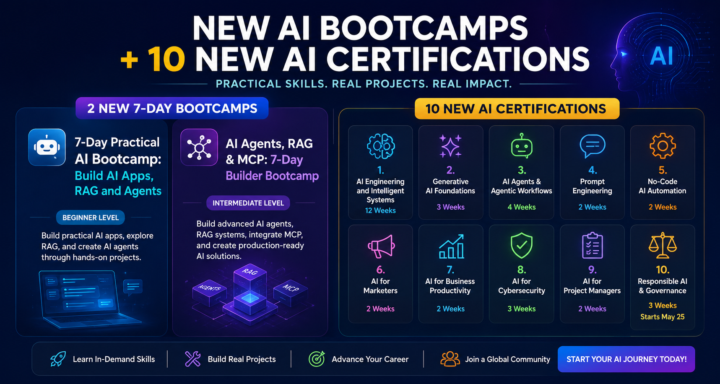
New AI Bootcamps + Certifications Now Available (PROMO)
Hello, I’m excited to share two new 7-day AI bootcamps and 10 new AI certification programs now available. New 7-Day Bootcamps 7-Day Practical AI Bootcamp: Build AI Apps, RAG, and Agents Beginner-friendly course to help you build practical AI apps, PDF chat with RAG, AI assistants, research agents, and multi-agent workflows. AI Agents, RAG & MCP: 7-Day Builder Bootcamp Intermediate-level course focused on autonomous agents, RAG systems, MCP, tool use, multi-agent systems, and production-ready AI applications. New AI Certifications We also launched 10 certification programs: 1. AI Engineering and Intelligent Systems 2. Generative AI Foundations 3. AI Agents & Agentic Workflows 4. Prompt Engineering 5. No-Code AI Automation 6. AI for Marketers 7. AI for Business Productivity 8. AI for Cybersecurity 9. AI for Project Managers 10. Responsible AI & Governance
1
0
1-10 of 155

@vivian-aranha-2354
School of AI empowers professionals to master AI, automation, and emerging tech through practical, future-ready learning built for real-world impact.
Active 7h ago
Joined Dec 25, 2025
Atlanta, GA
Powered by