Activity
Mon
Wed
Fri
Sun
Mar
Apr
May
Jun
Jul
Aug
Sep
Oct
Nov
Dec
Jan
Feb
What is this?
Less
More
Memberships
Freedom For Founders
213 members • Free
The Founders Union
42 members • Free
The Founders Club
61.7k members • Free
Nomad founders
46 members • Free
Founders Academy
339 members • Free
AI GENERALIST MASTERMIND
180 members • Free
🇹🇭 Skool IRL: Bangkok
169 members • Free
🇮🇩 Skool IRL: Bali
152 members • Free
🇸🇬 Skool IRL: Singapore
72 members • Free
12 contributions to Automation-Tribe-Free

7d •
You're Using Claude Code Wrong (And Losing Hours Because of It)
Look, I've been using Claude Code for a few months now and I just realized most people are doing it backwards. Everyone's just throwing vague prompts at it like "build me a login system" and then spending forever going back and forth fixing stuff. There's a better way. Write the damn spec first. I'm serious. Before you even open Claude Code, spend 20 minutes writing out what you actually need. Requirements, edge cases, how the API should work, what errors to handle. Just a markdown file. Nothing fancy. Then (and this is the part nobody talks about) you point Claude Code directly at that spec file. "Implement the auth service in auth-spec.md." That's it. What happens next is honestly kind of wild. It reads the whole thing, sometimes asks you questions if something's unclear, then just builds it. Multiple files, proper error handling, tests that actually make sense. Because it knows exactly what you want. No more asking - actually can you change this fifteen times. No more - I forgot to mention we need to handle OAuth too. The spec is right there. And here's the thing that sold me: your specs don't disappear into some Google Doc graveyard. They live with your code. When you need to refactor three months later, the spec is still there telling you what the hell you were thinking. Try it once. Write a proper spec, save it as a .md file in your project, and tell Claude Code to build from it. You'll get why everyone who does this won't shut up about it.
10d •
He Built His SaaS for $500 Instead of $23K
So I grabbed coffee with my buddy Rohan last week, and his story is kind of wild. He's been sitting on this enterprise SaaS idea in the HRTech space for months. Good idea too - validated with potential customers. But he can't code much. So he started getting quotes. The developer route? > Senior devs wanted $120K-150K a year plus equity. Even juniors were $80K+. But it's not just the salary - it's the commitment. What if it doesn't work? He was worried about bleeding cash every month on payroll while trying to figure out if anyone will pay for his product. Dev agencies? > Cheapest quote: $23,000. Most expensive: $47K. Timeline? 3-4 months. And any changes after delivery? Extra. Always extra. Then he found this AI coding thing. He took a $500 course on Agentic spec coding - basically using specialized AI agents to build software without being a developer. A month later, he had a working MVP. Not a prototype. An actual product he's testing with real users. The math: - Devs: $120K+ per year - Agency: $23K, months of waiting - His way: $500, one month What surprised him most: The speed, flexibility, and scalability. With an agency, every change takes days or weeks of negotiation. Now he iterates in hours. Idea in the morning, tested and fixed by dinner. This isn't magic. Rohan had frustrating nights because of the lack of experience with spec coding. Things broke. You still need to understand what you're building - the AI doesn't think for you. But if you're scrappy? This is viable. Three years ago, non-technical founders had to learn to code for years or raise money. Now there's another path. Not replacing developers for complex stuff, but for getting an MVP out there? Completely different game. Rohan's product isn't perfect. But it exists. People are using it. Built for the cost of a used iPhone and a month of late nights. What would you build if you didn't need to raise $500K first?
2
0
12d •
Is vibe coding dying?
You're probably still vibe coding everything and it feels great, right? We were doing the same thing six months ago. Shipped our entire MVP with v0 and Bolt. Three landing pages in a week. Felt unstoppable. Then we tried adding payments. And user roles. And email notifications. Every single feature broke something else. We'd build something in 20 minutes, then spend 3 hours fixing what it messed up. The codebase was a mess because we never planned the architecture, we just kept prompting and hoping. Don't get me wrong - vibe coding is amazing for what you're probably doing right now: 1. Testing ideas fast 2. Building quick prototypes 3. Shipping demos to show investors But here's what nobody tells you: the moment you need to scale or bring someone else into the project, it completely falls apart. Good luck explaining your vibe-coded structure to a new dev. So we switched to spec coding. Now we spend 15-20 minutes writing out what we are actually building. The requirements, how it should work, where things go. Then AI generates the code based on that plan. Yeah, it's slower to start. But way faster to finish. Last week we created multiple landing pages with ongoing iterations every week - no bugs, no surprises, just worked as expected. Because we designed it before building it. We still vibe code when we are just messing around with ideas. But for real features that need to last? Specs every time. Most serious devs I know have made this shift. They realized the bottleneck isn't writing code anymore - AI does that. The bottleneck is knowing what to build and how it fits together. Where are you at? Still in the vibe coding honeymoon phase or starting to feel the pain?
14d •
Built something using Spec Coding? Get featured on our Podcast
Are you a Tech Founder who has developed an MVP or Product using Spec Coding? Join us to share your story, what you've built and how you've built it using Spec Coding to share it with the world through our podcast. Know someone who has built an MVP or a Product using Spec Coding? Tag them in the comments. Fill this form to get featured on our podcast: https://forms.gle/68ztRpEq4d5yXJcv6
1
0

Oct '25 •
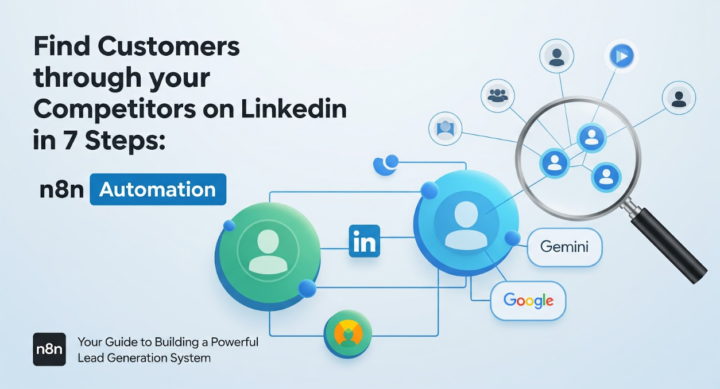
Find Customers through your Competitors on LinkedIn in 7 Steps: n8n Automation
Do you follow your competitors on LinkedIn to know what's happening in the market and who is working with your competitors? While it can give you a lot of insights, it is nearly impossible to track your competitors' activity manually on LinkedIn. That's when you use this n8n automation workflow to find customers through your competitors on LinkedIn: Step 1 - Define your competitors - Node: Manual Trigger or Form. - Input: list of LinkedIn company pages or personal profiles representing direct competitors. - Store them as workflow variables for later use. --------------------------- Step 2 - Identify competitors active 5+ days per week - Node: HTTP Request (PhantomBuster / LinkedIn API partner). - Pull each competitor’s activity log from the past 7 days: posts, likes, comments, shares. - Count active days. - Filter for those with engagement on 5 or more distinct days. - Output: “Active Competitors” list for further tracking. --------------------------- Step 3 - Fetch interaction network of active competitors - Node: HTTP Request (same tool). - For each competitor: - - Gather all profiles they’ve interacted with — those they’ve liked, commented on, or shared posts from. - - Also capture users who’ve engaged (liked/commented) on the competitor’s own posts. - Store: name, LinkedIn URL, interaction type, company name, and engagement date. --------------------------- Step 4 - Filter potential customers based on ICP - Node: Function / Gemini. - Input: all interaction profiles + your ICP. - Ask Gemini to filter and retain only those who match the ICP (e.g., “Operations Managers in manufacturing companies with 100–1000 employees in the US”). - Output: refined list of potential customers likely relevant to your offerings. Suggested Gemini instruction:“From this list of LinkedIn profiles, keep only those who fit the Ideal Customer Profile: [ICP details]. Return their names, companies, and roles.” ---------------------------
2
0
1-10 of 12

@varun-p-7555
I talk about all things automation and spec coding. Let's connect if you need help with spec coding: connect@navan.ai
Check https://sam.navan.ai
Active 9h ago
Joined Aug 29, 2025
India
Powered by