Activity
Mon
Wed
Fri
Sun
Nov
Dec
Jan
Feb
Mar
Apr
May
Jun
Jul
Aug
Sep
Oct
What is this?
Less
More
50 contributions to Life Powered By AI

May 19 •
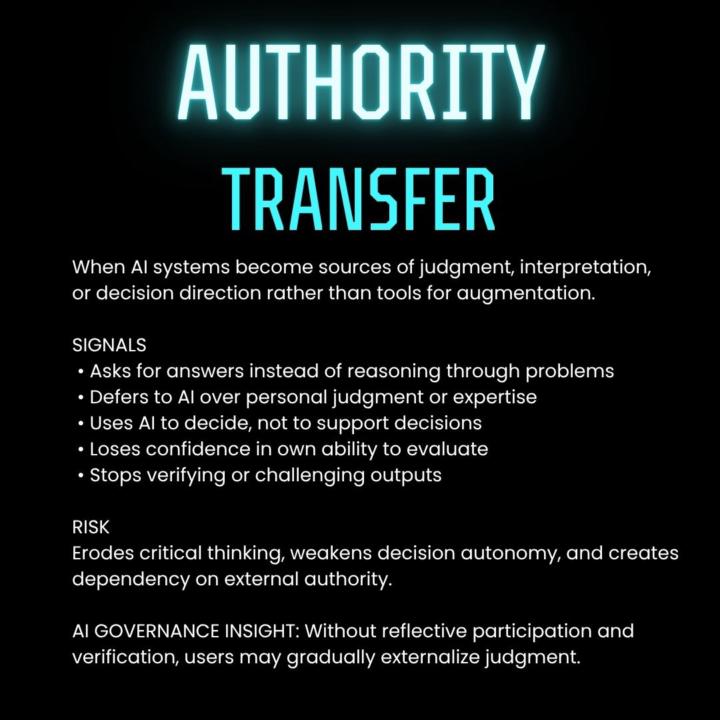
Authority Transfer
The danger with AI is not just misinformation, but the gradual transfer of judgment. The moment people stop actively reasoning with systems and begin deferring to them, authority starts shifting. Productivity should increase human capability, not reduce participation in thinking, reflection, or verification. Stay engaged, verify, think, decide, and own your decisions.
1
0
May 4 •
My Posts On AI Safety Get Pushbacks. Here's What They Don't Understand
When I post on AI safety, the biggest responses are people talking about cybersecurity and data leakage. This makes it clear that people are looking at a fundamentally new system through a traditional lens. They think the conversation is about protecting the system, but the real conversation is about you being protected from the system. This is not a cybersecurity problem. This is a language problem. Language is the oldest and most complex surface any system has ever been built on, and now, for the first time, it is not just describing systems, it is driving them. The nuance of language is being handed to a system to interpret, prioritize, and act on. Every tool you connect becomes a joint where interpretation can shift. Every model you call can interpret the same words differently, and even the same model can produce different outputs when given the same inputs. You can train it all day, but eventually you will get drift. Language is foundational to AI, but it is also something humans do not fully agree on, which means machines certainly will not. When context collapses, meaning degrades even further. No system fully addresses the complexity of this. You cannot control a model with language, prompts, policies, guardrails, context, or memory. Those can influence behavior, but they do not enforce anything. Control happens at execution, and if execution is not governed, everything that comes out on the other side is a hope and a prayer. It might be right today, but it will be confidently wrong tomorrow because nothing is actually enforcing whether it is allowed to act. The answer is not sandboxing, better prompts, more context, or better memory. It is a fully governed environment. It is an architecture where judgment happens before action, and where meaning is preserved across the system instead of collapsing. Because that is the only way to command AI without it eventually screwing something up. And the only way to know it isn’t is through full observability and end-to-end traceability of its decisions.
0
0
Apr 28 •
Stop Asking AI Random Questions
People keep asking how I’m using AI. I’m going to be honest...my situation is different. My system, Life, was built for me... how I think, how I move, how I make decisions. So, you won’t get the same results I get. But I do want to give you something useful you can use right now with what’s available. Stop asking AI random questions. Do this instead: 1. Give it a job “Act like my operator.” “Act like my deal analyst.” “Act like my COO.” 2. Dump everything in your head Don’t organize it. Don’t clean it up. 3. Make it decide “What actually matters?” “What makes money?” “What needs to go?” 4. Get one move "What should I do in the next 30 minutes?” 5. Pressure test it “Where could this be wrong?” “What am I not seeing?” 6. Tell it what not to do Do not give generic advice Do not list options without choosing Do not add fluff Do not ignore impact or ROI.” That’s it. Most people are using AI to get more information. You don’t need more information. You need clarity and movement. And one more thing… These systems are ungoverned. They’ll give you answers — but not always the right ones. So challenge the output. Don’t accept confident wrong answers. Use this to get closer. Until MyOS is ready.
2
0
Apr 13 •
The dirty secret no one is saying out loud:
People are buying separate Macs to run autonomous systems so they don’t damage their personal computers. That should tell you everything. You’re literally buying a second device because you don’t trust the system. And it’s not just Macs. People are spinning up VPS servers, running virtual machines, locking things in containers, using remote desktops and cloud sandboxes, tightening file permissions… All to “contain” the risk. And yes—those things reduce local damage. But that’s not where the real risk lives. Once that system is connected to: your CRM Google Drive / Dropbox email banking / loan docs real estate workflows …it’s no longer contained. The moment you connect it, you’ve given it access to everything that actually matters. Now it doesn’t need to break in. It’s already inside. So no—you didn’t eliminate the risk. You moved it. That’s not security. That’s exposure that feels safe.
1
0
Apr 9 •
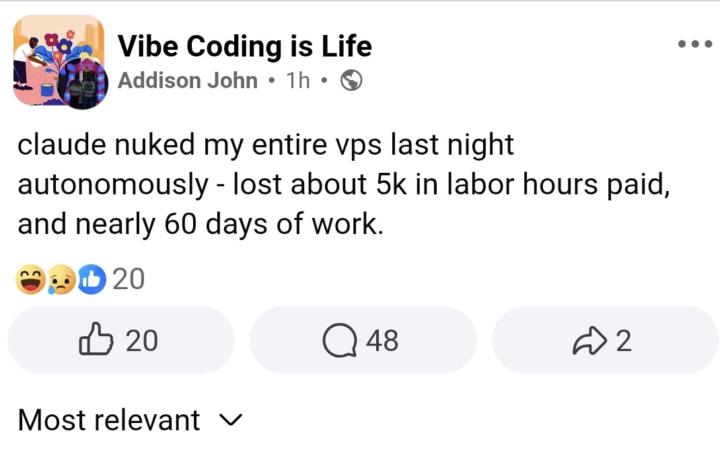
*Claude Code Nuked My Entire VPS Last Night""
I have said this before, but. . . ungoverned systems can not be trusted. What likely happened here. . . An autonomous agent was given: file system access (VPS) execution permissions vague or unsafe instructions And then: It made a “decision” With no real judgment layer And executed it That’s it. No intent. No awareness. No “oops.” Just unguarded execution. The real issue is NOT: a Claude problem an AI model problem This is: A system design failure The model didn’t “go rogue.” It was allowed to act without constraints. This person found out the hard way that autonomy without proper constraints is dangerous.
1
0
1-10 of 50
@urania-smith-7177
Co-Creator of MyOS a human-centered AI for life and business.
Writer, Editor, Designer and Investor, developing AI systems to manage it all.
Active 16d ago
Joined Sep 8, 2025