Activity
Mon
Wed
Fri
Sun
Sep
Oct
Nov
Dec
Jan
Feb
Mar
Apr
May
Jun
Jul
Aug
What is this?
Less
More
Tennessee Apologetics
62 members • Free
3 contributions to Tennessee Apologetics

Jun 4 •
Learning Islam
At this month's Fellowship Night, we have a special guest, Dr. Syed Barmaver. I will be interviewing him abotu Islam. He is an orthodox Sunni Muslim. Below is a link to biblicaltraining.org. They have a fantastic series on Islam (among other things). Biblicaltraining.org is an amazing resource. you can actually earn a degree through the resources the provide. I would encourage people to listen to some of this series. https://www.biblicaltraining.org/learn/institute/wm647-islam This is a link to a lecture series by Shaykh Yasir Qadhi. It's really, really good and i would encourage everyone to listen to this playlist. https://www.youtube.com/watch?v=b0n-nBm028M&list=PLZ5yPKz3FvW7HsrqOKs26C7PxM61JZEan

0 likes • Jun 7
@Aaron Yost when are we meeting this month?

May 20 •
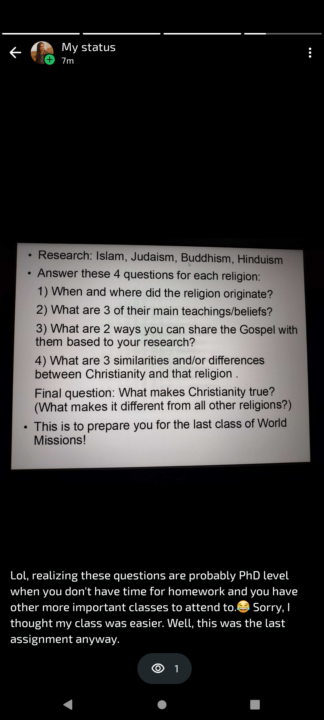
Fun Apologetics Research Assignment
So I was randomly scrolling through my photos and came across an assignment from a World Missions class I taught while I was overseas. I realized that this could be a fun little activity to try to help understand Christianity and it's uniqueness by seeing the differences and the similarities of other major religions in comparison to it. (Good to sharpen those apologetical skills😏)
0 likes • May 23
@Aaron Yost I thought the issue with Jews was: 1. They don’t worship God at all. They are atheist, Jewish by cultural heritage only 2. Or they are Orthodox Jews meaning that they don’t believe Jesus is the messiah and the messiah is still to come. And they hold to the old Jewish tradition (some if not all) I think Problem 1 can be addressed very similarly to how we address other atheist Problem 2 we need to know who and what they expect the Messiah to be and do and contrast that with prophecy in the Old Testament. How does Jesus fullfill them? Is 53 is a popular one. Also how the messiah is yet to come is impossible based on prophecy as well. With the temple having been destroyed. There are are things in prophecy that could have only been fulfilled back when the temple was still standing before 70 AD. That’s my understanding anyway.
May 11 •
The Problem with Arguments from Evidence
At the last Fellowship Night we learned about the moral argument for God as stated by William Lane Craig: 1. If no God, then no objective moral values and duties. 2. Objective moral values and duties exist. 3. Therefore, God exists. At the very end we started to critique the actual argument. We ran out of time, but I wanted to follow up with this idea because I think understanding the strengths and weaknesses of arguments is important. What I said at Fellowship Night is that evidential arguments have some flaws because they start with man, assume his reasoning is neutral and capable, and then ask him to evaluate evidence and make a judgment about God. My issue is not with evidence or logic. My issue is with pretending man can stand in neutrality, evaluate God, and then render a verdict. To me, concluding God seems backwards because, as Christians, we reason from God to man. In fact, many of the unbeliever objections to the moral argument we reviewed were overcome by reasoning from God as the necessary starting point. What I said at Fellowship night is that I would frame the argument this way: 1. If God exists, objective morality exists. 2. God exists. 3. Therefore, objective morality exists. People asked me what the difference is and I was having trouble stating it in a way that drew a strong contrast. In this video, I think Alex O'Connor does a masterful job of critiquing the moral argument (which I'm not even sure is his intention nor is this video about the moral argument). Alex says “that moral intuition that so powerfully tells people...certain things are right or wrong… that should lead you to Christianity. And then the first thing I see opening that book is something which contradicts the very moral intuition that I was supposed to use to get there in the first place.” When you put man as the judge over God, he doesn't relinquish that position easily. So let's imagine we are talking about the moral argument. We establish with the unbeliever that he can, indeed, reason his way to God. But as soon as he reasons improperly - which he will, according to Romans - we tell him to pump the brakes and question his moral authority. The problem is that we gave him that authority when we asked the unbeliever to evaluate the evidence and judge for himself.
0 likes • May 12
Yes that makes sense. That’s an aspect of the original moral argument subjective vs objective right?
0 likes • May 12
@Aaron Yost this is similar to what Frank Turek does “where does the atheist get their moral foundation from… they must steal from God to get that” He did right a book about it. he’s not a presuppositionialist as far as I understand. I’m not saying you’re wrong because you’re not. In fact I admit my view on those verses I shared was incorrect given the context you provided Maybe when I asked is it a rhetorical issue was the wrong word. To me it’s just a nuisance I don’t think is a hill to die on. God doesn’t think any less of us if we advocate for him evidentially or presuppositionaly . Really he doesn’t need us to advocate for him at all. It’s a blessing that he allows us to be the tools he works through As long as we aren’t misrepresenting the gospel and we represent him well in our lives and while sowing leading souls to Christ that’s the hill to die on. This is all my own opinion of course but I don’t think I’ve said anything heretical haha
1-3 of 3

@tyler-brinkman-2065
Just a $1 apologist seeking to better their abilities to make the case for Christ
Active 12d ago
Joined Apr 29, 2026