Activity
Mon
Wed
Fri
Sun
Nov
Dec
Jan
Feb
Mar
Apr
May
Jun
Jul
Aug
Sep
Oct
What is this?
Less
More
29 contributions to Jazz Singer Harvey Thompson

Jun 1 •
Johnny Hartman's Influence Over Harvey Thompson
June 1, 2026 (Tokyo, Japan) - The following is what I wrote about Johnny Hartman influencing jazz vocalist Harvey Thompson's singing in Harvey's biography: "Harvey recalled meeting Johnny Hartman in March 1983 after Greg Dunmore's mother Jo told Harvey that Hartman would be singing at the Book Cadillac Hotel inside the Motor Bar. Harvey arrived early at the hotel's bar. As he walked in, he noticed an extremely well-dressed man in a gray suit with a loud, bright yellow necktie on. Harvey thought to himself, "That must be Johnny Hartman." Harvey said he was so nervous his hands were shaking. But Harvey, always being the one to venture forth, walked up to Hartman, extended his hand, and was warmly met by Hartman's deep baritone voice and an inviting warm smile. Harvey described Hartman as "a real gentleman." https://youtu.be/ILDqWHutba0?si=ZKVaUBTYu2vhMcSO
0 likes • Jul 1
@Jane Porteous After writing Harvey's story I started looking around at the research behind singing and how the human voice resonates with the listener. I didn't write this research into the book but Hartman's voice was incredibly emotionally soothing to listen to. It gave the listener a safe emotional space listening to him sing. Harvey and I might be writing a book on jazz in the far east. It might be something to write about because that is a lost art in Harvey's estimation. And Hartman apparently did perform in Japan.
1 like • Jul 5
@Jane Porteous Yes, I didn't at first consider the physics and science of singing too much until Harvey and I started talking after the book was completed.
Jul 1 •
Only Love, Only Peace by Jazz Vocalist Harvey Thompson
July 1, 2026 (Tokyo, Japan) - This is a fantastic rendition by jazz vocalist Harvey Thompson singing Only Love Only Peace. This music video was created with the hope that, transcending borders, race, language, and religion, we can all live in harmony and peace in the beautiful world that is our Earth. How wonderful it would be if everyone received a proper education and learned about humanity, animals, plants, and the true nature of our world. We strive for a world where no one cries out in anguish due to ugly discrimination, destructive wars, environmental pollution, hunger caused by food shortages, or the heartbreaking plight of refugees. Harmony exists in this world only when we share with one another, care for one another, and support one another. Furthermore, the equation for progress must never stray from humanity. Can we truly call it progress only when technological advancements are in harmony with us as human beings? We cannot leave this chaotic world to the children who will carry the future.
0 likes • Jul 5
@Jane Porteous We all do and that includes healing ourselves from all the trauma I think.
Jul 1 •
The Physics of Comfort: Why Johnny Hartman's Voice Still Feels Like Home
July 1, 2026 (Tokyo, Japan) - There's a particular quiet that falls over a room when Johnny Hartman starts singing. It isn't just admiration. It's closer to relief, like a held breath finally let go. Listeners often reach for the same words: warm, velvet, like being wrapped in a blanket. That instinct isn't just poetic. There's real acoustics behind it. Hartman, the Chicago-raised baritone best known for his 1963 studio date with John Coltrane, never had the biggest voice in jazz. What he had was control: a low, dense, unhurried instrument. One reviewer called it a "buttery baritone" that melts into the horns around it, and that tactile language points to something physical. Low, steady, harmonically rich sound registers in the body differently than a bright or jagged one does. A baritone's pitch sits well below a tenor's, closer to distant thunder than a sudden crack of noise. The nervous system reserves alarm for sharp, high-pitched, fast-onset sounds, the acoustic signature of danger. Hartman's voice arrives without spikes. He described his own approach as treating a lyric almost like talking, telling a story rather than performing one. That conversational phrasing strips out the jagged transients a more theatrical singer might lean into. His voice also carries a dense stack of overtones that reinforce each other smoothly instead of clashing, giving it low acoustic "roughness." It's part of why certain voices read as smooth almost as a texture, not just a sound. Add the genre itself: ballads, slow tempos, resolved harmony, few surprises. A nervous system that can predict what's coming tends to relax into it. That tradition didn't end with Hartman. Detroit vocalist Harvey Thompson has been called "the keeper of the flame" of male jazz vocals, carrying forward the sound Hartman helped define alongside the influence of Nat King Cole. What Thompson inherited isn't a technique so much as a discipline: staying low, unhurried, and warm when a lesser singer would push and perform.
0
0
Jun 14 •
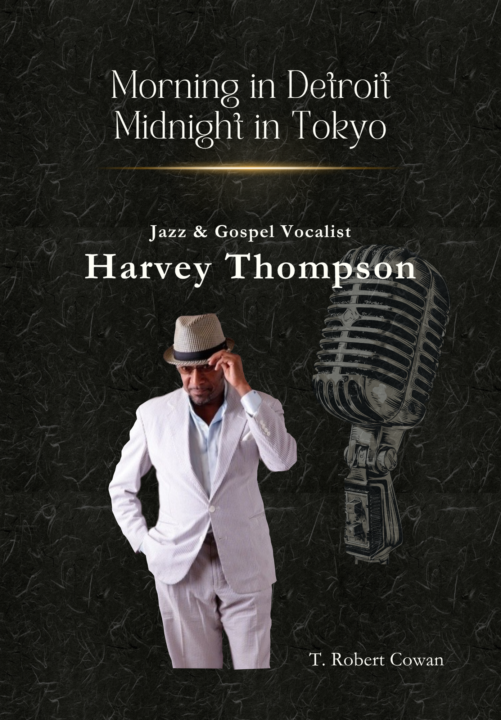
BOOK RELEASE: Morning in Detroit Midnight in Tokyo - Jazz and Gospel Vocalist - Harvey Thompson
June 14, 2026 (Tokyo, Japan) - Jazz vocalist Harvey Thompson's biography was released today. I included several pages for readers to review. The book is currently available as an eBook and will soon be published as a paperback. Harvey Thompson was born in Detroit in 1956, in the shadow of Motown. He grew up singing gospel, absorbed the soul of the American South, and eventually walked into jazz clubs on two continents — carrying with him a baritone that one writer described as "smooth as aged Suntory whiskey, deep as the Detroit River." "All I want to do is sing." — Harvey Thompson In 2002, Harvey made a decision that changed everything: he moved to Japan. There he found what every artist hopes for, an audience that truly listens. In Tokyo and Osaka, he became the first Detroit jazz singer to make Japan his permanent home, collaborating with Japanese and visiting American musicians, singing the Great American Songbook in intimate clubs night after night. This biography traces that journey, from gospel revivals in Detroit and Georgia, to performing alongside Dorothy Donegan and the Benny Green Trio, to a decades-long residency in Japan that turned a regional U.S. artist into a quietly celebrated international voice. It is a story about devotion to music, the courage to follow a gift wherever it leads, and the way jazz needs no translation. Written by a longtime Tokyo resident and friend who spent years at Harvey's side, at the table and in the audience, this is an honest, unhurried account of a life lived inside music that fans of jazz will enjoy as a historical reference. This book will also be available in paperback soon. https://payhip.com/b/wVCHK
2
0
Mar 23 •
Jazz vocalist along with pianist Hiroshi Tanaka at jazz session in Azabu, Tokyo
March 24, 2026 (Tokyo, Japan) - Jazz vocalist Harvey Thompson at a live jazz session in Azabu, Tokyo at a small corner jazz cafe. It was a lot of fun as a few Japanese came in off the streets to watch Harvey sing with the fantastic piano playing accompaniment by Hiroshi Tanaka.
0 likes • Jun 1
@Jane Porteous Thank you, Jane. I haven't been on Skool in awhile. My apologies. We sure would like to get some shows set up for Harvey outside of Japan. He has become too local here which wasn't his plans at all.
1-10 of 29

@tim-robert-3358
American living in Japan who became a huge jazz fan after becoming friends with the jazz singer Harvey Thompson who also lives and performs in Japan.
Active 94d ago
Joined Dec 20, 2025
Japan