Activity
Mon
Wed
Fri
Sun
Aug
Sep
Oct
Nov
Dec
Jan
Feb
Mar
Apr
May
Jun
What is this?
Less
More
Owned by Ted
You didn't work this hard to end up broke. The system exists. You just haven't had it shown to you. 💪 Until now. Let's lock in your success! 👇
💳Tired of bad credit/Debt? Fix it FREE with CreditGeniusAI or Hire us to do it for you. 85% deletion rate. We don’t sell hope - we deliver it.
Memberships
AI Realism Academy
47 members • $9/month
Synthesizer Scaling
286 members • $1,950/month
The ClickBank Profit Club
576 members • Free
UNSCREWUPABLE™ - Even for YOU
34 members • $232/year
Business Leaders Network
196 members • $97/month
27 contributions to What Is Skool?

21d •
💡 One Thing You NEED To Know About Growth Boost
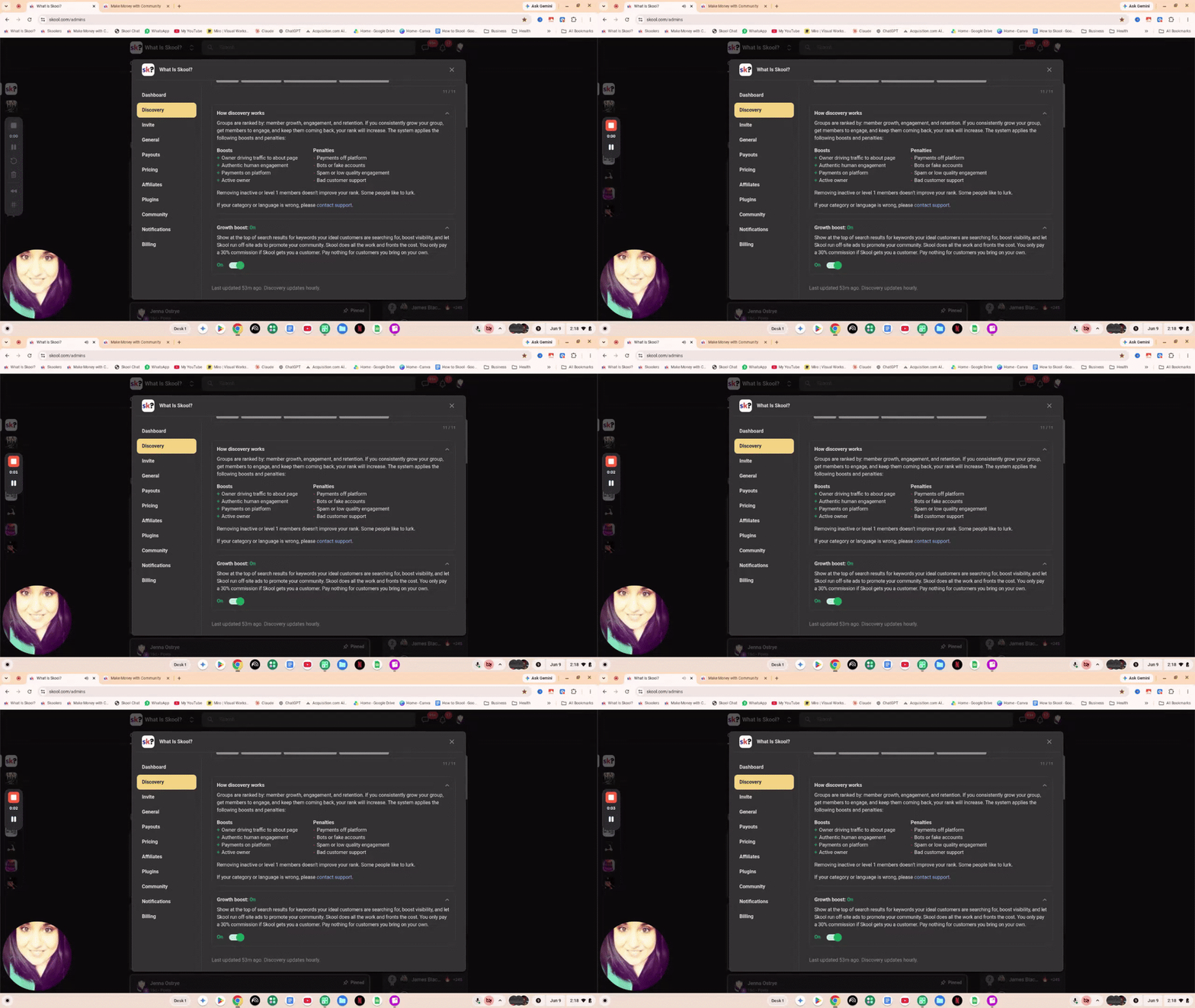
Growth Boost is now available in your group settings and it's turned on by default. BUT it's not active until next week. That means you have plenty of time to click around, read through it, ask questions, and understand how it works before it actually goes live. I've seen a lot of questions already and I'll be answering many of them... ...but I wanted to share one thing right now about the Growth Boost Skool Ads: Skool pays for the ads. Meta decides who gets shown. And if you know anything about Meta, you know it rewards what performs. That's why your cover photo, group description, about page, onboarding, and retention suddenly matter a whole lot more. Because Meta isn't just looking at clicks. It's looking at what happens after the click. Do people join? Do they stay? Do they become customers? The communities that get people to click, join, engage, stay, and spend money are positive signals that are likely to have an advantage. That's exactly why I decided to soft launch Make Money with Community. For the next 30 days, we're going to focus heavily on the things that influence clicks, conversions, engagement, and retention so you're in the best position possible when Growth Boost goes live. I made this video to go over what it looks like in your Group Settings and explain all of this if you want to hear it from me vs read it. 👇 If you have questions, drop them below and I'll do my best to answer them.

1 like • 21d
Thanks for sharing @Jenna Ostrye 🙏🙏
Mar 9 •
The Online Community Show Episode 1 Is Out Now! 🎙️
The first episode of The Online Community Show is officially live. This podcast is focused on real conversations about online communities, community building, trust, traffic, and connection. Not just the biggest success stories, but the full range of experiences from people who are actively building communities right now. In this first episode, @Eric Howell and I introduce the show, share how we met through Skool, and talk about why online communities are becoming one of the most important places on the internet in 2026. Here are a few of the things we get into: • Why social media often feels less social today and why communities are filling that gap • How online communities create real human connection in a world full of AI generated content • The difference between traffic tools and nurturing tools when you are growing a community • Why podcasting can become a long term trust builder for your future members • How overthinking and perfectionism stop people from starting communities or creating content • Why testing, experimenting, and learning together is one of the biggest advantages of communities One of the biggest ideas we talk about in this episode is that people are looking for something real again. When most social media feeds are filled with algorithms, ads, and content from strangers, communities create a place where people can actually talk to each other, build relationships, and learn together. We also talk about something that many creators misunderstand about podcasting. A podcast is not mainly a traffic tool. It is a trust builder. Someone might scroll past dozens of short videos and forget them instantly. But when someone spends thirty to sixty minutes listening to you talk, they begin to understand how you think, what you value, and whether they trust you. That is where communities grow. We already have 3 more episodes recorded with upcoming conversations featuring @Matthew Burns, @Victoria Gallagher, @Artin Asghari, & @Ethan Brits, each bringing a different perspective on building, growing, & running online communities.
3 likes • Mar 9
Thanks for the heads up @Jenna Ostrye 🙏🙏 I have this bookmarked, so I can watch when time allows.
2 likes • Mar 10
@Jenna Ostrye thanks 😊 🙏 I appreciate the way you keep pouring 🫗 out the value bombs 💣
Feb 11 •
Is AI Recommending You? Live Call on Friday with Matt Burns 🔥
AI is becoming the new search engine. People are not just typing into Google anymore. They are opening ChatGPT, Gemini, Grok, Claude, Perplexity, and asking real questions about problems they want solved. They are asking about strategies, tools, mistakes, comparisons, and recommendations. That means they are asking about solutions you likely already provide. If your content is clear and accessible, it has a chance to be surfaced when those questions are asked. If everything is hidden or buried, it cannot be referenced. This is an actual behavior shift in how people search and how they make decisions. We ran out of time on our last live call, so we are continuing it this Friday! Add it to your calendar if you want to be there live: Is AI Recommending You? Friday at 3:30pm CST In this session, @Matthew Burns is sharing updated 2026 learnings on AI discoverability and what he is seeing in real time from his own website being analyzed by ChatGPT and other AI tools hundreds of times per day. He is breaking down what that actually means for your visibility and what you should be paying attention to right now. It's not about IF your audience is searching.. they are. It matters if you're one of the answers being given to them. Whether you have a private or public community this information can be applied. Quick note: I will be getting back to the previously mentioned posts in this public community series. A piece of tech broke here and I am waiting on a package to arrive so I can finish everything properly. We are not skipping it. Just adjusting timing. 👇 Did you see the first call Matt did for us back in July? (You can see it here.)
Poll
20 members have voted

5 likes • Feb 11
Thanks for the heads up @Jenna Ostrye 🙏🙏
Feb 9 •
Why the Skoolers Community Uses Vague Rules on Purpose
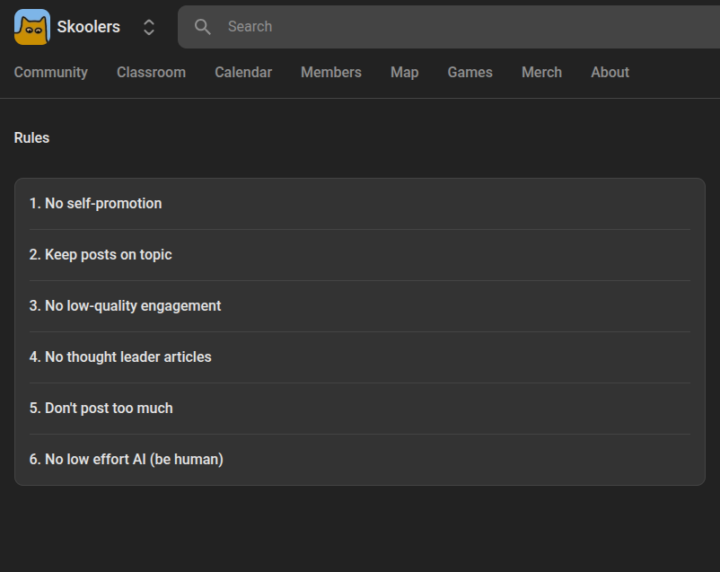
I’ve been asked this directly and I’ve also seen a lot of people asking it publicly. Why are the Skoolers community rules vague? Some people are totally fine with it. Others really dislike it. Both reactions are okay. Some people prefer things extremely clear with exact limits. Some are used to platforms where everything is spelled out. Others have been part of large communities before and already understand why vague rules exist in the first place. Here’s the part that matters and why I now strongly recommend vague rules… even for smaller communities. Hard rules create loopholes. Vague rules create better communities. The moment you introduce hard limits, people naturally want to reach those limits. Instead of looking at the intention of a post, it turns into “does this technically fit in the guidelines?” It even takes away from something that makes a community really wonderful. If a community like Skoolers spelled out exactly what a good post is and what a bad post is, we might never see some of the creativity that comes from someone trying something out. From experimenting. From sharing something that wasn’t done before that ends up being genuinely good. Vague rules leave room for that. They also mean that as moderators and admins, we end up having a lot of conversations. We look at patterns. We make decisions based on context instead of black and white rules. Sometimes there is a new person who is just trying to fit in. A post might technically be questionable, but the right response is to welcome them and guide them. Other times someone is new and blatantly self promoting, which clearly is not allowed. In that case, we can redirect and still welcome them without letting the behavior continue. Those situations look similar on paper but they are very different in reality. Vague rules allow for that distinction. They also protect against bad actors. An example that Andrew Kirby shared explains this well. If people were told they would not be prosecuted for stealing things under $50, you would immediately see people stealing things up to $49. The clear rule creates the behavior.
Poll
49 members have voted
3 likes • Feb 10
@Jenna Ostrye 😆😂🤣
Feb 4 •
Should You Have a Public Skool Community or a Private One? 🤔
There is no "one-size-fits-all" answer to this question, and I think that is why so many people feel unsure about what to choose. Most people are trying to make this decision based on what they think they “should” or are “supposed” to do, instead of what actually makes sense for their niche, their goals, and the type of community they want to build. Including whether they even have a real plan for getting members. 👀 And a big part of the stress around this choice comes from thinking it is final. Like once you pick public or private, you are locked into it forever. That is not actually how I look at it. 🤷♀️ You have way more flexibility than you think. You are allowed to test. You are allowed to change your mind. You are allowed to treat this like an experiment and collect real data instead of trying to make the perfect decision upfront. Whatever you choose is going to show you how people actually respond. What they engage with, what they ignore, and what needs to change. Don't forget to track it! ✍️ You have way more flexibility than you think. In fact, you should be testing. You should be changing your mind when you get more information. And if you needed someone to tell you, you are allowed to have more than one community serving different purposes. Especially if one of them is meant to help you get discovered. It does not have to be complicated or add a "massive" amount of work. Because I will tell you one big myth that is still floating around out there.. you know the one.. "If you build it, they will come." No. 😐 That is not how it works. So much good work never gets seen. Not because it is bad. Not because the person is not smart or capable. But because nobody ever sat them down and said the simple truth. You have to get traffic. * hello * Please read that again.. PLEASE! lol This is not me trying to sell you on a traffic package. Yes, I have found people that can help you like @Eric Howell and his upcoming Free community Traffic Lounge and then even @Matthew Burns with his ProveWorth community that is essentially the community Trust Pilot or Yelp. Two people I trust a lot, because I know traffic is needed for you to even get the business help.
Poll
37 members have voted

5 likes • Feb 4
@Dave Sheridan please 🙏 keep us posted 📫 🙏
1-10 of 27

@ted
Helping people in retirement or wanting to be, eliminate worry and gain peace of mind.
DM me “CASHFLOW” 🤑 for a link to our FREE course & community.
Online now
Joined May 13, 2025
Colorado
Powered by