Activity
Mon
Wed
Fri
Sun
Sep
Oct
Nov
Dec
Jan
Feb
Mar
Apr
May
Jun
Jul
Aug
What is this?
Less
More
Owned by Stephen B.
A curated menu of courses, content, and tools for creators and solopreneurs; explore, choose what fits, and move forward with clarity.
Stephen B. Henry’s "Your Pathway To Growth" community is a calmer, safer place for learning A.I. through natural conversation and guidance.
Memberships
Skoolers
161.4k members • Free
Tools For Motivation Community
2.7k members • Free
IN SESSION
8 members • Free
Phoenix Rising
20 members • Free
Promotion Hub
88 members • Free
Skool Network 💲💰📈💰💲
150 members • Free
The SKOOL Directory
905 members • Free
the skool CLASSIFIEDS
2k members • Free
Skool Nexus
223 members • Free
46 contributions to KDP Publishing

🔥
18h •
🎬 The Conversational Age #2
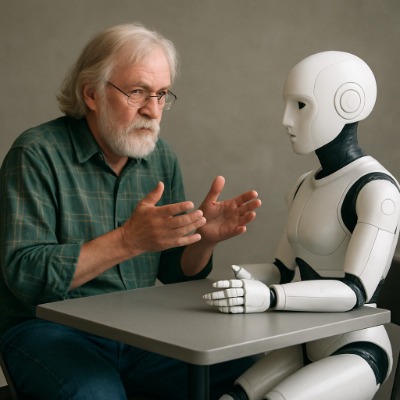
The End of Prompting When people first began experimenting with conversational artificial intelligence, one word quickly rose to prominence. Prompt. It became the centerpiece of countless videos, courses, ebooks, and online discussions. Entire libraries of "perfect prompts" appeared almost overnight. Social media filled with collections of prompts for marketing, blogging, programming, business planning, and nearly every other imaginable task. The message was simple. If you could learn to write the perfect prompt, artificial intelligence would produce the perfect answer. It was a reasonable conclusion. After all, every new technology develops its own vocabulary. Early computer users memorized commands. Search engines rewarded carefully chosen keywords. Websites depended upon precise navigation. It seemed natural to believe that conversational A.I. would also require mastering a specialized language. For a time, it did. Those early prompts served an important purpose. They helped people discover what artificial intelligence could do. They introduced concepts such as assigning roles, defining audiences, specifying tone, and requesting particular formats. Good prompts often produced noticeably better results than vague instructions. They were, and still are, useful. But they were never intended to become the destination. They were the bridge. The real destination is conversation. There is an important distinction between the two. A prompt is typically a single instruction. It asks for an answer, a list, an outline, or a completed task. Once the response arrives, the interaction often ends. A conversation is different. A conversation grows. It asks follow-up questions. It explores alternatives. It revisits earlier ideas. It changes direction when something unexpected appears. It allows understanding to develop over time. Think about how you would work with an experienced colleague. You would not spend an hour carefully crafting one perfect instruction, deliver it, and then walk away. You would discuss the project. You would clarify your objectives. You would explain what had already been tried. You would consider new possibilities together. Most importantly, each exchange would build upon the last.

🔥
2d •
🎬 The Conversational Age #1
Welcome to the Conversational Age There are moments in history when the world changes so gradually that few people notice until they look back years later. The shift from horse-drawn transportation to the automobile did not happen overnight. Neither did the transition from handwritten letters to email, or from libraries to search engines. Looking back, each seems obvious. Living through them was another matter entirely. I believe we are living through another of those moments. Artificial intelligence is often described in terms of technology. We hear about larger models, faster processors, impressive benchmarks, and astonishing capabilities. While these developments are certainly important, they are not, in my opinion, the most significant part of the story. The real revolution is not taking place inside computers. It is taking place in conversations. For decades, we have become accustomed to communicating with technology in very rigid ways. We clicked buttons. We filled out forms. We memorized commands. We learned search syntax. We typed carefully chosen keywords into search engines, hoping they would return the information we needed. Success depended upon learning the language of the machine. Today, for the first time, the machine is learning the language of people. That is a profound change. Instead of asking, "Which button do I press?" we ask, "Can you help me understand this?" Instead of searching for isolated facts, we explore ideas. Instead of issuing commands, we begin conversations. It sounds simple, almost ordinary, yet it changes everything. Throughout history, every major advance in communication has expanded human capability. Writing allowed knowledge to survive beyond memory. Printing allowed ideas to spread across continents. The telephone connected voices separated by great distances. The Internet connected billions of people to information. Conversational artificial intelligence introduces something different. It allows us to interact with knowledge itself in a way that feels natural, dynamic, and collaborative.

🔥
1 like • 2d
Thank you, @John Elcik, for your detailed response. I am working on part 2 and should have it posted shortly.

🔥
8d •
🎬 What If You Could Watch a Memoir?
What if your memoir wasn't just something people read... What if they could experience it? As I write my memoir, I Escaped Hollywood, Barely, I'm experimenting with a new form of storytelling. Alongside the written chapters, I'm creating short cinematic AI scenes inspired by key moments in the book. Imagine reading about modeling in Japan during the 1980s, then watching a visual scene that captures the emotion, atmosphere, and energy of that chapter. Or stepping onto a Hollywood movie set before turning the next page. The book remains the heart of the story. The visuals simply invite readers deeper into it. I'm not replacing memoir writing—I'm exploring how technology can enhance the storytelling experience while staying true to real memories. I'm excited to see where this journey leads and how it might inspire other authors to think beyond the printed page. If you could watch scenes from a memoir, would it make you want to read the book even more? 📖🎬✨ Memoir Skool

🔥
2 likes • 8d
@Cristal Vancarson I love this. Now, imagine a new structure to tie all of these bits and pieces togehter over multiple platforms and even across time. Imagine...
🔥
13d •
║▌║█║▌│║ Sunrise 2027 #5
The Opportunity Beyond Retail When I began this series, I suggested that Sunrise 2027 is one of those quiet technological revolutions that most people will not notice until it has already become part of everyday life. After exploring the technology, I believe that observation is even more true than when I first wrote it. At first glance, Sunrise 2027 appears to be about replacing one type of barcode with another. It is not. It is about changing the relationship between physical objects and digital information. For more than fifty years, the barcode has answered a single question. "What product is this?" The answer was usually a number, nothing more. Everything else depended on a database somewhere else. The next generation answers a much richer question. "What can this product tell us about itself?" That may seem like a subtle difference, yet it changes almost everything. Throughout this series we have looked at safer product recalls, better inventory management, reduced food waste, product authentication, and richer consumer experiences. Those are important developments, and they will reshape retail in ways most shoppers may never consciously notice. Yet I suspect the most interesting opportunities lie outside the grocery store. Knowledge has become one of the world's most valuable products. Books. Courses. Training manuals. Memberships. Printed workbooks. Conference materials. Research reports. Educational games. Even a simple business card. Each represents knowledge packaged into a physical form. Until now, that knowledge has largely been frozen at the moment it was printed. An author finishes a manuscript. A coach prints a workbook. A consultant delivers a report. An educator creates a course manual. From that moment forward, the printed material remains exactly as it was, even while the ideas continue to grow. Imagine a different future. A reader purchases a book and, with a single scan, discovers new chapters, updated references, companion videos, or an invitation to join an online discussion.

🔥
1 like • 13d
@John Elcik, thank you for your comments. Sincerely. You make the effort of a five article series like this one fully worth it!
🔥
1 like • 13d
@John Elcik I will be posting all five articles in my Skool Cafeteria community classroom Members' Private Blog so it will remain accessible. I am likely to put it into printed format as well. If only there was something that would extend the static nature if a PDF into a future conversation... 😉 😉
🔥
14d •
🎬 A Milestone in My Publishing Journey
Today I finished a 46-second cinematic short inspired by one chapter of my memoir, I Escaped Hollywood, Barely. Movie Night at the Mansion Watching a scene that once existed only in my memories come to life has been an incredible experience. Between AI, storytelling, and filmmaking, I'm discovering new ways to share my journey long before the book reaches readers' hands. I'm especially grateful to @Krista Brea for helping guide me through the publishing process. Writing a memoir is one thing—learning how to publish it well is another—and I'm thankful to be learning from someone who understands the journey. This project has reminded me that a book doesn't have to stay on the page. It can become a visual experience that draws readers into the story. I'm excited to keep creating these cinematic moments as I continue writing and preparing my memoir for publication. Thank you to everyone in this community for the encouragement and support. Every chapter brings me one step closer to holding my book in my hands. 📖🎬✨ Memoir Skool

🔥
1 like • 14d
[attachment]
1-10 of 46
🔥
@stephen-b-henry-9359
WordPress Wizard & Coach's Coach: instructor, guide, mentor on your journey of success. The time to hire your guide: before you get lost in the woods!
Active 13m ago
Joined Apr 14, 2026
Powered by