Activity
Mon
Wed
Fri
Sun
Aug
Sep
Oct
Nov
Dec
Jan
Feb
Mar
Apr
May
Jun
Jul
What is this?
Less
More
Owned by Sopuru
A community for complete beginners ready to break into CYBER SECURITY, no experience, no tech background, no overwhelm required
Memberships
GetFit-With-Diana
2 members • Free
Skoolers
166.6k members • Free
4 contributions to Cybersecurity Training

Apr 11 •
The "Pro" Toolbox
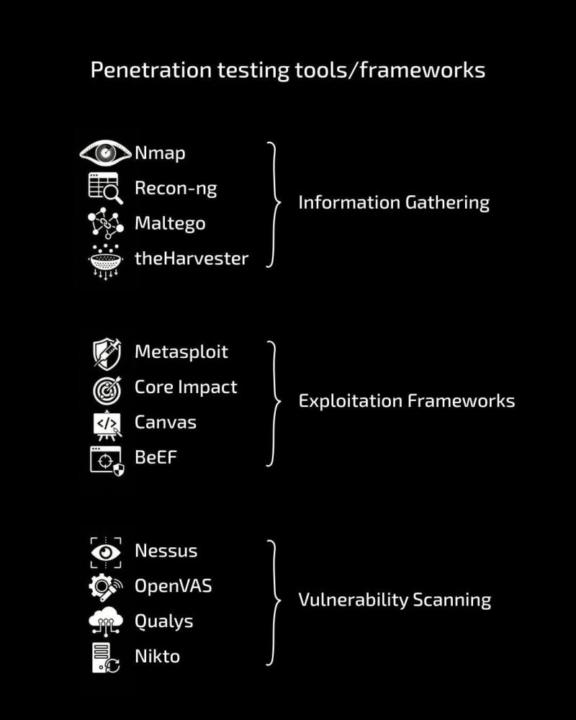
Essential Penetration Testing Tools The Industry Standards Every Professional Should Know In today’s rapidly evolving digital landscape, cybersecurity and ethical hacking are critical for protecting sensitive data. Penetration testing (or "Ethical Hacking") allows organizations to find and fix vulnerabilities before malicious attackers exploit them. Below are the primary tools used by experts across the three main stages of security testing: 1. Information Gathering (Reconnaissance) These tools act as "digital intelligence," collecting data about targets, networks, and infrastructure. - Nmap: The gold standard for network discovery and security auditing. - Recon-ng: A powerful web-based reconnaissance framework. - Maltego: Used for mapping out relationships between people, companies, and networks. - theHarvester: Collects emails, subdomains, and hostnames from public sources. 2. Vulnerability Scanning These scanners act as "security inspectors" to detect weaknesses and misconfigurations. - Nessus: The world's most widely used vulnerability assessment solution. - OpenVAS: A comprehensive open-source vulnerability scanner and manager. - Qualys: A cloud-based tool for identifying security gaps in global networks. - Nikto: A specialized web server scanner that finds dangerous files and outdated software. 3. Exploitation Frameworks Used to simulate real-world cyber attacks to verify if a system’s defenses actually work. - Metasploit: The most popular framework for developing and executing exploit code. - Core Impact: A high-end tool used to test the path of a potential breach. - Canvas: Offers hundreds of exploits for penetration testing and incident response. - BeEF: Focuses specifically on testing the security of web browsers. The Bottom Line Cybersecurity is not just about "breaking" systems—it is about building stronger security for the future. Mastering these tools is the first step toward becoming a professional protector of digital assets.
0
0
Apr 11 •
Learn Cyber security the easy way
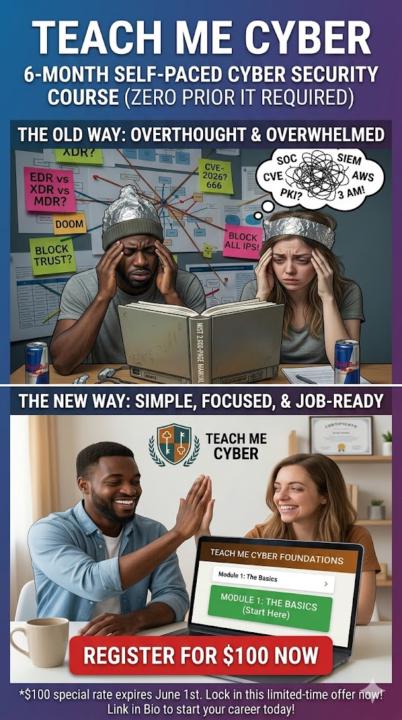
Raise your hand if this is you right now! 🙋🏾♂️🙋🏼♀️ When you decide to start a career in Cyber Security, the internet makes it feel like learning a thousand new languages. You look at that 2,000-page NIST framework, and it feels like "3 AM PKI Doom." It's not that hard. It's just being explained wrong. At Teach Me Cyber Foundations, we made this course for you, not for tech geniuses. We cleared the jargon, simplified the labs, and created a straight, step-by-step path from Zero to a job-ready foundation in 6 months.Stop overthinking. Start learning.$100 to build your future. The deadline to lock in this price is June 1st.
0
0
Apr 9 •
All about Networking
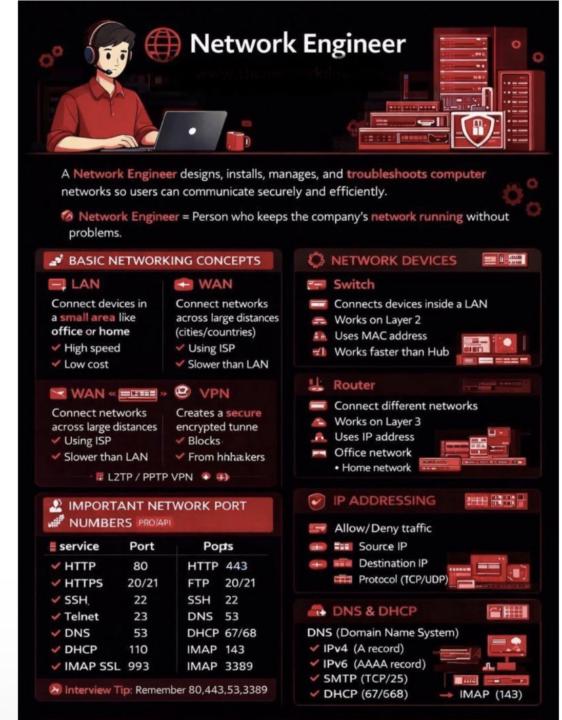
Networking- Network Engineer A Network Engineer is responsible for designing, installing, managing, and troubleshooting computer networks so that devices can communicate with each other securely and efficiently A LAN is a network that connects devices within a small geographic area such as a home, office, or school. Key characteristics: - Covers a small area - High speed - Low cost - Devices are directly connected through switches or WiFi Example: Your home WiFi network is a LAN. A WAN connects multiple LANs over large distances such as cities, states, or countries. Key characteristics: - Covers large geographic areas - Uses an Internet Service Provider (ISP) - Slower than LAN Example: The internet is the largest WAN. A VPN creates a secure, encrypted connection over a public network. Key characteristics: - Encrypts data (makes it unreadable to outsiders) - Protects against hackers - Often used on public WiFi or for remote work Protocols: - L2TP - PPTP Network Ports A port is a logical communication endpoint on a device. It allows different types of network traffic to be separated. Think of: - IP address = building address - Port = specific door in that building Important ports to know: Service Port Function HTTP 80 Web traffic (not secure) HTTPS 443 Secure web traffic FTP 20/21 File transfer SSH 22 Secure remote access Telnet 23 Remote access (not secure) DNS 53 Resolves domain names to IP DHCP 67/68 Assigns IP addresses IMAP 143 Email retrieval IMAP SSL 993 Secure email retrieval RDP 3389 Remote desktop access Network Devices A switch connects devices within the same LAN. Key characteristics: - Operates at Layer 2 (Data Link layer) - Uses MAC addresses - Sends data only to the intended device - Faster and more efficient than a hub Router A router connects different networks together. Key characteristics: - Operates at Layer 3 (Network layer) - Uses IP addresses - Connects a LAN to a WAN (e.g., home network to the internet
0
0
Mar 5 •
Welcome
Welcome to Cybersecurity Basics with Sopuru Awuzie From "What’s a Firewall?" to Job-Ready Confidence in 6 Months. Meet Your Instructor: Sopuru Awuzie, MS I don’t just teach cybersecurity; I live it. With over seven years in IT and cyber defense, I’ve navigated everything from desktop support to protecting critical infrastructure. I hold a Master’s degree in Cybersecurity from Southern New Hampshire University, but I know that degrees are only half the battle—practical experience is what gets you hired. I am currently pursuing a second Master’s to become a Board-Certified Behavior Analyst (BCBA). Why? Because the biggest "vulnerability" in any system isn't a computer—it's the human element. My mission is to bridge the gap between human behavior, AI, and digital defense. My Goal for You: I created this course specifically to expand access for students across Africa and beyond who have the talent but lack the expensive resources. I’m here to empower you to become the next generation of global cyber professionals. Why This Course is Different: - 6 Months of Structured Growth: A clear, 24-week roadmap designed for total beginners. - Behavior-Driven Security: Learn not just how hackers work, but why they do what they do. - Practical, Experience-Led Labs: No expensive gear. Use what you have to build what you want. - Lifetime Access for $100: My commitment to making world-class education affordable. Your First Mission (The Icebreaker) Before we dive into Module 1: Real Hacks Happening Now, I want to meet the team. Reply below with: 1. The "Why": What’s your name and your "Cyber Dream"? (e.g., "I want a remote career" or "I want to protect my community"). 2. The "Setup": Share a photo of your workspace! Whether it's a dedicated desk or a phone setup—show us where you'll be crushing these goals. 📸 3. The "Fun Fact": What’s your favorite movie or travel spot? (I love sharing my travel vibes on TikTok!) The 180-Day Transformation Starts Today.
1
0

1-4 of 4

@sopuru-awuzie-2970
I help beginners break into cybersecurity with clear, step-by-step training. Learn the skills, tools, and mindset needed to start your tech career.
Active 5h ago
Joined Mar 5, 2026
Texas