Activity
Mon
Wed
Fri
Sun
Aug
Sep
Oct
Nov
Dec
Jan
Feb
Mar
Apr
May
Jun
What is this?
Less
More
Memberships
Black Ops Biohacking
83 members • Free
17 contributions to Black Ops Biohacking
4d •
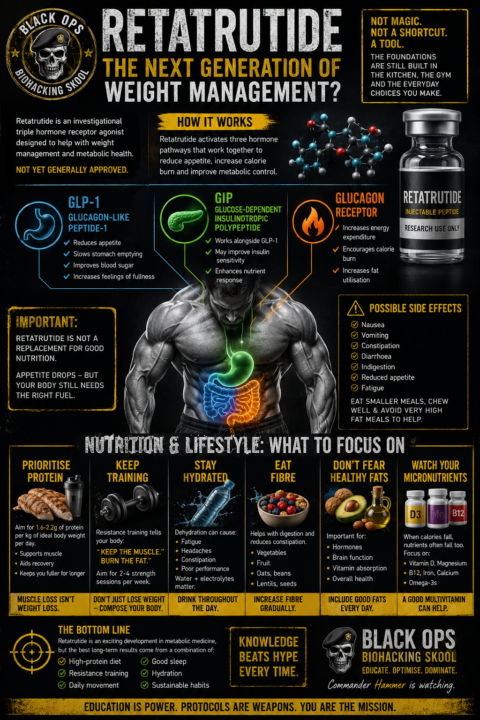
Retatrutide: The Next Generation of Weight Management?
Retatrutide is one of the most talked-about peptide medications currently being investigated for obesity and metabolic health. Although it is still undergoing clinical trials and has not yet received general regulatory approval, the results seen so far have generated enormous interest. So what makes it different? How Does Retatrutide Work? Unlike first-generation medications that work on a single pathway, Retatrutide activates three different hormone receptors involved in appetite and metabolism. These are: GLP-1 (Glucagon-Like Peptide-1) - Reduces appetite - Slows stomach emptying - Helps improve blood glucose regulation - Increases feelings of fullness GIP (Glucose-Dependent Insulinotropic Polypeptide) - Works alongside GLP-1 - May improve insulin sensitivity - May help enhance the body's response to nutrients Glucagon Receptor - Increases energy expenditure - Encourages the body to burn more calories - May increase fat utilisation The combination of all three pathways is why many researchers believe Retatrutide could become one of the most effective weight-management medications developed to date. But Here's the Important Part... Retatrutide is not a replacement for good nutrition. In fact, eating properly becomes even more important because appetite often falls dramatically. Many people simply stop eating enough, which can create a whole new set of problems. Prioritise Protein Protein should become the foundation of your diet. Aim for approximately: 1.6-2.2g of protein per kilogram of ideal body weight per day Good choices include: - Chicken - Turkey - Lean beef - Fish - Eggs - Greek yoghurt - Cottage cheese - Whey protein - Plant proteins if preferred - Adequate protein helps support: - Muscle maintenance - Recovery - Satiety - Healthy metabolism - Remember... Weight loss is great. Muscle loss isn't. Keep Resistance Training One of the biggest mistakes people make whilst losing weight is relying solely on the medication.

1 like • 3d
Ive been on a micro dose of Retatrutide 2.to2.5 mg weekly and that has proven much more effective at enabling food noise reduction but also maintaining a good appetite for the right foods.
Jan 16 •
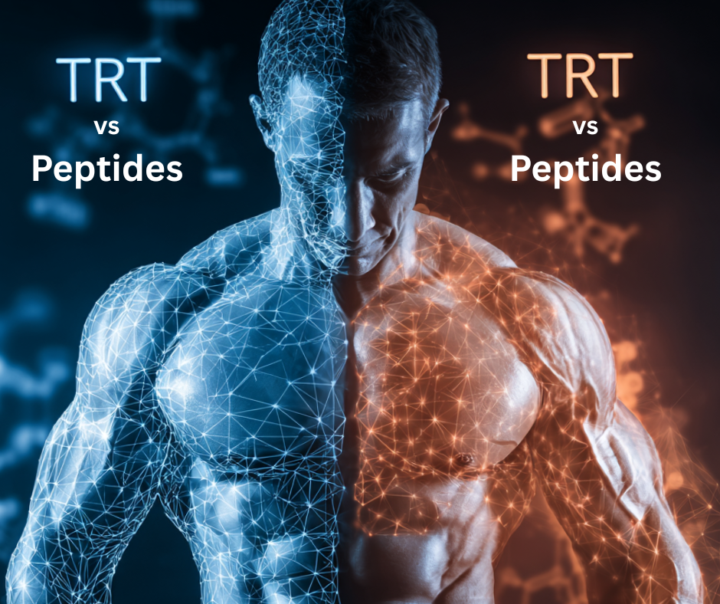
TRT or Peptides?
A big Question! Lets get into it Based on the sources, peptides and traditional hormone replacement therapies (HRT) differ primarily in their mechanism of action, their impact on natural hormone production, and their risk profiles. While traditional HRT directly replaces missing or declining hormones, many therapeutic peptides work by stimulating the body's natural systems to produce its own hormones. 1. Stimulation vs. Replacement Traditional hormone therapy involves the administration of exogenous hormones, such as testosterone or growth hormone, which directly enter the bloodstream. In contrast, a major category of peptides known as secretagogues (such as Ipamorelin or Sermorelin) signals the body's own glands—specifically the pituitary—to release its natural hormones. • Physiological Pulsing: Traditional growth hormone therapy "bleeds" into the system constantly, which is not how the body naturally operates. Peptide secretagogues allow the body to release hormones in natural, physiologic pulses, which the body is better equipped to handle. • Isoforms: While synthetic growth hormone typically contains only one isoform (repair-focused), natural production triggered by peptides can release various isoforms depending on whether the body needs immune regulation, muscle repair, or stress management. 2. Preservation of Natural Production A significant advantage of peptides over traditional HRT is the avoidance of the negative feedback loop. • HRT "Shut Down": Direct hormone replacement can often cause the body to stop its own endogenous production. For example, long-term testosterone use can lead to a loss of fertility as the body ceases sperm production. • Peptide "Swim Lanes": Peptide therapies generally do not shut down natural production. They work within the body’s existing "swim lanes," meaning you do not typically develop a central nervous system dependency or permanent alteration in physiological function. 3. Safety and Side Effects The sources suggest that peptides often have a more limited risk profile than traditional pharmaceuticals or synthetic hormones.
0 likes • Jan 16
Im currently experimenting with ipamorelin, testosterone and enclomiphene. It's early days but i will keep the squad informed on my progress
Sep '25 •
Arms and shoulder workouts please
Can I have a full arm and shoulder workout please including brachialus and forearm?. Shoulders are looking ace but need the rest to create a full build. Need to start small and work up.
2
0
Aug '25 •
Get your recovery and fat burn supplements now.
The little Supplement Company now has fresh stock of bpc157, tb500 ( the wolverine blend) skibbidy sigma, great fat burner, and methylene blue capsules, great for mitochondrial repair and nutrient absorption. Get in quick guys this stuff sells out fast.
4
0
Aug '25 •
Bank Holiday Shoulder Sesh!
Pre-Mission (Fuel): · 1 scoop Pre Workout “Smash It Up” 20 min pre; Swole Creatine — 5 g/day (any time). Hydrate + electrolytes. Supplement Support (optional): · Swole Creatine — 5 g/day for ATP output and faster recovery. · Freak of Nature (Natty) per label (AM/PM)… · Electrolytes and EAA's intra-workout… Everything else in the Black Ops Shoulder Giant-Set Gauntlet stays exactly the same—execute and enjoy the sleeve-splitting pumps. BLACK OPS SHOULDER GIANT-SET GAUNTLET 45–60 min • Sleeve-splitting volume • Zero fluff—just insane pumps and dense growth. Pre-Mission (7–10 min) - Band pull-aparts ×30 - Scap wall slides ×15 - Cable external rotations ×12/side - Light rope face pulls ×20 (2 sets) GIANT SET A — LATERAL DELT DOMINATION (3–4 rounds) No rest between exercises; 90 sec only after the full circuit. 1. Seated DB Lateral Raise — 15–20 reps @ 2-1-2 tempo (pause 1s at peak) 2. Lean-Away Cable Lateral — 12–15/side (constant tension, pinky slightly higher) 3. Machine/DB Partial Laterals (mid-range) — 20–25 reps (short, fast pulses) 4. Smith or DB Overhead Press — 8–10 reps @ 3-0-1 (controlled, elbows under wrists) 5. Rope Face Pull (high to eyes) — 15–20 reps (externally rotate hard) 6. Cue: Shoulders down & out, lead with elbows on laterals. Chase the burn but keep form surgical. GIANT SET B — REAR DELT & SCAP ARMOR (3 rounds) No rest between; 90–120 sec after the circuit. 1. Reverse Pec-Deck — 15–20 reps @ 2-1-2 2. Chest-Supported Rear-Delt DB Swings — 20 reps (light, top half) 3. High Cable Row to Face — 12–15 reps (elbows flared, squeeze 1s) 4. Arnold Press — 10–12 reps (arc smooth; don’t jam shoulders) 5. Prone “Y-Raise” on Incline — 12–15 reps (thumbs up, strict) Cue: Think “spread the floor with your shoulder blades.” Rear delts drive; traps assist, not lead. FINISHER — MECHANICAL DROP SEQUENCE (2 rounds) Minimal rest; empty the tank. 1. Seated DB Shoulder Press — 10–12 reps→ immediately into 2. Seated DB Lateral Raise — 12–15 reps→ immediately into 3. DB Partial Laterals — 20–25 reps→ finish with 4. Isometric Hold — 20–30 s at ~90° abduction

0 likes • Aug '25
After a successful arm workout I will be attempting this on Saturday. I will keep you posted
1-10 of 17
@simon-hewitt-2331
Simon (The Kemist). Experienced in use of Sarms and Supplement.
Active 3d ago
Joined Aug 12, 2025