Activity
Mon
Wed
Fri
Sun
Jul
Aug
Sep
Oct
Nov
Dec
Jan
Feb
Mar
Apr
May
Jun
What is this?
Less
More
Owned by Sherry
The Ripple Effect Community: a support and education platform designed to center the experiences of biological siblings within adoptive families.
Memberships
Community Builders - Free
11.2k members • Free
Skoolers
174.3k members • Free
The Table for Adoptive Parents
22 members • Free
18 contributions to The Ripple Effect Community

17h •
"The Sky Doesn't Ask Permission to Change."
Some evenings, the sky reminds us that change is rarely quiet. Tonight's clouds didn't ease into color. They burned into it, fast and wide, covering everything in sight. And yet, underneath all that motion, the shoreline stayed steady. The palms bent in the wind. The sand kept its shape. That is what ripple effects often look like in families touched by adoption. The sky changes. The emotional climate shifts in ways no one announced or asked permission for. And the people standing in it, especially the children already there, are left finding their footing in a landscape that suddenly looks unfamiliar. We talk often about the adoptee's experience, and rightly so. But today we are thinking about everyone standing on that same shoreline: the biological children who watched their family's sky change color too, often without anyone asking how it looked from where they stood. Their footing matters. Their experience of the shift matters. Because the ripple moves through all of them.
0
0

4d •
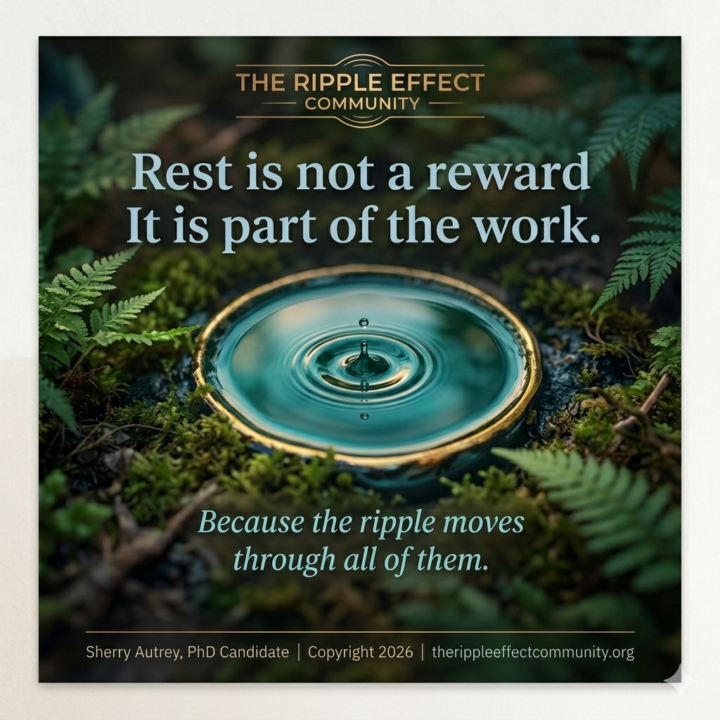
On Rest, and the Families Who Forget to Take It
There is a story many of us carry quietly: the idea that rest has to be earned. For those who have navigated adoption, family transitions, or the kind of change that reshapes everything around you, rest can feel almost forbidden. Like stopping means falling behind. Like exhaling means you have forgotten what you are carrying. But here is what the research on family systems and caregiver wellbeing keeps showing us: the people who give the most are often the ones who protect rest the least. Rest is not a pause from the work of showing up for your family. It is the work. Whether you are a biological sibling who grew up beside an adoption, a parent navigating a blended or adoptive family, or someone whose family story is still unfolding, you deserve permission to stop. Not when things are settled. Not when everyone else is okay. Now. The ripple moves through all of them. That includes you. Drop a word in the comments that describes what rest looks like for you today. Because the ripple moves through all of them.
0
0
13d •
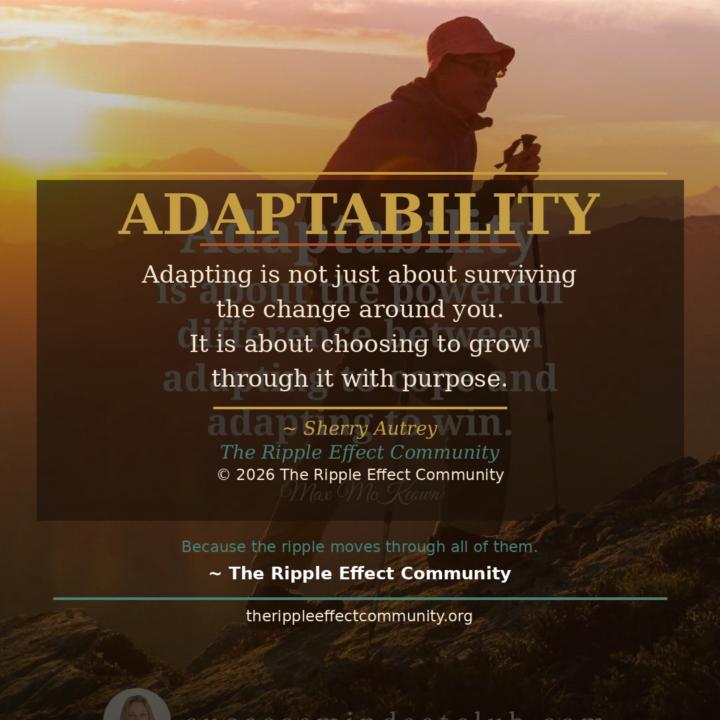
Adaptability
“Adapting is not just about surviving the change around you. It is about choosing to grow through it with purpose.” — Sherry Autrey | The Ripple Effect Community Adaptability is one of the most misunderstood strengths in family systems. We often equate it with simply getting through hard seasons. But survival and growth are not the same thing. In adoptive families, every member of the system is called to adapt at some level. Biological children adapt to shifting birth order roles. Parents adapt to expanding attachment demands. Adoptees adapt to new identities, new histories, and new bonds. Research grounded in Bowen Family Systems Theory and Adlerian birth order frameworks consistently shows that how a family navigates these transitions collectively shapes outcomes for every individual within it (Bitter, 2022; Kerr, 2023). The ripple does not wait. It moves the moment the family grows. What we choose to do with that movement is where the real work begins. Are you surviving the ripple or growing through it? #TheRippleEffectCommunity #Adaptability #AdoptionAndFamily #FamilyDynamics #BirthOrder #FamilySystems #TraumaInformedCare #AdoptionResearch #PublicHealth #BecauseTheRippleMovesThrough Because the ripple moves through all of them. Sherry Autrey therippleeffectcommunity.org © 2026 The Ripple Effect Community | Published by Sherry Autrey, PhD Candidate | All rights reserved
0
0
18d •
Am I Being Seen or Unseen?
There’s a conversation happening everywhere I look, and it never stops. Everyone is talking about healing about the children who came into our homes carrying wounds too heavy for their small frames. I believe in that conversation. I have sat beside my sibling through the hard nights and watched my parents learn a whole new language of love. But somewhere in all of it, my own story got folded quietly into the background, like a thread pulled so far into the weave that no one thinks to look for it anymore. Not even me, sometimes. I want to begin with what’s good, because there is so much good. I have watched my family grow in ways I never expected. I have seen my parents stretch themselves open, choosing love on the hardest days. I have felt proud of them. I have felt proud of us. The work our family has done is real and it matters, and I carry something close to gratitude for what adoption has taught all of us about grace. And yet. I was already here when the family changed. I had a place at the table, a birth order, a role I understood. I knew where I fit. And then the structure of everything shifted, and I was asked — not in words, but in the way families ask things without ever saying them — to be steady. To be easy. To need less, so that someone who needed more could have it. I understood. I still understand. But understanding a thing does not mean it leaves no mark. • • • What gets lost in the telling is this: I did not come through those years unchanged. The adjustment was not only my sibling’s. The trauma that arrived in our home moved through all of us, and it moved through me in ways quiet enough to go unnoticed. My needs did not disappear because they were smaller. My grief was real, even when it had no obvious name. I was not abandoned, not neglected, not harmed in any way the world has a word for. I was simply… unseen. And there is a particular kind of loneliness in being the child who is fine, in a house where so much energy is rightly going somewhere else. It is not a dramatic loneliness. It does not announce itself. It settles in gradually, the way a room cools when no one notices the window has been open all night.
0
0

22d •
When a Family Grows Through Adoption, Everyone Feels the Ripple — Especially the Biological Siblings
We talk a lot about adoption. We talk about the adoptee's journey, the parents' love, the legal process, the waiting, the placement. We talk about the joy of a family being made. And all of that matters deeply. But there is a group of children who rarely make it into that conversation. They were already there already sleeping in that house, already calling those parents "Mom" and "Dad," already settled into their place in the family before everything shifted. They are biological siblings. And when adoption happens, their world changes, too. The Disruption of Birth Order Birth order is one of the most enduring frameworks in developmental psychology. Alfred Adler first described how birth position shapes a child's personality, sense of self, and relational patterns and that research has held up through decades of study. When a new child enters the family through adoption, birth order doesn't just expand. It disrupts. An oldest child may suddenly find themselves in the middle. A youngest child may lose the attention and closeness they had always known. Roles that felt stable caretaker, peacemaker, the funny one, the responsible one are quietly renegotiated without anyone formally acknowledging it. What the Research Tells Us What does that do to a child? Research grounded in family systems theory, attachment theory, and trauma-informed care tells us it can be significant. Some biological siblings experience grief real grief over the family they knew before. Others take on parentified roles, trying to hold the emotional center of a home that feels tilted. Some act out in ways that get labeled as behavioral problems, when what they are really expressing is confusion, loss, and a desperate need to be seen. These children are not ungrateful. They are not selfish. They are not "the easy ones." They are children navigating one of the most complex family transitions a household can experience and they are doing it largely without a roadmap, without language for what they are feeling, and without a community that is paying attention to them.
0
0

1-10 of 18

@sherry-autrey-1875
Phd Student at Walden University in the Community Public Health program. I am also an adoptee,adopter,and grandparents raising grandchildren.
Active 17h ago
Joined Apr 14, 2026
Melbourne Florida