Activity
Mon
Wed
Fri
Sun
Jan
Feb
Mar
Apr
May
Jun
Jul
Aug
Sep
Oct
Nov
What is this?
Less
More
Memberships
Mastering.com Members Club
28k members • Free
The Reverse Engineer
1.7k members • Free
10 contributions to Mastering.com Members Club

Nov 5 •
Headphones and glasses? Advice needed...
Hi guys, it's a simple question but until now I found no good solution. For editing I need both, but thatt's pinching, and therefore distracting. These headphones are non negotiable (fat, heavy and over-the-ears); I'd modify at least the glasses. Any experience, good idea, advice how to deal with it ... would be helpful. Thanks in advance! 🌼

1 like • 25d
I replace all headphone ear pads with soft memory-foam sable earpads from these guys: https://www.brainwavzaudio.com/pages/brainwavz-earpad-guide Here in the tropics, the usual horrible vinyl earpad material makes my head sweat, and it starts peeling off within a year or two. (Sennheiser HD280s are notorious for this!) I have these Brainwavz replacements on all my studio HD280s, my ATHm70s and my studio HD650s. I also wear glasses and I found these very comfortable for prolonged use. I think these guys are Hong Kong based - maybe there's a better alternative in the USA? Regardless, ditch the factory earpads and get softer replacements.
⭐
26d •
New event: The Successful Home Studio
This Thursday, join members from our community as they share their secrets to reaching professional quality in a home studio. This brand new event is called "The Successful Home Studio". Join us live to hear from some of our alumni as they share their best advice for breaking through the intermediate plateau and finding success as a self-recording artist or producer. You'll learn straight from the source from people who were recently in the exact same position as you. This event will also act as an open day for anyone interested in our flagship program, The Reverse Engineer. It's your chance to learn more about how it works, what the day to day is like, the admissions process etc. Plus we'll have a special announcement for Black Friday. The Successful Home Studio takes place on Thursday 13th November, at 7am Pacific / 10am Eastern Time / 3pm UK / 4pm Central European time. Register here: https://courses.mastering.com/event_full/1762513533145x887181225805742100?utm_source=FTMSkool See you there, Rob
0 likes • 25d
Thanks for scheduling this early enough for Asia based students to join!

Oct 3 •
String library session section - what’s best?
I am going to buy a new string library and would appreciate your experience and knowledge to help me make a proper choice. I am NOT looking for a massive cinematic orchestra. More a 14-piece section for performance of string arrangements as we hear them in productions from Nashville or as they were done with Sinatra back in the days and today on albums as the wonderful new country album with Paul Carack. Hoping you are willing to share some ideas!
2 likes • Oct 9
@Mikael Wendt Hi Mikael - then yes, VSL is exactly what you want. Pretty good user community there too - you'll find a plenty of other professionals who are involved in orchestrating and scoring daily. There are lots of tutorials with VSL mockups, including session files, Cubase expression maps etc. so you can take a deep look into how they used MIDI Controllers to bring an arrangement to life.
2 likes • Oct 10
@Ken Crombie I started with VSL a long time ago, using their "dry" libraries, and then started adding their "wet" Synchron libraries. Man, this can got expensive really quick... They've now discontinued the original "VI" player plugin and libraries, and relaunched the series as the "Studio" series. So, I'm still leaning towards 2 paths, which are kinda similar, and the good news is, when you own some VSL and want to expand, you usually wind up with some level of crossgrade discounting, as most libraries will have some overlap with what you already own... These two paths are to start with either the BigBangOrchestra (BBO) series, or the Studio Special Editions. Complete either series and you'll have a complete orchestra, several smaller ensembles, 1st/2nd/3rd/4th chair strings, some solo instruments and generally, the basic articulations you'll need. From here, you can expand to the (discounted) Synchron/Studio libraries when/if you think you'll need more mic positions and way more articulations. BBO is probably the most out of the box, instantly gratifying and ready to blend offering. These libraries already have the Synchron Stage ambience/reverb included. You can create orchestral works with these, but I think they are also the best choice when you're looking to garnish other genres of music with some orchestra. Best thing is, you start with the first BBO library (Altair) and just add expand it with whatever library you want next. It all fits together consistently and seamlessly. The Special Editions lean more towards doing purely Orchestral & Chamber works. They have all the essential sections, essential articulations, techniques, ensembles, more solo instruments, and a few exotic/ethnic instruments. If you suddenly decide your piece need an exotic ancient flute or a solo flugelhorn with every possible articulation, you can buy a solo library that will marry with these libraries perfectly.

Sep 7 •
SSL
Hello Fellow Engineers, I'm curious to know from those using the SSL channel strip plugin which is your favourite and WHY?
2 likes • Sep 8
I started using SSL's own channel strips since I bought their UF1/UF8/UC1 controllers. It makes a huge difference looking at a controller instead of the screen - if definitely shifts the attention to your ears and away from any biases about how much gain at what frequency you 'should' use. The (official) SSL plugins are fine, with the new 4K G plugin adding some interesting tone shaping via the simulated input impedance knob. I'm mostly using the E or G versions. I still use the Plugin Alliance channel strips occasionally too. I particularly like their bx console 4000 E version, especially their unique tiny yellow THD knob feature (looks like a little trim pot under the V Gain knob). I like to add their 4K E to a stereo guitar bus and dial up the THD - it seems to add a nice width to the sound without adding harshness. That's probably the last use case I have that would make me choose this over the SSL brand channel strips. I'm a beta tester for both companies, so I can't/wont publicly speak about anything potentially negative about them. It's important to know that both PA and SSL use some form of inter-plugin communication between instances of their (own) plugins, with the SSL offering some more extensive features via their SSL360 software. You can infer that the more they communicate, the more processing resource they demand from your system.

Aug 12 •
What the heck does this knob do?
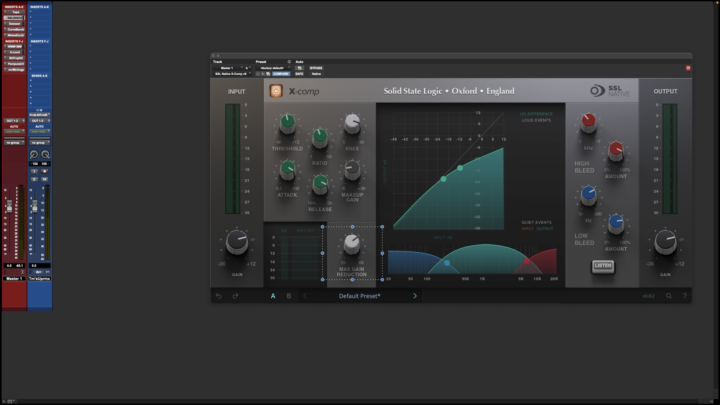
Hey, guys. Could someone please look at the screenshot I attached and tell me, for the love of all that is holy, what this little knob does? I read the user guide, which didn't click. My masters always come out getting louder on the quieter parts of my beats and parts where there are less instruments playing. I randomly mess with this knob and eventually, I find a spot that levels it out. I want to get to a point to where I just know where to set it. The rest of the compressor is no problem, although the bleed section was giving me problems, too, until I read the user guide, but afterwards, that part was a breeze to work. How do I make this "Max Gain Reduction" knob work for me?
1 like • Aug 22
Here's my take on the "why" we have a max gain reduction adjustment... I don't think of compression as dynamics control anymore. I used to, but Gregory Scott from UBK has some great YT videos about compression you should check out. Inherently, compressors change transients. It's often misunderstood, but the threshold sets the point at which compressions starts, attack sets how long it takes to apply the compression ratio... so as it is compressing, it's changing the waveform, and therefore the time at which the peak is achieved. For that reason, I think of compression as "groove" or "feel"... slow attacks can actually make an instrument feel like it's lagging behing the beat a little - often a cool effect for feel, or to help let a snare or kick not get masked by bass instrument. So you might dial in your compressor in such a way as to aggressively grab the attack of an instrument's transients, but with such overall gain reduction, it causes an audible pumping effect. In that case, you can limit the amount of gain reduction caused by your ratio and attack settings, thus minimizing the pumping while keeping the "behind the beat" feel you want. Certainly not the only way to achieve the outcome you want, but it's a handy parameter to have access too. Another thought, since the parameter exists, you can easily automate it. Think of situations where you might want to let a bus or an instrument feel less restrained, or to start/stop pumping in certain song sections - like a chorus... It would be much easier to automate that parameter, than to tweak several others at once to achieve a similar result.
1-10 of 10

@sean-thompson-6683
Played guitar since 1976, with zero fatalities, so far... Audio Software Beta Tester.
Online now
Joined Aug 22, 2023
Thailand
Powered by