Activity
Mon
Wed
Fri
Sun
May
Jun
Jul
Aug
Sep
Oct
Nov
Dec
Jan
Feb
Mar
Apr
What is this?
Less
More
Owned by Dr. Sancian
Experience AI SoftLife—reclaim your time, optimize every task, and transform automation into lasting freedom, focus, flow, and intentional living.
Memberships
AI Power Circle Mastermind
362 members • Free
The Excelheron AI Academy
101 members • Free
Kingdom AI Learning Lab
829 members • Free
Peaceful AI Network 🕊️
63 members • Free
Ai Fueled Profits: Live
4.2k members • Free
AI Automation Agency Hub
312.4k members • Free
The AI Advantage
117.2k members • Free
Growth Hub 365
8.3k members • Free
NarratAI™ AI Academy
77 members • $27/month
6 contributions to The AI Advantage

Mar 18 •
Leadership 101: Learn to manage the applause AND the criticism
Here's the thing nobody tells you about building something real — The applause will make you move too fast. The criticism will make you want to stop altogether. Neither one should be running your decisions. This is especially true when you're learning to use AI in your life and work. The moment you share what you're building, you'll get both: 👏 "Wow, you're so ahead of the curve!" 🗣️ "AI can't replace real skill/connection/creativity..." And if you're not grounded in your own vision, both will throw you off. The applause feels good, but it can push you to perform instead of build. The criticism stings, but it can keep you small if you let it. The leader in you learns to hear both and still move from the inside out. Your AI tools are only as steady as the person using them. That's why we don't just talk tech here. We talk about the inner work that makes the outer work actually land. That's real leadership. That's the work. 👇 Which one trips you up more — the applause or the criticism? Be honest. 👇

1 like • Mar 18
@AI Advantage Team "Polishing the sharp edges off something just to make it more likable." That one hit me, Justin. I've done that more times than I'd like to admit. And you're right. That's usually the giveaway. To your question: both, but they show up differently. In content, the drift is faster and easier to spot. The feedback loop is quick. You post, you feel something off, you learn. In bigger business decisions, it's slower and sneakier. You say yes to an opportunity that looks good on paper but doesn't sit right in your gut. You shape an offer around what you think people will buy instead of what you actually want to deliver. You partner with someone because of their platform, not their alignment. And the regret doesn't hit immediately. Sometimes it takes months to realize you built something you don't want to run. That's why I've learned to pressure test the bigger decisions harder. Content I can course correct. Business architecture is harder to undo. What about you? Do you find the drift shows up differently in those two spaces?
1 like • Mar 18
@AI Advantage Team "Little concessions that stack up until you barely recognize what you built." That's the whole trap right there, Justin. And by the time you see it clearly, you're already deep in it. What's helped me catch it earlier: Scheduled clarity checks. Not waiting until something feels off. I build in moments to ask: "If I were starting fresh today, would I build it this way?" If the answer is no, that's a signal. Not necessarily to burn it down, but to stop adding to something that's already drifting. Trusting heaviness as data. You said it: "the day-to-day starts feeling heavy." I've learned to stop explaining that away. Heaviness usually isn't about workload. It's about misalignment. The work that's aligned can be intense and still feel light. The work that's drifted feels heavy even when it's "easy." Talking to the right people before deciding. Not people who will validate. People who will ask the uncomfortable question: "Is this actually what you want, or just what makes sense?" Still a work in progress. But the earlier I catch it, the less I have to untangle later. This has been one of the best exchanges I've had in this community. Appreciate you going here, Justin. 🙏🏽
Mar 3 •
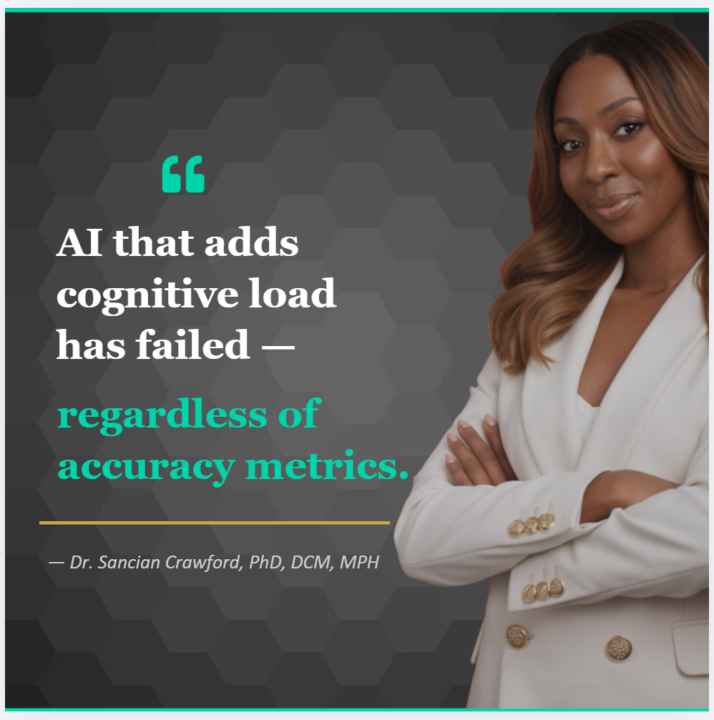
Leaders don't need another AI tool. They need their cognitive bandwidth back.
Everyone is building AI assistants. But here's the question worth asking: - Does your AI wait for instructions or understand the mission? - Does it complete tasks, or triage priorities? - Does it work when prompted, or does it anticipate what you need? The difference isn't capability. It's architecture. What's your benchmark for whether AI is actually helping you lead better?
1 like • Mar 3
@AI Advantage Team Great question. The key sign I look for: decision fatigue going down, not just task completion going up. A lot of AI "helps" by adding more options, more outputs, more things to review. That's not support. That's delegation in reverse. When AI is actually helping a leader think and act more effectively, you'll notice: 1. Fewer decisions that didn't need to reach them in the first place 2. Faster clarity on what actually matters right now 3. More confidence that what's being ignored can safely be ignored If the leader still feels like they have to check everything the AI produces, the AI isn't freeing cognitive bandwidth. It's just shifting where the load shows up. The real benchmark: Can they think better because the AI is in the room? Or are they just thinking more?
Feb 3 •
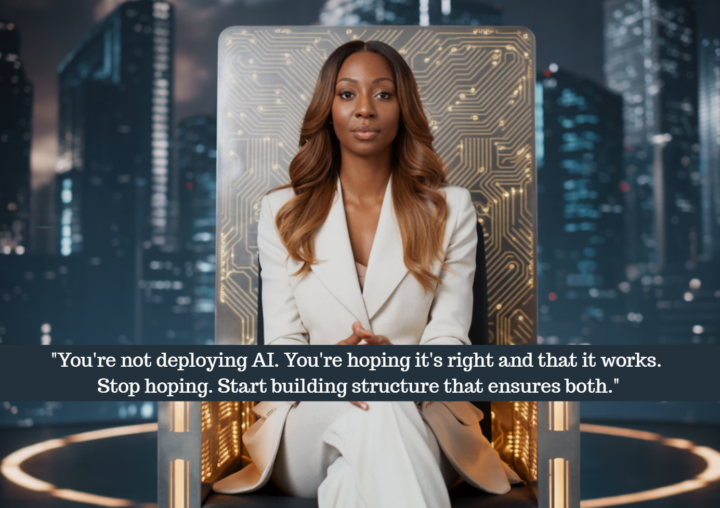
Moving fast with AI isn't the flex. Moving ready is.
Three questions every leader deploying AI should be able to answer: 1. Can your governance tell the difference between AI that advises and AI that executes? 2. Has anyone audited whether your human oversight actually catches errors — or just approves by reflex? 3. If an AI takes an unauthorized action tomorrow, can you trace exactly who authorized it to act? If you're 0 for 3, you're not alone. But you're also not ready. What would you add to this list? 👇🏽
3 likes • Feb 3
@AI Advantage Team Appreciate the team! 🙏🏽 "Moving fast" gets all the hype, but readiness is what separates sustainable deployment from expensive lessons. Grateful to be in a community that values that distinction.
0 likes • Feb 3
@Johnson John rose I'm honored by the invitation. Ethical AI strategy is exactly the space I'm passionate about, and this exchange has surfaced some important questions worth exploring deeper. I'd love to learn more about the panel and the discussion you're envisioning. Let's connect directly to see if there's a fit. Are you on LinkedIn?
Jan 20 •
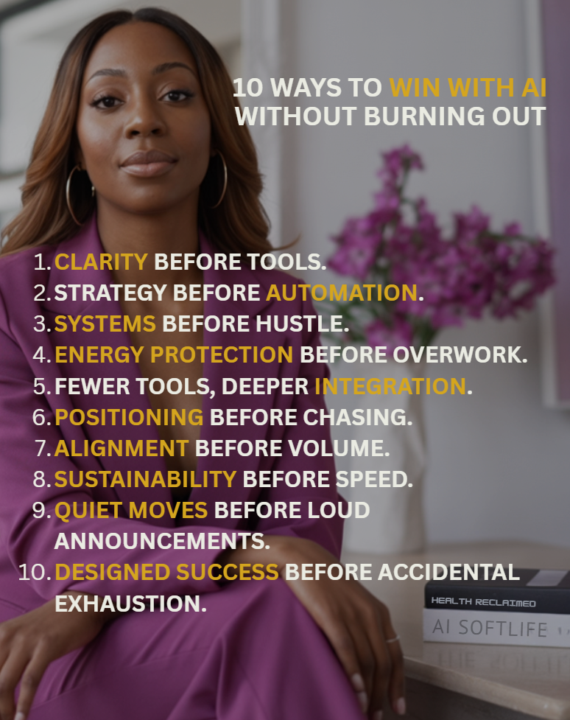
The AI burnout cycle is real.
Learn a tool. Chase the next one. Automate the wrong things. Work harder. Repeat. Here's what I've learned helping leaders build with AI: The ones who win aren't moving faster. They're moving with more intention. Clarity before tools. Strategy before automation. Systems before hustle. This isn't about doing less; it's about designing better. Which of these 10 do you need to prioritize most right now?
1 like • Jan 24
@Kiana Raymond Kiana, I have to say, this exchange has been one of the highlights of my week. The depth of your questions is rare. Thank you for engaging like this. 🙏🏽 As for the best way to introduce someone to my work? Honestly, a conversation is usually the best starting point. I'm happy to connect with anyone at that inflection point and explore whether there's a fit. No pressure, just clarity. P.S. I'd love to stay connected beyond this thread. Are you on LinkedIn?
1 like • Jan 25
@Catherine Christie Great question, Catherine! Passive income is a big topic, and it depends a lot on your skills and how you want to show up. I focus more on helping leaders design sustainable AI systems than on specific monetization platforms, so I may not be the best resource for the tactical "how to" on that. That said, this community has a lot of people building in that space. Might be worth posting your question as a standalone thread to get more eyes on it. Someone here will likely have exactly what you're looking for. 🙌🏽
Jan 1 •
Hot take for 2026: The AI hustle is a trap.
Happy New Year, everyone! Chasing every tool, trend, and hack is exhausting, and it's not where the real advantage is. The leaders winning with AI are the ones who slow down, get strategic, and build systems that compound. This year, I'm prioritizing ease over hustle. Who's with me? What's ONE thing you're doing differently with AI in 2026?

0 likes • Jan 4
@Dr. Michele Henry Appreciate you, Dr. Henry! 🙏🏽 What's resonating most for you heading into 2026?
0 likes • Jan 4
@Di Crawford-Errington Love that, Di! What kind of plans are you brewing? Always curious what people are building. 🔥
1-6 of 6

@sancian-crawford-6592
AI Strategist | Helping leaders move from overwhelm to intentional systems. Founder of AI SoftLife 🎯 Excellence by Design, Intelligence with Purpose.
Online now
Joined Dec 30, 2025
INTJ
Atlanta, GA
Powered by