Activity
Mon
Wed
Fri
Sun
Aug
Sep
Oct
Nov
Dec
Jan
Feb
Mar
Apr
May
Jun
Jul
What is this?
Less
More
Owned by Sabine
A place for science lovers to share their passion
Memberships
Skoolers
167.1k members • Free
2 contributions to All Things Science

8d •
Physicist Successfully Demonstrates a possible Origin of Time
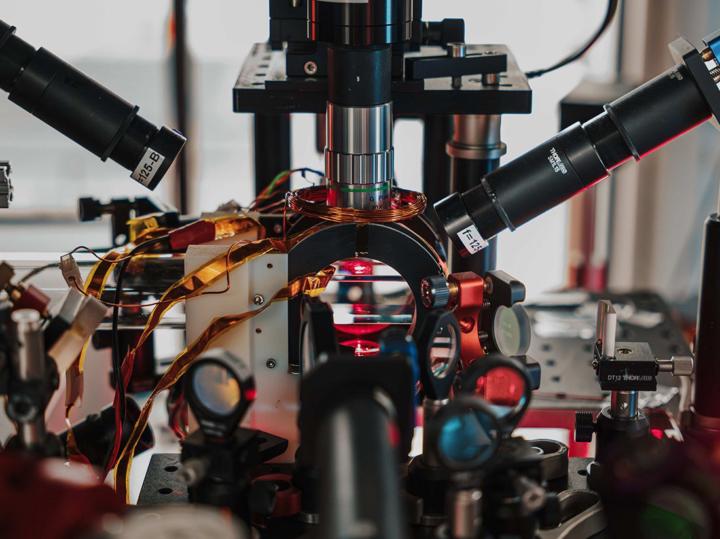
Giovanni Barontini from the University of Birmingham, UK, has used a cloud of cold atoms to test the origin of time. This is an interesting contribution to the long-standing question of how to define time in a non-circular way (time is what a clock measures and a clock is what measures time). One of the proposed solutions is to define time in quantum physics from the interaction of two different subsystems. This interaction, so the idea, introduces an oscillation that serves as the ‘tick’ of the clock. If that was so, then time would be purely ‘relational’ — an emergent, derived quantity — rather than (as in Einstein’s theory), a fundamental property of the universe. Barontini used about 24,000 ultracold rubidium atoms in a trap split by a thin light barrier into an observed “bright” part and an unobserved “dark” part. Atoms could move between the two, so the bright part expanded and collapsed in repeated cycles, rather like a toy version of a big bang and big crunch. Barontini then defined an internal “entropic time” from how the entropy of the bright part changed as atoms moved in and out. This internal time ordered the observed events almost as well as laboratory time.This experiment lends support to the idea that time is not fundamental, but emerges from interactions between parts of a closed system, though one may ask how interactions can change a system if there is not already a time for them to change in, but then maybe that’s just Sabine being grumpy again. Paper here. Press release here. Image: The device, called a ‘trap’, that holds the cloud of cold atoms in place using a combination of lasers and magnetic fields. Credits: Giovanni Barontini/University of Birmingham
0
0
10d •
A Giant Ring in Space That Should Not Exist
Hello everyone, today I have a new video about a topic that I have followed for a long time, namely whether the "Cosmological Principle" is correct. This principle has it that we (our galaxy) is not in any special place in the universe, but that the universe is on average the same everywhere. Sounds plausible enough, but is it correct? For all I can see, the data is unwilling to comply with the principle. It is somewhat perplexing that astrophysicists for the most part ignore the issue.

0 likes • 10d
Test
1-2 of 2

Active 8d ago
Joined Jun 26, 2026