Activity
Mon
Wed
Fri
Sun
Aug
Sep
Oct
Nov
Dec
Jan
Feb
Mar
Apr
May
Jun
Jul
What is this?
Less
More
Memberships
The AI Medical Society
57 members • Free
Pocket Singers Free
18.6k members • Free
AI Automation Agency Hub
328.4k members • Free
13 contributions to AI Automation Agency Hub

1h •
To anyone building AI/Automation for clinics & hospitals... Let's talk strategy
Hey everyone, I’m diving deep into the healthcare niche (clinics, diagnostic centers, and hospitals) and want to get some real-world insights from anyone who has successfully signed clients or built systems in this space. If you’ve worked with medical clients, I’d love to know: The Pain Points: What was the burning problem that actually made them take a meeting with you? (e.g., missed appointments, chaotic patient onboarding, staff burnout, manual data entry?) The Offer: What exactly did you sell them? (A specific AI agent, a WhatsApp/SMS workflow, a custom EHR integration, etc.) The Fears & Objections: What were they terrified of before they bought? (Data privacy/HIPAA, older staff refusing to use it, tech breaking down?) The Adoption: How did you actually get the doctors or administrative staff to adopt and use your automations consistently? The Implementation: Which specific areas or departments saw the biggest impact? Healthcare is notorious for being tough to break into, so I’d love to hear how you navigated the sales process and what the reality of delivery looks like. Drop your experiences below—let’s swap some insights!
1
0
6d •
For those running n8n in production:
What infrastructure are you using right now? - Self-hosted on a local/home server? - VPS (Hostinger / Hetzner / DigitalOcean / others)? - Cloud providers like Amazon Web Services or Google Cloud? I’m trying to understand: 1. What made you choose that setup? 2. How much do you pay monthly? 3. How many active workflows do you run? 4. Any uptime, scaling, or maintenance issues? 5. If starting again today, would you choose the same setup? Context: I’m currently running 2–3 active workflows and trying to decide the most cost-effective setup for long-term use.

20d •
THE BOTTLENECK FOR 24/7 AGENTS ISN'T THE LLM — IT'S STATE MANAGEMENT ACROSS RESTARTS
Been working on a persistent Claude agent for an SME client to handle their 24/7 lead qualification. Getting the tool-use and conversation flow right was the first step. The real challenge hit when we started thinking about deployment and reliability. An agent that goes down and loses its memory is just a fancy script. 🚧 True autonomy requires it to survive server reboots, code pushes, or just random crashes. The core problem isn't the Claude API call; it's the agent's memory. We found the only way to guarantee uptime is to decouple the agent's state from its execution environment. Before every major action, the agent now serializes its current conversation state and task progress to a simple database. 💾 On startup, its first step is a re-hydration check, loading the last known state and picking up exactly where it left off. This completely changes the operational model. 🧠 The agent is no longer a single, fragile process. It’s a resilient system where the logic can stop and start without losing context. This architecture is what turns a cool demo into a production-ready service for a client. 💡 How are you guys handling state persistence for your long-running agents? Redis, Postgres, or just flat files for simple cases?
3 likes • 17d
@Dimitris Kassavetis I actually haven’t started cold calling yet! Since I'm a medical student building in the health-tech niche, I'm focusing entirely on the doctors, clinics, and medical professionals already within my circle. My strategy right now is just leveraging that warm network and properly pitching to people I know first. If I pivot to cold outreach later, I'll definitely share what works
1 like • 15d
@Lesetša Mutchinya Just go for it. This is a great niche
17d •
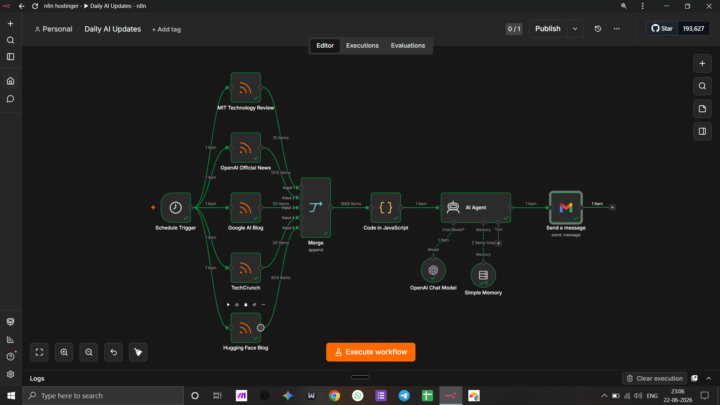
How I built a 5-channel AI Newsletter Agent in n8n (And solved a 1,800+ item backlog)
Hey everyone! 🤖 I just finished an n8n workflow that completely automates my morning tech and business news scanning. It pulls from 5 channels, picks the top 5 breakthroughs, and drops a premium, custom-branded newsletter straight to my inbox every midnight. Here is the exact setup and a major scaling issue I solved: 🧱 The Flow: Schedule Trigger ➡️ 5 Parallel RSS Nodes ➡️ Merge (Append) ➡️ JS Code Node ➡️ AI Agent ➡️ Gmail (HTML). 🚨 The Problem: When I first merged all 5 streams, it spat out 1,865 raw articles. Passing that straight to an LLM would instantly blow past context limits or cost a fortune. ⚡ The Fix: I added a simple JS Code Node right before the AI Agent. It strips out all the raw HTML metadata, extracts just the title, summary, and sourceUrl, and uses a .slice(0, 30) script to hand over only the 30 freshest headlines. 🧠 The Result: The AI Agent filters those 30 down to the top 5 entrepreneur-focused stories, formats them with clean inline HTML links, and drops them into a beautiful, mobile-responsive "Card Layout" template inside the Gmail node under my brand, Automedops. No more scrolling through noise. Just a high-yield, 2-minute intelligence brief waiting for me every morning. ☕ #n8n #Automation #AIAgents #WorkflowDesign
0 likes • 16d
@Sankalp Salve Absolutely, happy to share it.Just message me, I'll share with you
1 like • 16d
@Vishal Singh this is just the name of agent which contains 5 channels as you can see on the pic i attached
Jun 8 •
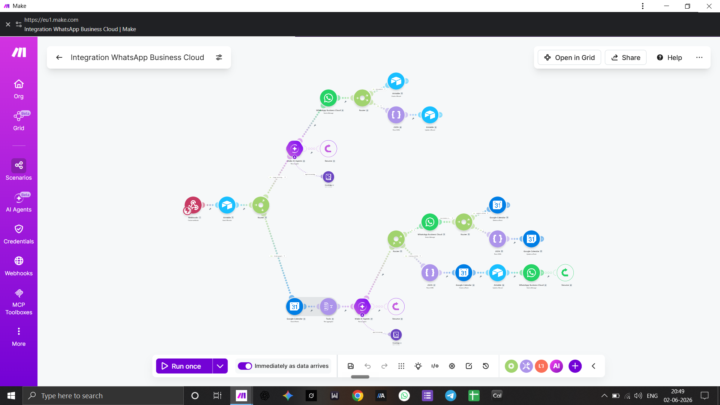
🚀 Built a Bulletproof WhatsApp AI Medical Receptionist (Multi-Agent + Live Calendar Sync + Error Boundaries)
Hey everyone! I wanted to share a look into a pre-consultation medical orchestrator I’ve been developing over at Automedops. The goal was to build a flawless client experience for clinic front-desks over WhatsApp—completely hands-free. Here is how the architecture handles complex clinical operations under the hood: 🏥 Interactive Knowledge Hub: Instantly answers patient questions about clinic timings, location, and services. 📅 Live Calendar Syncing: Dynamically reads the doctor’s Google Calendar to fetch and suggest available slots mid-chat. 🔒 Double-Confirmation Logic: Waits for an explicit "Yes" from the patient before triggering the booking payload. 🔄 Airtable State Tracking: Logs the Google Event ID to Airtable. For cancellations/reschedules, it reads the ID, deletes the old event, and re-opens the slot. 🛡️ Fail-Safe Error Handling: Uses a Resume Error Handler. If a timeout or JSON parse error occurs, it instantly prompts the patient to call the helpline if their receipt doesn't arrive in 5 minutes. The system keeps data completely clean, avoids double-bookings, and secures absolute stability for a live clinical environment. I'm looking to push this even further. What advanced optimization strategies or tools should I learn next to stay ahead in this space? Also, if anyone in the community is focusing on the healthcare automation niche, let’s connect! I’d love to brainstorm, share insights, and collaborate. 👇
1-10 of 13

@ridhi-shrama-9352
Med student building automation and Ai agents for healthcare
Active 49m ago
Joined Dec 24, 2025
India
Powered by