Activity
Mon
Wed
Fri
Sun
Nov
Dec
Jan
Feb
Mar
Apr
May
Jun
Jul
Aug
Sep
Oct
What is this?
Less
More
Owned by Randy
Join our online Kenjutsu classes to learn Japanese swordsmanship. Explore mastery of body, mind, and spirit through traditional samurai martial arts.
Plans of Grandeur
1k
$97
Skool Course
36.6k
1.0
$29/m
86 contributions to Kenjutsu Online
16d •
Thought for the day.
"Failure is delay, not defeat." Denis Waitley. I really like this one. It gives us permission to accept and learn from our mistakes and failures. Not getting something on the first, second or hundredth time is ok. It is just a delay in our succes. Next time I struggle with something in class, or things in life really, I will remind myself it is not defeat, it is delay. 🙂
2 likes • 2d
@Wayne Nadler wonderful insights and this is exactly how you know you're in the process of internalizing kenjutsu. As your kenjutsu instructor, I can see it week after week. As with most things in life, it's difficult for us to truly know whether we're progressing or how much we're progressing until our training gets pressure tested. As martial artists, we talk about the need to pressure test our art, but that conversation seems to always revolve around levels of resisting opponents. Of course, I agree with that, but I also think there are plenty of opportunities to use our training just by going about our day and bumping up against challenges, like you had with the heavy lift. To stay on topic with the thought of the day, failure can be the best teacher. I absolutely love what you said about the value in practice not being that we'll master something or even succeed at it, but the attitude and knowing you're the kind of person who comes to the fight or challenge armed with the right attitutude, is priceless.

2 likes • 2d
@Luis Bedoya excellent!
Sep '25 •
Welcome!
Welcome to Nami ryu Kenjutsu online. I'm excited to have you here, and to share your passion for learning Japanese swordsmanship. ⚔️ Please take a minute to introduce yourself and share what motivates you to learn kenjutsu. Maybe you're into Kurosawa movies, the samurai, or Japanese swords, or maybe you've wanted to learn Japanese swordsmanship but don't have a place to train or a community to support you. We'd like to know what brought you here!
1 like • 24d
@Eugene Salleh great to have you here! I'm excited for you to check out the resources, especially classical kenjutsu movement.
1 like • 2d
@Luis Bedoya another huge welcome to the community! As always, if you have any questions or comments, feel free to post them in here, Luis.
3d •
27th Annual Shinbukan Seminar & Demonstration
We're excited to be a few days away from welcoming Kuroda Yasumasa Sensei of the Shinbukan Kuroda Ryugi to Fresno for a 5-day seminar and Saturday evening demonstration. This has been in the works for a year, and it's hard to believe it's finally here. We have been associated with Kuroda Tetsuzan O-Sensei (late father of Kuroda Yasumasa Sensei) for nearly 30 years. We believe this will be the largest North American Shinbukan seminar, with over 40 Shinbukan members and new koryu members coming from Europe and all over the U.S. It will likely be another two years before this seminar returns to the U.S. It's not too late to plan ahead and start training in anticipation of the next seminar. If you know anyone within a few hours of Fresno, CA, please encourage them to come to the demonstration on Saturday, 10/24 at 5pm.
2 likes • 2d
@Luis Bedoya I'll post as much as I'm allowed. Kuroda Sensei doesn't allow photos or videos of seminars or training, but I believe it's okay to show the demonstration since it's public. I'll confirm and I'll share as much as I can!
13d •
Another great online class tonight!
The online classes have been so helpful. Good details, well paced, questions are encouraged and feedback given. I do feel as though I am making progress. I definitely recommend checking it out!
2 likes • 13d
Thanks so much, Joanne! Everyone is making good progress, which I can see with every class. Credit to you all, though, because I can tell that everyone is practicing!
1-10 of 86
@randy-george-3439
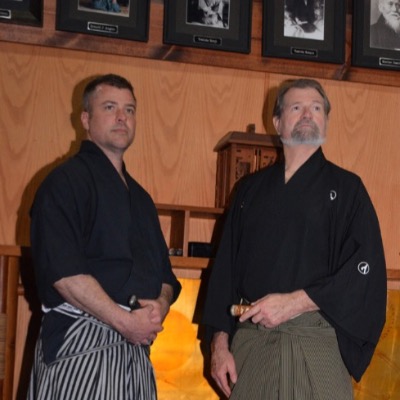
I am the chief instructor of Fresno Samurai Arts, a Nami ryu Aiki Heiho school of samurai bujutsu.
Active 14h ago
Joined Jun 28, 2024
Fresno, CA
Powered by