Activity
Mon
Wed
Fri
Sun
Aug
Sep
Oct
Nov
Dec
Jan
Feb
Mar
Apr
May
Jun
Jul
What is this?
Less
More
Memberships
Biology Unlocked
30 members • Free
3 contributions to Biology Unlocked

6d •
Journal Club Number 6 is happening tonight!
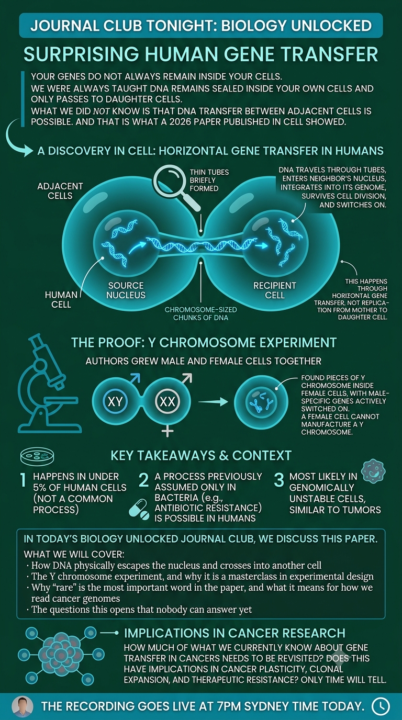
Your genes do not always remain inside your cells. Sounds weird right? We were always taught that DNA remains sealed inside your own cells and is only passed on to your own daughter cells. What we did not know is that DNA transfer between adjacent cells is possible. And that is what a 2026 paper published in Cell showed. It turns out, chromosome-sized chunks of DNA can be passed from one human cell to an adjacent one. The point to note here is that the DNA does not pass from mother cell to daughter cell through replication. This happens through a process called horizontal gene transfer. The DNA travels through these thin tubes that are briefly formed between two touching cells, enters the neighbour's nucleus, integrates into its genome, survives cell division, and switches on. What fascinates me is the proof. The authors grew male and female cells together, and found pieces of the Y chromosome inside the female cells, with the male-specific genes actively switched on. A female cell cannot manufacture a Y chromosome. This only happens under 5% of human cells, so it is not a common process of gene transfer. What is notable is that a process that we used to assume happens only in bacteria—i.e., horizontal gene transfer between bacteria is how they develop antibiotic resistance—is also possible in human cells. What is also important is that the cells most likely to do it are the genomically unstable ones. Similar to the ones in a tumor. In today's Biology Unlocked Journal Club, we discuss this paper. Here is what we will cover: · How DNA physically escapes the nucleus and crosses into another cell · The Y chromosome experiment, and why it is a masterclass in experimental design · Why "rare" is the most important word in the paper, and what it means for how we read cancer genomes · The questions this opens that nobody can answer yet The recording goes live at 7pm Sydney time today. This is also fascinating to me because of the implications of this paper in cancer research. If cells can transfer DNA to each other, how much of what we currently know about gene transfer is cancers needs to be revisited? Does this have implications in cancer plasticity, clonal expansion, and therapeutic resistance? Only time will tell.

0 likes • 6d
Very interesting
Jun 10 •
A very warm welcome to Vivek Kumar!
Vivek is a leading name in scientific and academic editing in India and the founder of the Indian Copyeditors Forum. We are so glad to have you here! If you are interested in science communication, editing, or translating research for broader audiences, Vivek is exactly the kind of person worth connecting with in this community. Welcome, Vivek!
1 like • Jun 10
Welcome Vivek!!
May 15 •
🔬 Biology Unlocked Journal Club — Register Your Spot!
Starting Saturday 6 June, 11am AEST — every week for 10 weeks. Each session we break down a real molecular biology paper — what it found, what it means, and what the authors didn't say. The first two sessions are free. 📍 Live on Twitch — link shared inside this community 📹 Recordings available to Practitioner and Immersive members To register: comment "I'm in" below. That's it. You'll get session details, paper previews, and reminders right here on Skool before each Saturday. See you June 6th. 🧬
1 like • May 20
This is a great initiative, definitely going to join
1-3 of 3

Active 6d ago
Joined May 17, 2026