Activity
Mon
Wed
Fri
Sun
Aug
Sep
Oct
Nov
Dec
Jan
Feb
Mar
Apr
May
Jun
Jul
What is this?
Less
More
Memberships
AI Workshop Lite
37.1k members • Free
Easy Machine AI
2.9k members • Free
Creator Academy
9.4k members • Free
Self Publishers Unite!
554 members • Free
Voiceover Masterclass
175 members • $27/month
KDP Publishing
1.2k members • Free
Podcaster Pals
102 members • Free
Creator Party
5.6k members • Free
AI Creator Profits
27.3k members • Free
41 contributions to AI Automation Agency Hub

4d •
Roast my two landing pages? (A vs B)
Hey everyone, building in public and could use honest eyes from people who actually get this space. I'm building a white-label AI front desk that agencies resell to local businesses. I made two completely different landing pages and I genuinely can't pick: A) the classic SaaS page: https://a.konvy.ai B) a scroll story, the page plays as you scroll: https://b.konvy.ai Not selling anything here (there's nothing to buy on either page anyway). I just want the roast: which one would make you keep reading, and where exactly do you drop off? Comment A or B plus one sentence why. Brutal beats polite. P.S. The B variant is built as distinct experiences for both mobile and desktop. I’m not sure which device you tried, but feel free to try both desktop and mobile. They have slightly different behavior and visuals, making the user experience more optimized for each device. Mods: if links aren't allowed here, say the word and I'll delete or move them to a comment.
1 like • 3d
@Kevin Marra Thank you
0 likes • 2h
@Dionny Chejito Thanks for sharing your feedback. That is correct, exactly what I had in my mind when I created B, IMO is it important to show the journey. Like they say an image speaks a 1000 words and a video speaks a 1000 images. What I have created in B is an intension video walkthrough of the journey and lifecycle of their bussiness. Appreciate your time.
Apr 24 •
WOW! GPT-5.5 and most awaited Deepseek V4 Flash & Pro dropped today
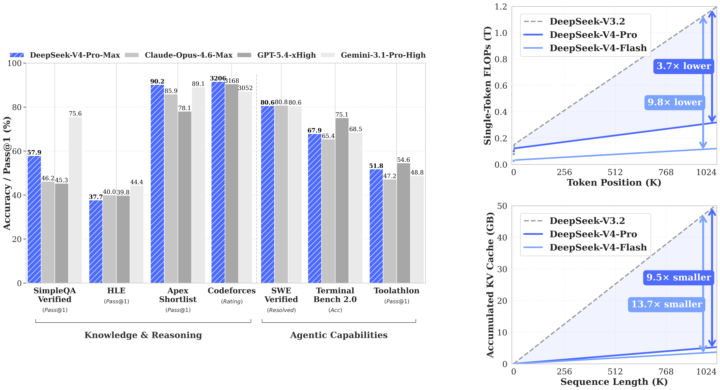
What a Friday. For two years, if you were building anything serious with AI, you were building on Claude. Not because it was a rule — because it was the right call. Anthropic set the bar for coding. They set the bar for writing. They set the quiet default that if you cared about quality, you paid the Opus premium and didn't ask questions. I didn't either. The whole builder community ran on Claude for a reason. This week, that changed. GPT-5.5 shipped yesterday. DeepSeek V4 Pro shipped the same day. Inside twenty-four hours, the ceiling on agentic coding went up — and the open-weight floor came within striking distance of the closed frontier. Real contenders. Not "almost there." Actually here. Three things this changes for anyone building, and none of them are in the headlines yet. Coding: The default setting of "Claude writes the code, Claude runs the agents" breaks this week. GPT-5.5 is measurably better on the kind of long-running multi-step agent work that used to be Claude's moat. DeepSeek V4 Pro is within a fraction on real software engineering, at a price point where "run it myself" is genuinely on the table. Every tool in your stack that quietly assumed Anthropic — your IDE integrations, your review agents, your automation glue — is about to get reconsidered. That's good for you. Less lock-in. More leverage. Marketing and writing: The price-per-draft math just flipped. We've been rationing the good model forever — the flagship handles the brand-safe stuff, volume work gets the cheap model, and we've all quietly accepted that frontier-quality writing at scale isn't possible. That's over. Frontier-quality writing at open-weight pricing means every ad variant, every email rewrite, every landing-page test, every personalization loop runs at the top tier. The whole architecture of "one good draft, fifty cheap copies" starts feeling as dated as shared creative. Everything top-tier. Everything personalized. Everything testable. Agentic work: This is the one I am most excited about, and the most under-talked-about. For two years, "multi-model agent stacks" has been a slide in decks. Nobody actually builds them, because there hasn't been a real second option. GPT-5.5 for the reasoning step. DeepSeek V4 Pro for the long-context research step. Claude for the interpretive writing step. A cheap open model for the high-volume structured step. Not one runtime. A pipeline. Composed by you. Owned by you. That stops being a slide and starts being the default next month.
1 like • Apr 24
@Varun Sharma thanks, Warren. I do have a YouTube channel, but I don't make videos like these. Unfortunately, I don't have the time to spend on video making. I have multiple projects I work on. I do own and maintain 10 YouTube channels, but they run on autopilot. None of them are about these topics, and I agree YouTube has a lot of fluff and hype. It's because everyone is trying to sell something behind these.
Apr 15 •
Has anyone else been playing with Andrej Karpathy's "LLM Wiki" idea from the gist he dropped this month?
Quick version in case you missed it: instead of using RAG to re-chunk your sources every time you ask a question, you compile each source once into a persistent markdown wiki. The LLM extracts concepts, writes entity and concept pages, updates cross-references, flags contradictions, and maintains the whole thing. Future queries read the pre-synthesized wiki. The part that clicked for me: the reason most of us abandon our second brains is that backlink and cross-reference upkeep is boring. The LLM doesn't care. It's happy to touch fifteen pages in one pass. I spent a couple of weeks turning Karpathy's pattern into a Claude Code plugin that actually scales (atomic pages, sharded indexes, BM25 fallback past ~300 pages). It also runs in Codex, Cursor, Gemini CLI, Pi, and OpenClaw through the skills CLI. Install in Claude Code: /plugin marketplace add praneybehl/llm-wiki-plugin /plugin install llm-wiki@llm-wiki Or in any other supported agent: npx skills add praneybehl/llm-wiki-plugin -a <your-agent> Five slash commands (init, ingest, query, lint, stats), stdlib-only Python, no dependencies. Plays well with Obsidian if you want the graph view. Repo: https://github.com/praneybehl/llm-wiki-plugin Karpathy's gist: https://gist.github.com/karpathy/442a6bf555914893e9891c11519de94f Curious if anyone here has tried the pattern themselves. What did you ingest first, and what broke before it worked?
0
0

Apr 7 •
Australian Developers
Any Queensland-based AI engineers in here? I'm James - running an AI automation consultancy out of Brisbane. Looking to connect with other engineers and builders in QLD who are deep in this space. The goal is to build a local network - share ideas, swap notes, catch up in person quarterly. But also create something like a Queensland jobs board where I can pass work your way as opportunities come through my business. If you're in Queensland and working in AI automation, drop a comment or shoot me a message. Let's build something local.
0 likes • Apr 10
Hey, Praney from Melbourne here :wave
Mar 22 •
I Run 10 YouTube Channels. I Don't Make a Single Video. Here's what that actually looks like
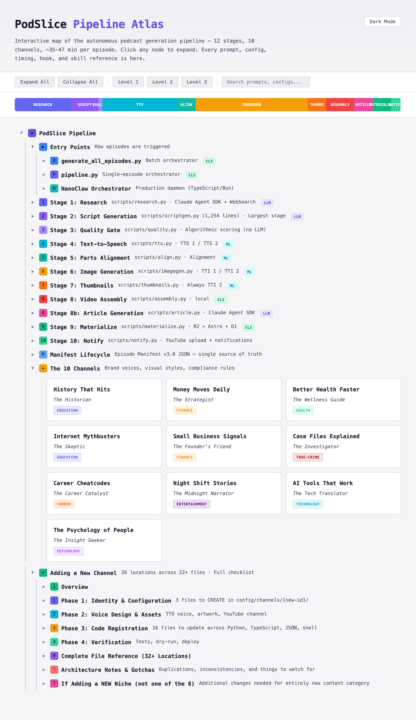
I woke up this morning to 10 fresh podcast episodes. Fully researched. Scripted. Narrated. Visuals timed to every beat. Published to YouTube, RSS, and my own website. I didn't make any of them. A machine on my desk did. While I slept. I launched these channels at the end of February. It hasn't been a month yet. Some episodes are pulling 1,000+ views and gaining subscribers - with zero ads, zero promotion, zero outreach. But here's what I need you to understand: this is not a prompt. When people hear "automated content," they picture someone typing a topic into a chatbox and hitting publish. That's not what this is. That's not even close. What I built is a multi-stage production pipeline. Not a single generation step - a sequence of independent systems, each with its own job, its own rules, and its own quality bar. Every stage has to pass before the next one starts. If something isn't good enough, it gets caught, flagged, and redone automatically. Here's what that actually means in practice: Every episode starts with real research. Not "summarise this topic." Actual source-finding, fact-checking, angle evaluation. The kind of editorial groundwork a good producer would do before writing a single word. Most automated content skips this entirely. Mine can't - the pipeline won't let it move forward without it. Then there's the writing. And this is where I spent most of my 45 days. I didn't just generate scripts - I built an entire set of rules around how spoken language works differently from written language. How rhythm changes when someone is listening instead of reading. How a pause lands. How a transition should feel. Early versions sounded like a textbook. Now they sound like someone talking to you. After the writing comes the part most people don't think about: quality control. Every script gets evaluated across multiple dimensions before it moves on. There's a hard pass/fail threshold. I've watched the system reject its own output dozens of times and come back with something genuinely better. Nothing mediocre gets through. That's not a nice-to-have - it's the reason the content performs.
1 like • Mar 22
@Oddvar Meyer thanks, here is one of the latest episode from one channel https://youtu.be/ZllDIiibnN0?si=oW-hOO-j3I5GYMh8
1 like • Mar 22
@Gnaneshwari P so for now its private but I am working on productising it
1-10 of 41

@praney-behl-3117
Creator, Developer, Entrepreneur, Marketer, Husband & a Dad.
Building Vois.so, konvy.ai, heynyx.app, volant.app and a couple more ;)
Active 2h ago
Joined Mar 16, 2024
Melbourne AUS
Powered by