Activity
Mon
Wed
Fri
Sun
May
Jun
Jul
Aug
Sep
Oct
Nov
Dec
Jan
Feb
Mar
Apr
What is this?
Less
More
Memberships
The Culinary Timekeeper
13 members • Free
The Cozy Makers Club
148 members • Free
2 contributions to The Culinary Timekeeper

🔥
Mar 7 •
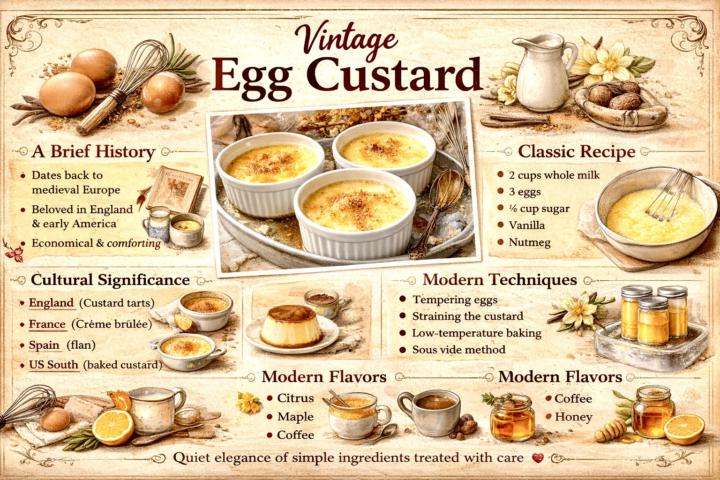
Vintage Egg Custard
- A humble dessert that quietly crossed centuries Few desserts feel as timeless and comforting as egg custard. With only a handful of ingredients — eggs, milk, sugar, and gentle heat — this simple dish has been appearing on tables for hundreds of years. It is the kind of dessert that feels both ordinary and elegant, the sort of sweet that could be served in a royal dining room or a farmhouse kitchen. For culinary timekeepers, egg custard is a beautiful example of how technique and patience once mattered more than elaborate ingredients. - A Brief History of Egg Custard Custard dates back to medieval Europe, where cooks learned that eggs could thicken liquids when heated slowly. By the 14th century, custards were already appearing in English cookbooks, often baked inside pastry shells. As dairy became more widely available, custard evolved into a dessert on its own. By the 1700s and 1800s, baked egg custard had become common in both England and early American kitchens. In the American South, especially, custard became beloved because: - Eggs were plentiful on homesteads - Milk came fresh from household cows - Sugar had become more affordable by the 19th century The result was a dessert that was economical, nourishing, and comforting. Custard also appeared frequently in boarding houses, hotels, and Sunday suppers, because it could be made ahead and served chilled. - Cultural Significance Egg custard quietly carries the history of home cooking traditions. Across cultures, custard appears in different forms: England - Custard sauce served with puddings - Baked custard tarts France - Crème brûlée - Crème caramel Spain - Flan United States - Baked egg custard with nutmeg - Custard pies - Custard ice cream bases In many Southern households, nutmeg-topped baked custard was considered the proper finishing touch for Sunday dinner. Some families even passed down custard cups and ramekins used only for this dessert.

0 likes • Mar 7
I have never had this. Sounds like its delicious.
🔥
Feb 28 •
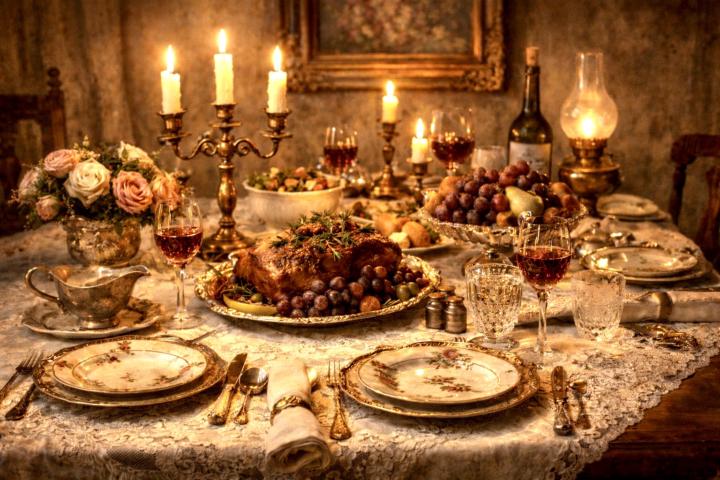
How Great Grandma Might Have Set Her Sunday Table
In the early 1900s, a hostess setting her Sunday supper table would have been thinking about far more than plates and silverware. She would be considering how her home reflected her family’s values — order, hospitality, and care. Sunday was not merely a meal; it was a weekly gathering point, often after church, when extended family or close neighbors came together. She would have thought about whether the linens were freshly pressed, if the best china was brought out, and whether the roast would stretch generously to feed everyone. Appearances mattered, but not for vanity — rather as a quiet sign of respect for her guests. A well-set table signaled welcome, stability, and gratitude. She may also have been thinking practically: keeping dishes warm without modern conveniences, timing the courses just right, ensuring children were seated properly, and that conversation remained pleasant. Above all, she would have hoped that those who gathered felt nourished — in body and in fellowship — before the week began again.
0 likes • Mar 2
I still can't figure out how my mother managed to do this every Sunday when I was growing up.
1-2 of 2
@penelope-gamble-5485
Crafted for many years. A quilter and slow stitcher. Love working with fabric.
Active 7h ago
Joined Mar 2, 2026