Activity
Mon
Wed
Fri
Sun
Aug
Sep
Oct
Nov
Dec
Jan
Feb
Mar
Apr
May
Jun
Jul
What is this?
Less
More
Memberships
InnerLifeSkills Master Coaches
234 members • Free
We Do Wellness and Resilience
17 members • Free
Mauni-London Recovery Coaching
127 members • Free
20 contributions to Mauni-London Recovery Coaching
12d •
Chemsex
Most people hear that word and think they already know what it means. The reality is, they usually don’t. Chemsex isn’t just about the drugs. It isn’t just about sex either. For many people it’s about escaping, coping, connection, confidence, loneliness, trauma, shame or simply trying to quieten a brain that never seems to switch off. Sometimes it’s all of those things at once. We also know there’s a significant overlap between chemsex and neurodivergence, particularly ADHD. That doesn’t mean ADHD causes chemsex, but it can help explain why some people become caught in a cycle that’s incredibly difficult to break. Recovery isn’t about judgement. It’s about understanding what’s underneath the behaviour in the first place. Because until we understand why, it’s very difficult to change what. That’s where coaching can make a real difference. Having someone alongside you to help make sense of what’s happening, explore what’s driving it, and support you to move towards the life you actually want. No judgement. No labels. Just honest conversations and practical support. We’re looking at introducing Chemsex Coaching sessions on Mondays and Fridays. Before we do, we’d like to know… Would this be something you’d find helpful? We’re simply trying to understand whether this is a service people would genuinely use. Let us know below or send us a private message.
1 like • 12d
@Ruth Lilleker Great stuff. Encountering this more and more over time with clients.
13d •
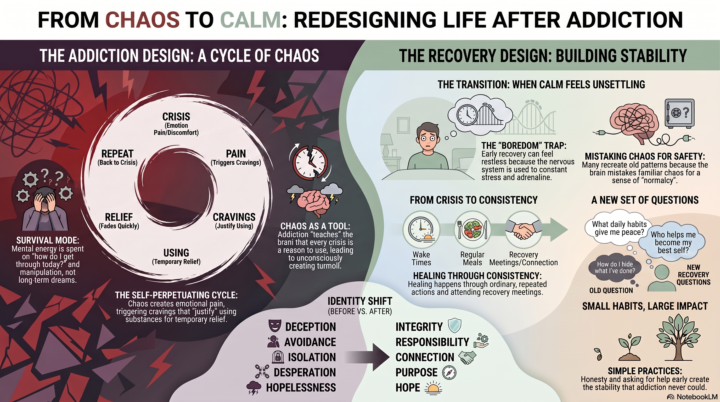
How Active Addiction Designs a Life Around Itself - CHAOS, CRISIS & CONFLICT
One of the most misunderstood aspects of addiction is that the substance is rarely the only addiction. Over time, many people become equally addicted to the lifestyle that surrounds it — a lifestyle built on chaos, crisis, and conflict. These experiences do not simply happen by accident. In active addiction, they become part of the fuel that keeps the addiction alive — a subconscious architecture designed to protect and sustain substance use above all else. "The addiction is not simply something a person does. It becomes the organising principle of their entire life." 1. ADDICTION NEEDS AN ENVIRONMENT TO SURVIVE Addiction is remarkably adaptive. It does not simply demand a substance. It slowly and systematically begins to redesign a person's entire life so that using becomes easier, more acceptable, and far harder to challenge. This is rarely a conscious decision. Instead, addiction gradually reshapes priorities, relationships, routines, finances, employment, emotions, and personal identity — until everything begins revolving around one central purpose: protecting the addiction. The result is a life that appears permanently stuck in survival mode. 2. THE BRAIN'S ROLE: REWIRING SURVIVAL AND REWARD Addiction fundamentally rewires the brain's survival and reward pathways. The substance or behavior hijacks the brain's dopamine system, transforming it from a source of pleasure into a perceived biological necessity. An individual's daily routine, priorities, and psychological framework are subconsciously — and sometimes consciously — reconstructed to sustain the addiction. Key neurological changes include: – Hijacked Priorities: The brain's reward circuits become flooded, making natural rewards — hobbies, food, meaningful relationships — far less satisfying. The addiction becomes the primary focus, leaving little time or energy for anything else. – Prefrontal Cortex Impairment: Repeated use damages the brain region responsible for decision-making and impulse control, making it extremely difficult to weigh consequences, maintain routines, or stop using despite the harm caused.
1
0
20d •
TODAY’S FILE
Or: Congratulations. Apparently We’re All Neurodivergent. I’ve noticed something recently. Nobody is neurotypical anymore. Not one person. Everyone has ADHD. Everyone is autistic. Everyone is dyslexic. Everyone is dyspraxic. Everyone is OCD. The entire population has apparently received a diagnosis during a brief self-reflection exercise in Asda. “Oh my God, I’m so ADHD.” Really? What happened? “I got distracted.” Right. Because I once put deodorant in the fridge, a can of San Pellegrino in the bathroom cupboard and spent forty-five minutes looking for my phone while using it as a torch. But yes. Sounds identical. Then comes: “I think everyone’s a little bit autistic.” Do you? Because I spent most of my life feeling like everyone had secretly been given a handbook on how to be a person and mine got lost in the post. Maybe you’re referring to enjoying a routine. I enjoy routines too. Mine usually involve spending three days planning something, immediately abandoning the plan and then becoming annoyed with myself for not following it. Who can say? Then dyslexia. “Oh I’m probably dyslexic.” Why? “I mixed up two words.” Of course. And because I once coughed, I assume I’m a chain smoker. That’s how diagnosis works now. Makes perfect sense. Then dyspraxia. “Oh I’m so dyspraxic.” Why? “I walked into a door.” Interesting. I once walked into a door frame, apologised to it, dropped my San Pellegrino, got my sleeve caught on the handle, spun round to free myself and headbutted the door on the way back out. But carry on. Then OCD arrives. Usually uninvited. “Oh I’m literally OCD.” Why? “I checked the door twice.” Twice. You brave, brave soldier. Somewhere a person with actual OCD has just checked the hob for the eighteenth time and is wondering if reality itself can be trusted. But yes. Twice. The thing is, everybody gets distracted. Everybody forgets things. Everybody gets overwhelmed. Everybody trips over. Everybody checks things.
1 like • 18d
Spot on.
25d •
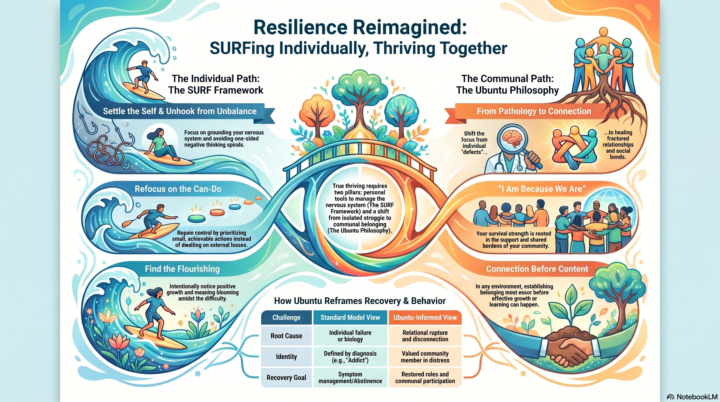
Ubuntu - From Adversity to Resilience and SURF
A look at the psychological and cultural dimensions of building resilience through the African philosophy of Ubuntu. While traditional psychology often views recovery as an individual effort, Ubuntu re-frames healing as a communal responsibility, suggesting that personal strength is rooted in collective belonging. This framework is applied across diverse sectors, including clinical mental health treatment, addiction recovery, and education, to replace isolation with social connection. One specific strategy, the SURF framework, offers a practical method for settling the mind and refocusing on controllable actions during times of distress. Ultimately human beings thrive best when supported by a network of mutual care and shared purpose. This integrated approach suggests that sustainable recovery depends on moving beyond symptom management toward full reintegration into a supportive community. The SURF framework offers a structured psychological strategy designed to help individuals navigate adversity by transitioning from a state of distress to one of growth. The process begins by calming the nervous system through physical grounding and then shifts toward mental clarity by detaching from skewed, negative thought patterns. By prioritising actionable choices over uncontrollable circumstances, a person can reclaim their agency before finally seeking out positive opportunities for personal flourishing. The SURF Framework The SURF acronym is a highly regarded, practical framework taught in psychology and trauma treatment to navigate adversity and build resilience. It provides a step-by-step approach to managing distress, unhooking from unbalanced thinking, regaining control, and ultimately finding ways to thrive. The four letters stand for the following: - Settle the self: Focus on both body and mind. Settle your nervous system through grounding, breathing, resting, and maintaining daily routines (like sleeping and eating well) to prevent emotional overload. - Unhook from unbalance: Avoid spiraling into negative, one-sided thinking. Instead of fixating only on what is wrong, acknowledge your strengths and manage your emotions by staying flexible. - Refocus on the can-do: Take back a sense of control by focusing on tiny actions or choices you can still make, rather than dwelling on the aspects of the adversity that are out of your hands. - Find the flourishing: Intentionally notice what is positive and blooming in your life. This helps reset your nervous system and can even lead to new personal growth or finding purpose amidst the difficulty.
1 like • 19d
Absolutely Ruth. This, I think, is where Unified Protocol (UP), a CBT Framework and Third-Wave Therapies such as ACT, CFT, DBT and MBCT play a role. The role of the Recovery Coach, I feel, is to assist a client to potentially identify and become open to pursuing which ever skill-set will benefit them on their journey. IMHO

Jun 7 •
Just stopping by for a quick Hi
Hi everyone, I'm Eddy from Bristol but originally born and bred in Joburg. CPRC trained through U-ACT in 2022. Recovery coach, peer recovery specialist, and facilitator. And have been doing all sorts of weird and wonderful things in the recovery space, which has slowed down a bit at the moment but I'm Looking forward to reconnecting with the community, with some of the old faces and the new and seeing how the London Recovery Coaching Campus has evolved, and also hopefully being able to be more actively involved here again, anyway hope you all are well 👍🏻💪🏻😄
1 like • Jun 10
@Edward Alison Great to hear from you mate.😎
1-10 of 20
@paulo-pinto-6768
"Everything has Beauty, but not Everyone see's It."
Online now
Joined Mar 8, 2026
Powered by