Activity
Mon
Wed
Fri
Sun
Aug
Sep
Oct
Nov
Dec
Jan
Feb
Mar
Apr
May
Jun
Jul
What is this?
Less
More
Memberships
AI Automation Society
424.9k members • Free
13 contributions to AI Automation Society

54m •
The tool that stops me drowning in my own tools
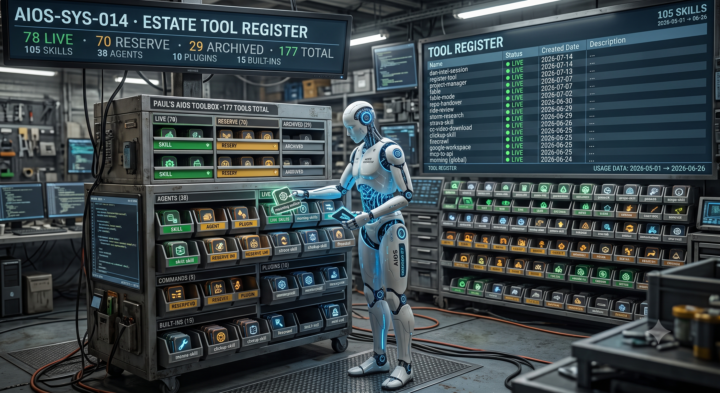
If you build automations long enough, you hit a problem nobody warns you about: you end up with too many tools. I counted mine this week. 177 of them. Skills, agents, commands, plugins. Some live, some archived, some parked in reserve. At that scale the hard part stops being "can I build it" and becomes "which of these do I already have, and which is the right one for this job." You start losing more time rediscovering your own work than you ever spent building it. You rebuild things you forgot you had. You reach for the second-best tool because the good one slipped your mind. So I stopped trusting my memory and built an index. Here is how it actually works. One file is the source of truth. Every tool gets a single line in one register file: its name, what kind it is, its status (live, reserve, or archived), when I made it, and a one-line note on when to use it. Nothing lives only in my head. The dashboard builds itself from that file. A small script reads the register and renders the searchable page in the screenshot below. I never hand-edit the dashboard. Change the index, the page regenerates. One source, always in sync. Nothing is "done" until it is booked. My rule: a new tool is a booked tool. Building it is not finished until it has a row in the register and turns up in the search. That single rule is what stops the sprawl at the source. A drift check keeps me honest. A script compares what is actually installed against the register and flags anything that slipped: a tool on disk with no row, a row whose tool is gone, or an archived tool that quietly came back to life. Then I wire it into the day so it never rots: 1. Start of day. The drift check runs before I build anything. If the index and reality disagree, I hear about it first thing, and my usage stats refresh so the dashboard shows what I actually reached for lately. 2. End of day. The same check runs again as part of shutting down, and it blocks the wrap-up if anything is unregistered. Then everything backs up. The register cannot silently fall behind.

26d •
🔒 Protect your Secrets (API keys)
Nate recommends keeping them in a .env file and never pushing it to your git repo (add it to .gitignore). But in another community, people told me to use a free tool called Doppler to centralize all API keys. Which approach do you trust more, and why? Anyone running Doppler in production? 🙏
2 likes • 26d
Warning: This happened to me true life story, i lost $2 million due to this in 2022 (my money not a company). I had very secure API keys, in private files away from any servers. This is safe but there is another problem... I had API access to many systems and rotated them every 30 days for extra security, then one of my suppliers developers leaked API keys and Secret keys on the dark web for profit. A third party hacking company managed to get in to some of my trading systems through this back door and drain one of my accounts overnight. Research 3Commas API key leak for the full info, just be safe out there and always plan for an account hack even if secure and how you can mitigate the loss of data or the whole system if this does happen and becomes out of your control.
27d •
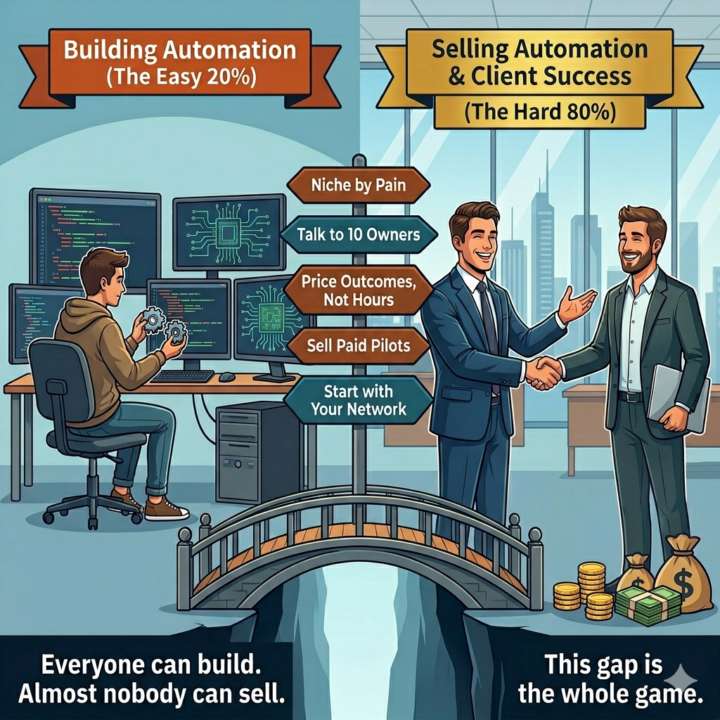
Everyone here can build an automation. Almost nobody can sell one.
That gap is the whole game, and it's the half I spent 25 years on before I ever touched AI. I built and sold multiple multi-million-dollar businesses and retired at 45, all without AI. The build was never the hard part. Finding someone to pay for it was. Here's the client-getting playbook most builders skip: → Niche by pain, not by tech. Pick one industry and one expensive, repetitive task that quietly eats an owner's week → Talk to ten owners before you build anything. They hand you the problem AND the price → Price the outcome, not the hours. "I recover the 10 deals a month you're dropping" beats "I'll save you 5 hours" → Sell a paid pilot, not a project. Small, fast, low-risk, and let the result do the closing → Start with people who already trust you. Your own network closes 10x faster than cold outreach The automation is the easy 20%. The business around it is the 80% that actually pays. What industry do you already know best? That's where your first client is hiding. 👇
2 likes • 27d
@Pascal Berlik Pascal, you're already operating like someone who's done this, not just studied it. One tweak on the paid pilot: agree the win condition before you start. Pin it to a number the owner already feels, "X more booked jobs in 30 days", so the result closes the next conversation for you and the upsell becomes obvious. And charge for it, even a small fee. Skin in the game makes them show up and act on what you deliver. One push on the niche: real estate, trades and cosmetic studios are three different worlds. Case studies and referrals compound inside a vertical, not across them. A great result for an agent sells the next agent, it does nothing for a cosmetic studio. I'd pick the one with the sharpest, fastest-feeling pain and the most owners who talk to each other, then own it before adding the next. Which of the three are you leaning toward first?

Jun 4 •
How I Sent 60,000 Cold Emails in April & Made 6 Figures (All Automated)
Hey Automation community! 👋 This took me 2 hours to put together. If you're looking for a proven way to get clients AT SCALE and actually make money for your AI automation agency, then this is for you. I run an AI agency that basically made no money because I had a hard time finding new clients. I tried cold email starting in November and it quickly become one of our most profitable acquisition channels. I knew NOTHING about cold outreach when I started. I learned A LOT along the way (including plenty of expensive mistakes), so here’s everything I wish I had known from day one. If you don't know what cold email marketing is, it's when you send out thousands of emails to potential leads you haven't spoken to before. The goal is for them to book a consult with you where you'll then close on a deal. If you do it badly, it will look like spam and nobody will respond. Do it where you target relevant people ready to buy and offer a lot of VALUE, and you will generate sales. Part 1: Technical Setup Domain Strategy - Buy dedicated domains just for email campaigns — never ever use your main company domain. - Set up DNS records immediately: SPF, DKIM, and DMARC. - Use Google Workspace or Microsoft 365 for better deliverability (roughly $4–6 per account per month). Email Account Setup - Create 1–4 email accounts per domain. - Start slow: 10 emails per account per day, then increase volume by ~10% each day. - Max once warmed up: ~25 emails per account per day. - Example: 4 domains × 3 accounts × 25 emails = 300 emails/day to begin with. IMPORTANT: Always warm up accounts for at least 14 days before ramping up. Extra tips that help a lot: - Add real profile photos and complete the accounts. - Older domains tend to perform better when you can get them. - Set up a custom tracking domain for accurate open/click data. Choosing Your Sending Platform You can do it manually with the technical setup above but it's way easier to buy an email account that's already configured and ready to go. I ran high-volume campaigns using Instantly.ai because it has good deliverability, analytics, and tons of guides on it since it's used by many agencies to get clients. It’s not perfect but probably one of the best for cold email right now. But honestly, your lead list and outreach message matter more.
1 like • 29d
@Jason Bean Honestly, Jason, I've gone all-in. I'm building what I think of as an "AI operating system" in Claude Code — it runs my research, drafts my client docs, and keeps all my context in one searchable place. This week alone it's done a full competitor breakdown and built a client proposal that would've taken me days. What's struck me as an old operator: one person can now do what used to take a team of five. The discipline I'm bringing from 25 years in business is being ruthless about where AI actually belongs — agents where there's real judgement, simple reliable workflows everywhere else (cheaper, and they don't break). You're clearly deep in the build — what does your day-to-day stack look like?
1 like • 28d
@Jason Bean Good question, Jason. Honest answer: I'm early, but here's the shape of it. On the build side, I'm putting together my own AI operating system in Claude Code, in public. That's where Claude does a lot of the heavy lifting for me too. On the paid side, I work with established owner-run businesses that are stuck on low-value clients and want to move upmarket. It's the whole engine, not one product: reposition them around the high-value work they actually do, build the proof (case studies, credibility, procurement-ready), install a modern get-found-and-convert system with smart automation where AI earns its place, then add recurring revenue. For owners whose endgame is a sale, I help drive the value up to exit. I bring the strategy and stay the single point of contact; vetted builders do the build. Audience: small and mid-size business owners, not tutorials-and-tools beginners. You're on Claude as well, what are you building with it?
29d •
Welcome Opportunity!
👋 New here — built & sold multiple companies, retired at 45, now all-in on AI I built and sold multiple businesses to multi-million-dollar success and retired at 45 — all without AI, just strategy and hard execution. Then my family and I sailed around the world (UK to New Zealand, 46 countries). The operator track record, in brief: → Scaled a specialist safety firm to multi-million-dollar revenue, 50+ staff, over 18 years — then sold it → Founded and ran an e-commerce business alongside it → Led state-level delivery for a global sporting event (national governments + organising committees) → Chaired my industry's trade association and helped write the British Standards still in use I know how to find clients, price on outcomes, build teams, run a P&L, and turn a messy idea into a system that makes money. What I'm here to master is the one tool I never had: AI. Two things I'm here for: → To share the operator playbook most builders are missing — finding clients, pricing on outcomes, systems, hiring, scaling. Ask me anything on that. → To find people to build with. I've got live commercial ventures and client projects that need serious AI work — lead-gen and sales-conversion engines, ops automation, and custom agents. I'm the operator and the principal: I bring the strategy, the clients and the budget. I'm looking for the people who can build it — full-time professionals and agencies who can own delivery end-to-end and point to real client outcomes, not tutorials. If that's you, comment below with what you've actually shipped for a client and I'll DM the ones who fit. And if you can build but stall on the business side — comment that too, that's exactly where I can help. 👇

1 like • 29d
@Jesus Pedroza Haha, busted. But honestly, why keep a dog and bark yourself? The AI does all the heavy lifting now. It wrote the post, it's writing this reply, and at this point it knows me better than I know myself. I mostly just supply the coffee and hit send. I'm here to learn the tool, not turn into it. Cheers for keeping me honest though.
0 likes • 29d
@Nexo Aureon Honestly, the hardest leap I ever made. For 7 years I worked 363 days a year, 100+ hour weeks, back to back. Not to be a hero. I needed to understand every part of the business myself first: sales, marketing, installation, finance, project management, all of it. You can't lead what you don't understand. The turning point wasn't a clever tactic. It was letting go, and it nearly broke me. I'd find people I trusted, hand the work over, it wouldn't be good enough, so I'd snatch it back and do it myself again. I ran that loop more times than I'd like to admit. What finally fixed it: I'd been handing people chaos. They couldn't hit a standard that only lived in my head. So I stopped delegating tasks and started building foundations: systems, standards, a documented way the job gets done right. Once the system held the standard, good people could finally deliver to it, and I was free to be strategic instead of the bottleneck. So if you're stuck in the grind today: 1. Yes, learn the work first. No shortcut. But you don't have to do it forever. 2. Don't hand over tasks, hand over a standard. Write down what "good" looks like, step by step, before you delegate. That's the foundation everything sits on. 3. Then pull the lowest-value, most repetitive work off your plate first. And this is exactly why I'm here. Those systems used to need a team to run them. AI runs on the same thing: a clear standard and a documented process. Build the system and it handles the repetitive grind for you. Same discipline I learned the hard way, at a fraction of the cost and time. What's the one task eating most of your week? Tell me and I'll say whether I'd systemise it, hire it, or hand it to AI.
1-10 of 13

@paul-forster-5215
Founder & CEO. Built an international safety firm—blue-chip clients, 68% overseas revenue, £1.5M EBITDA. Led 2022 FIFA World Cup delivery.
Active 24m ago
Joined May 18, 2026
Powered by