Activity
Mon
Wed
Fri
Sun
Aug
Sep
Oct
Nov
Dec
Jan
Feb
Mar
Apr
May
Jun
What is this?
Less
More
Memberships
Empath Haven🦋🌈🪄
165 members • Free
Skool Growth with Carolina
130 members • Free
TMT Tribe - Gut Health Repair
201 members • Free
Cosmic Sol Mystery School
436 members • Free
Plant Medicine Yogis
55 members • Free
Astrology As Your Compass
55 members • Free
Hagwitch Herbals
81 members • Free
RH - Starseeds Community
93 members • $7/month
3 contributions to Hagwitch Herbals

Apr 13 •
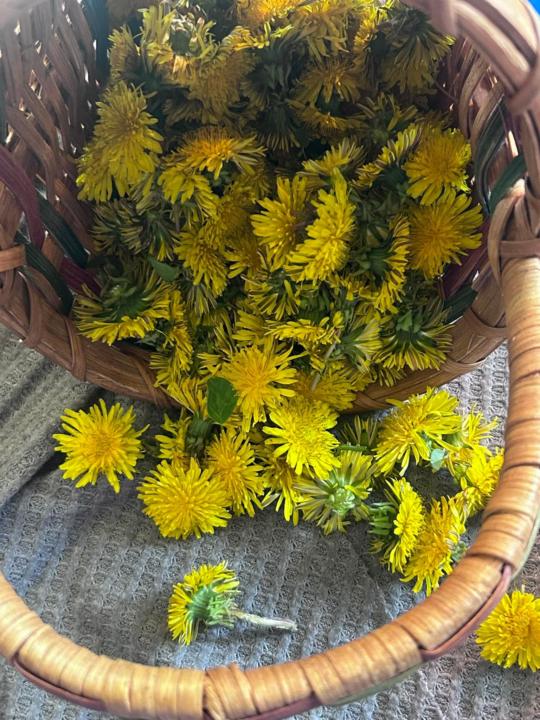
Dandelion syrup/ jam (jelly in US)
This is the recipe I’m following: What you’ll need: • 2 cups packed dandelion petals (green parts removed) • 2 cups water • 2 tbsp lemon juice • 3–3½ cups sugar • 1 packet liquid pectin ** Step 1: Make your dandelion tea Pour 2 cups boiling water over your petals. Cover and let steep 12–24 hours (overnight is perfect). Strain well—you want just the golden liquid. **Step 2: Cook it down Pour your strained tea into a pot. Add lemon juice + sugar. Bring to a rolling boil (one that won’t stop when stirred). **Step 3: Add pectin Stir in your liquid pectin. Boil hard for 1–2 minutes. **Step 4: Jar it up Pour into clean jars. Let cool and set (usually within a few hours). **Tips: • If it turns out soft, it still makes an amazing syrup! • Taste before jarring—you can add a touch more lemon for brightness • This is incredible on toast, or even in tea, I have in the past added syrup to icing sugar for the top of cakes and poured over ice cream. #dandelion #homemade #jelly #jellymaking #herbs

1 like • Apr 13
that sounds delicious
0 likes • Apr 14
@Elizabeth Anne i will thank you

1 like • Apr 11
where are you from
0 likes • Apr 13
@Lucas Benjamin it’s quieter than most places the weather is milder than most and there is a lot of charm indeed
Apr 10 •
Tattoos
Why I regret my tattoos…from someone that used to tattoo others for a living; Back then, it was about art, self expression and creative identity. Now I know the ingredients and risks however I see it differently and regret the tattoos I have on myself and have given to others over the years. Here’s what they don’t tell you when that needle touches your skin… 💉Red ink often contains mercury sulphide (cinnabar) - a toxic heavy metal linked to allergic reactions, skin inflammation and systemic toxicity. Many people will say ‘that’s old ink, the new ink doesn’t contain that’ and yet a study done in 2023 showed that a shocking 30% of UK tattoo studios were using ink that DID contain mercury. 💉Black ink, the most commonly used, contains carbon black, which may be contaminated with polycyclic aromatic hydrocarbons (PAHs) - classified as Group 2B carcinogens by the International Agency for Research on Cancer. 💉Many tattoo pigments also include lead, arsenic, cadmium, and aluminium…heavy metals with known neurotoxic and carcinogenic effects. 💉Tattoo ink particles don’t stay in the skin. They travel through your bloodstream and often accumulate in the lymph nodes, where they can disrupt immune function and remain for life. 💉When exposed to UV light or laser removal, these inks can break down into even more dangerous substances, including formaldehyde, benzene, and hydrogen cyanide…all linked to cancer. This isn’t just about what’s in the ink… it’s about what happens to it after it’s in your body. Studies have shown that tattoo pigment doesn’t just sit harmlessly in your skin. It’s actively transported through the lymphatic system and stored in your lymph nodes… the very part of your body responsible for filtering toxins and supporting your immune system. Over time, those nodes can become discoloured, inflamed and overloaded… and nobody can tell you what that does to your health over 10, 20, 30 years, because the long term data simply isn’t there. This is a global industry worth billions and yet long term human safety data is incredibly limited. You are essentially part of a long term experiment the moment you get tattooed.
2 likes • Apr 10
that’s awesome i never thought of it that way i have 1 homemade tat 1 with a gun but by a friend of a friend in which i contracted hepatitis c and i never thought about that at time either so i stopped i decided then it wasn’t worth it thank you for the insight good writing
0 likes • Apr 13
no problem it was that in a instant of bad judgment i could have lost my life for something so trivial unimportant and even though i didn’t lose my life it did effect many things i cant help people i was lucky it could have went so bad but it didn’t
1-3 of 3
@pamela-grubb-2593
62 O- cancer hyper sensitive intuitive love nature empath retired
Active 6d ago
Joined Mar 27, 2026
chattanooga tn