Activity
Mon
Wed
Fri
Sun
Aug
Sep
Oct
Nov
Dec
Jan
Feb
Mar
Apr
May
Jun
Jul
What is this?
Less
More
Memberships
AI Automation Society
425.5k members • Free
KDP Publishing
1.3k members • Free
The AI Advantage
126.6k members • Free
AI BookPreneurs (FREE)
3k members • Free
8 contributions to AI Automation Society

22d •
What’s the biggest frustration you’ve faced when trying to use AI for your daily work?
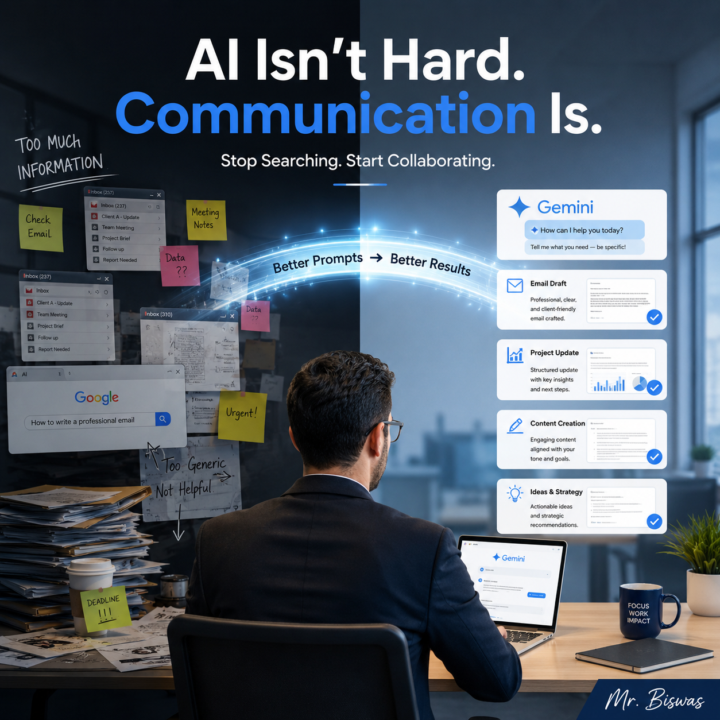
Honestly, most of the conversations around AI these days feel a bit overwhelming. We keep hearing terms like "Prompt Engineering" or "Frameworks," and it makes it sound like you need a degree in computer science just to save some time at work. But here’s the reality I’ve noticed: You don't need to learn how to code. You just need to change how you talk to the tool. Most people treat Google Gemini like a fancy search engine. They type a short, random question, get a generic answer, and assume the tool isn't that smart. But if you treat it like a real, competent assistant—giving it a specific role, a clear context, and strict boundaries—the quality of what you get back completely changes. For example, instead of asking it to "Write an email about a project update," try telling it exactly who it is representing, what tone to use, and what corporate clichés to avoid. Setting those boundaries takes an extra 30 seconds, but it saves you an hour of manual editing later. At the end of the day, AI isn’t going to replace our jobs, but the people who learn how to build simple, repeatable habits with it are definitely going to have an easier time managing their workload. 💬 I'm curious to know: What’s the biggest frustration you’ve faced when trying to use AI for your daily work? Does it feel too generic, or is it just hard to get it to say exactly what you want? Let’s chat in the comments! 👇 #AIProductivity #GoogleGemini #SmartWork #Workflow #ProfessionalGrowth #MrBiswas
22d •
Most people are using Google Gemini entirely wrong.
Most people are using Google Gemini entirely wrong. They treat it like a basic search engine—asking random questions, getting generic text back, and then feeling disappointed with the results. But the truth? AI isn't the problem. The system is. Top-performing professionals don’t just "chat" with AI. They build repeatable frameworks to turn it into a 24/7 executive assistant. I’ve spent months testing workflows to crack this, and I bundled the entire no-code, 4-Pillar Framework into my new paperback, "THE PROMPT ADVANTAGE", which just went live on Amazon! 🚀 It’s designed to help busy creators, managers, and entrepreneurs reclaim 10+ hours a week by automating their daily heavy lifting. 💬 Let’s do a quick poll in the comments: What is the #1 task you wish you could completely offload to an AI assistant right now? 1️⃣ Drafting endless emails & replies 2️⃣ Deep market research & data analysis 3️⃣ Content creation & brainstorming 4️⃣ Meeting preparation & scheduling Drop your number (1, 2, 3, or 4) below! I'll personally reply to each comment with a quick prompting tip on how to automate that exact task. 👇 https://www.amazon.com/dp/B0H1VRB13S
0 likes • 22d
@Frank van Bokhorst yeah 👍
Jun 8 •
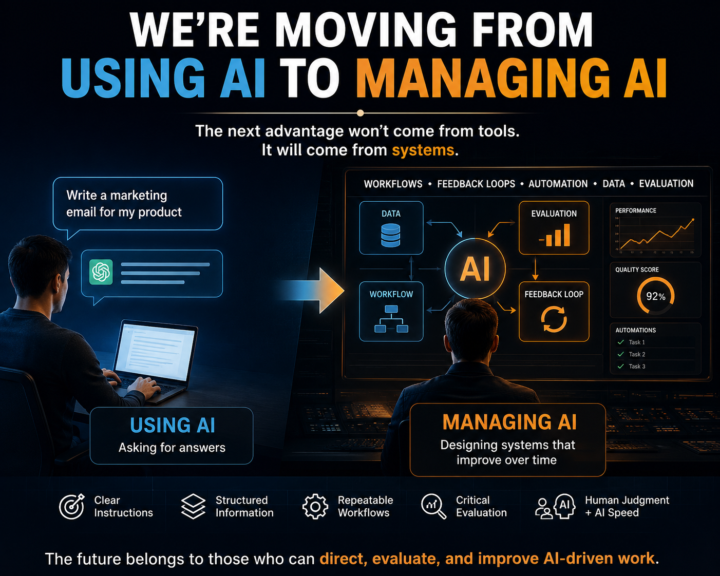
We're Moving From Using AI to Managing AI
A prediction: Within 5 years, "AI literacy" will become as important as computer literacy. Not because everyone will become a programmer. But because everyone will manage AI in some form. Think about it. Most professionals today don't build software, but they still need to know how to use computers effectively. The same thing will happen with AI. The highest performers won't necessarily be the people with the highest IQs. They'll be the people who know how to: • Give clear instructions • Structure information • Create repeatable workflows • Evaluate outputs critically • Combine human judgment with AI speed The interesting part? We're still treating AI as a tool. Eventually, many people will be managing multiple AI systems the same way managers oversee teams today. The question may shift from: "Can you use AI?" to "Can you effectively direct, evaluate, and improve AI-driven work?" I think that's where the real competitive advantage is heading. Curious to hear your take: What's the one AI-related skill that will be most valuable by 2030? Checkout this 👇https://www.amazon.com/dp/B0H3ZSHLJJ
Jun 8 •
Most people still think AI is about getting better answers.
I think they're looking at the wrong trend. The next major shift isn't smarter chatbots. It's AI that improves its own workflows. Right now, AI helps humans work faster. But we're entering a phase where AI systems can: • Analyze their own performance • Identify inefficiencies • Refine processes • Generate better solutions over time • Assist in building and improving other AI systems That changes the game. For the last 20 years, the biggest advantage was having access to information. Today, information is everywhere. The new advantage is leverage. A single person with the right AI systems can operate with the output of an entire team. The question isn't: "Will AI replace people?" A more important question is: "How much more effective will AI-augmented people become compared to everyone else?" I believe the gap between those who learn to collaborate with AI and those who don't will become one of the biggest competitive advantages of this decade. We're still very early. Most people are experimenting with prompts. Very few are building systems. And that's where the real opportunity is. What's one AI trend you think most people are underestimating right now . #The Time Lens for Businesses (Productivity Lesson) #AI Email Agent (9/20/24) #AI Email Agent (9/20/24) #RAG Chatbot AI Agent (9/22/24)
0 likes • Jun 8
@Hamza Alhamdi Absolutely. Sometimes it feels like we're watching a major technology shift happen in real time. It'll be interesting to see where things are just 2–3 years from now.
0 likes • Jun 8
@Duncan Rogoff That's exactly the point. Most people are still evaluating AI based on the quality of a single response. But once you start working with feedback loops, evaluations, and iterative workflows, you realize the real value isn't in the output itself—it's in the system's ability to keep getting better. The first time you see a workflow improve its own results over multiple cycles, it changes how you think about AI entirely.
Jun 6 •
Most People Are Preparing for the Wrong Future
A surprising number of professionals are asking: "Will AI take my job?" But that question misses the point. The people who thrive in the next decade won't be the ones who can predict every new technology. They'll be the ones who can adapt faster than technology changes. Think about it: Software changes. Platforms change. Tools change. Industries change. But some skills become more valuable every year: ✓ Judgment ✓ Creativity ✓ Taste ✓ Trust ✓ Adaptability AI can generate. AI can analyze. AI can automate. But AI still needs humans to decide: What matters? What is worth building? What should be ignored? The future isn't Human vs AI. The future is Human + AI. If you could strengthen only ONE skill over the next 12 months, which would create the biggest advantage for you? Judgment Creativity Communication Adaptability Technical AI Skills Comment with your choice and explain why.
2 likes • Jun 6
@J F So glad you enjoyed the read! It’s the smartest question you could ask yourself right now. Tech will handle the hard skills, but humans must master the soft skills to direct that tech. For the modern landscape, I highly recommend doubling down on Adaptability—it’s the anchor that makes all other soft skills work. What's the main soft skill you've been experimenting with lately?
1 like • Jun 7
@Don Jefe 100% true. There’s a huge difference between building basic automation and trying to get AI to handle complex, creative tasks. It loves to take shortcuts! That’s why human guidance is irreplaceable—you need that sharp eye to pull it back on track when it starts hallucinating. It sounds like you’ve had your fair share of battles with lazy AI prompts too?
1-8 of 8

Active 7d ago
Joined May 18, 2026
Powered by