Activity
Mon
Wed
Fri
Sun
Sep
Oct
Nov
Dec
Jan
Feb
Mar
Apr
May
Jun
Jul
Aug
What is this?
Less
More
Owned by Mona
Build systems & leverage AI to attract, connect & convert clients. Helping coaches and consultants work smarter without bro marketing tactics
5 contributions to Write Your Business Book

Jun 15 •
A space to connect... drop your links here
I'd love to know you all a little better, what you do, whether you have a main job and a business on the side or a business full time. Drop your links in the comments here (website, YouTube channel, LinkedIn, Instagram, wherever you would like to connect).


5 likes • Jun 15
Here are mine: My LinkedIn My Website My Community: Next Level Growth Hub My YouTube Channel
3 likes • Jun 15
@Ashley Jasper Styles thank you! I've updated it. 😊
Jun 4 •
30 minutes a day
Do this and you'll walk away with a realistic writing rhythm for the busiest version of you, so you make real weekly progress in stolen minutes instead of waiting for a free weekend that never comes. The #1 thing standing between members and finishing their book isn't difficulty, it's time. Most people here are writing in stolen hours: after the kids are down, before work, on a lunch break. The good news is that this works in as little as 30 minutes a day, but only if you run it the right way. Here's how. One chapter at a time (kill shiny-object syndrome) The fastest way to make zero progress is to keep restarting. You get halfway through Chapter 3, decide your structure is wrong, and start the outline again. Sound familiar? Pick one chapter, one section, one piece of writing. Finish it. Move on. A finished rough draft beats a perfect chapter you rewrote four times and never completed. The 30-minute session shape - 5 min — open your document and read your last note to yourself ("tomorrow: write the opening of section 2"). No deciding what to work on; you already decided yesterday. - 20 min — one small, specific writing move. Not "write the chapter." One paragraph, one section, one idea fleshed out. Keep it small enough that it feels achievable before you even sit down. - 5 min — read back what you wrote and make a quick note of your next single move. That note is what makes tomorrow's session start instantly instead of stalling. If you have 60 minutes Lucky you! Double the writing block to 40 minutes and use the extra time like this: - 5 min — open your document and read your note from yesterday - 40 min — your writing block, split into two 20-minute bursts with a 2-minute stretch in between if you need it - 10 min — read back, edit lightly, and write tomorrow's single move - 5 min — a bonus round: jot down any ideas, questions or tangents that came up during writing so they're captured and out of your head Two sessions at 60 minutes a day will move your book forward faster than almost anything else you can do.

3 likes • Jun 4
Love this! I’m deep into some other projects right now but your consistency is helping me not forget I want to write a book. 😊
May 21 •
What Exactly Is a Business Book?
If you tell someone you’re writing a novel, most people immediately understand what that means. But when you say you’re writing a business book, people often look puzzled. Does it mean a textbook? A memoir? A self-help book? A giant hardback full of charts and corporate jargon? The truth is that “business book” is a broad term. A business book can take many different forms depending on the author’s goals, audience and expertise. At its core, a business book is simply a non-fiction book designed to help readers solve a problem, improve a skill, understand an industry, grow a business or think differently about work and success. Business books are often written by entrepreneurs, coaches, consultants, industry experts, speakers and professionals who want to share knowledge, build authority or help others achieve results. And importantly: not all business books are “about business” in the traditional sense. A mindset coach, parenting expert, leadership consultant or nutrition professional may all write business books if the content helps readers improve some aspect of their work, leadership, productivity or professional life. Why Do People Write Business Books? Business books are rarely written only to sell copies. Most authors write them because a book can: - Build credibility and authority - Attract ideal clients - Support speaking opportunities - Create trust with readers - Open doors professionally - Share expertise at scale - Generate leads for coaching, courses or services - Create a long-term business asset For many entrepreneurs and experts, a book becomes the foundation of an entire brand. Different Types of Business Book Here are some of the most common categories of business book, along with typical length ranges and examples. 1. How-To or Practical Guide Books These books teach readers how to achieve a specific outcome through step-by-step guidance. They are highly actionable and often include frameworks, exercises, checklists or strategies.

1 like • May 21
Very helpful 😊
May 15 •
Should I use AI to write my business book?
For the past 6 years, I’ve been coaching business owners and entrepreneurs to write and publish their business books. Lately, a lot of people have started turning to AI to write for them. There are pros to doing this - it's faster, cheaper and less effort. However, YOU are your business and if your voice doesn't come through in your writing, you won't attract (the right) clients with it. You won't be able to show your book during networking meetings and truthfully announce with pride that YOU wrote a book. And when people read it and realise it's AI generated (and they will realise), your reputation could take a downturn. My advice for anyone wanting to write is to embrace AI without letting it suck your personality out of the pages. In the planning stages, brainstorm ideas with it. Ask it to suggest chapter titles. Run your writing through it for spelling and grammar, ask it to suggest improvements or create infographics to include. Research agents/publishers or self-publishing platforms with it. But make the content your own. Write it from the heart and let your audience hear your voice in the words on the page.

2 likes • May 18
@Lindsey Ciarrocca yeah I’m still trying to figure out how much to use it. I like using it for a lot of things and will use to to help me write but I don’t want to with a book. Like @Rachel Harmsworth said, it wouldn’t feel like mine. I have been using Claude code to build things too. But I think that’s a totally different thing. And if I can find some useful agents I’ll probably use them too. But when it comes to writing a book, I want it to feel like I actually wrote it so I’ll definitely be limiting use. Do you use Ai for some things?
2 likes • May 18
@Lindsey Ciarrocca yes I totally get that way too. I’m constantly having to talk myself out of my “great 💡 ideas”. Knowing my client journey has really helped me with that. If my idea doesn’t fit on their journey I don’t entertain the ideas anymore. 😁
May 17 •
UPDATE ON "Please help me test my quiz!"
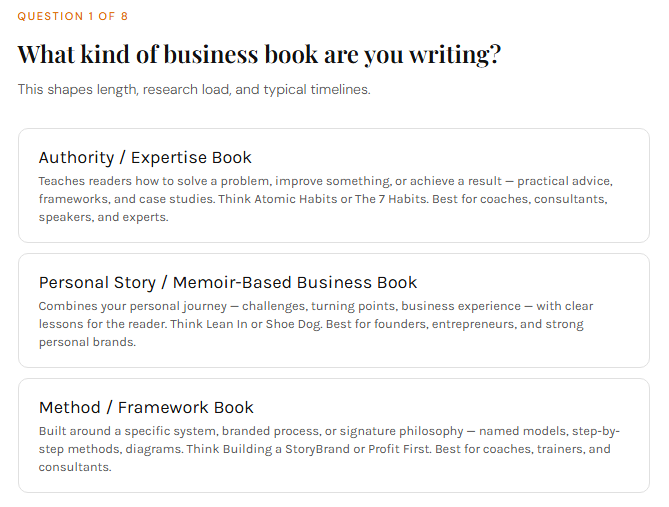
I've created a 'How long will it take to write my business book' quiz where you answer 8 multiple choice questions and get a personalised writing timeline and a writing routine, as well as some personalised planning/writing tips at the end. EDIT: The new and improved QUIZ is now here: https://www.writeyourbusinessbook.com/take-the-quiz I've finally worked out all the bugs and got it working, it's much improved and now collects email addresses and sends an automated welcome email as suggested! Thank you for your help with this so far! If anyone else has a minute to click the above link and take the quiz, I'd be really grateful for any further feedback, e.g. any typos, glaring errors, suggestions for improvement.
1 like • May 17
I’m not ready to start my book but this was helpful and gave me a realistic view of the process.
1-5 of 5

@mona
I help established coaches replace chaos and self-doubt with clear strategy, smart systems, and sustainable growth. Business Coach & Strategist
Active 1m ago
Joined May 17, 2026