Activity
Mon
Wed
Fri
Sun
May
Jun
Jul
Aug
Sep
Oct
Nov
Dec
Jan
Feb
Mar
Apr
What is this?
Less
More
Memberships
The Sunday Strategy
63 members • Free
SBA Model (FREE)
34 members • Free
Ai Automation Business Skool
45 members • $49/month
AI Automation Agency Hub
311.5k members • Free
AI Automation (A-Z)
152.5k members • Free
The AI Advantage
102.3k members • Free
AI Automation Society
335.8k members • Free
Voice AI Accelerator
7.7k members • Free
AI Enthusiasts
11.6k members • Free
9 contributions to Ai Agency Launch - Free

Feb 24 •
No more awkward cold emails: My automated lead-cleaning workflow
Yo everyone! I just finished building a new Make.com workflow for outbound campaigns and wanted to share the sauce. If you do any kind of cold email, you know the pain of scraped data making you sound like a robot (e.g., "Hey! I noticed you work at Elate Staffing Solutions Ltd..."). I built this Growth System to bridge the gap between raw scraped data and perfectly formatted, human-sounding cold emails. Here is the breakdown of how the automation flows: - Trigger (Apify): The workflow kicks off the second an Apify actor finishes scraping a list of target leads. - Validation (Mails.so): It automatically grabs the dataset and runs every email through an HTTP request to an API to check if it's deliverable. Gotta protect that domain reputation! 🛡️ - The Magic Sauce (GPT-4o): Here’s my favorite part. If the email is valid, the data gets passed to GPT-4o. I wrote a prompt that normalizes the company name by stripping out the generic corporate jargon (Inc, LLC, Ltd) and focusing on the most memorable element. So, "Walmart Inc" becomes "Walmart", and "JP Morgan Chase Bank" becomes "JPM". - CRM Push (Instantly): Finally, it pushes the validated email, first name, last name, and the cleaned company name directly into an Instantly campaign. I'm implementing this as part of the backend for my AI automation agency, Zestflow. Honestly, the AI company name cleaner alone is a massive game-changer for keeping personalization looking authentic at scale. Are you guys doing anything similar to clean up your lead lists before sending them to your sending tools? Drop your workflows or tech stacks below!
0
0
Nov '25 •
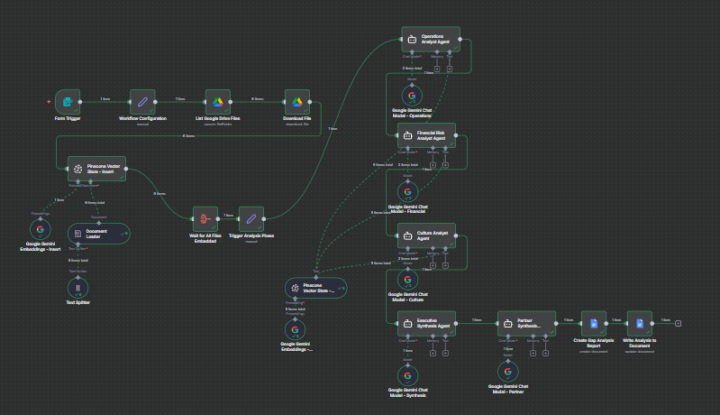
Refactoring from Parallel to Sequential Agents for better context
I recently posted V1 of my Agency Operations Engine, which used a parallel architecture where the Operations, Financial, and Culture agents ran simultaneously. After testing, I realized the final synthesis was weak because the agents weren't learning from each other. I completely rebuilt the flow to be sequential. The Logic Change: 1. Ingestion: Added a "Wait" node to ensure all files are fully embedded in Pinecone before analysis starts. 2. Sequential Chaining: Instead of running in parallel, the data now flows linearly: Operations Analyst -> Financial Risk Analyst -> Culture Analyst. 3. Partner Synthesis: In V1, I just used a Set node to combine the text. In V2, I added a specialized "Partner Synthesis Agent" that acts as a Senior Partner (McKinsey style), taking the previous outputs to generate a "Strategic Business Health Audit" before writing to Google Docs. The output quality is significantly higher when you force the LLM to build context layer by layer rather than trying to stitch three simultaneous outputs together.
1
0
Nov '25 •
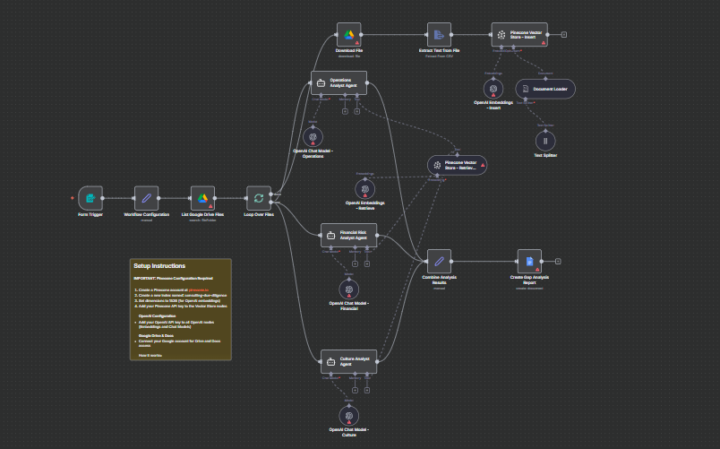
The "AI Junior Consultant" (Auto-Discovery & Gap Analysis)
I’m dropping a workflow today that solves the most expensive bottleneck in consulting: The Discovery Phase. We all know the drill. You sign a client, they dump 50 PDFs, contracts, and SOPs into a Google Drive, and you (or your junior staff) spend 2 weeks reading them just to figure out what’s broken. So I built an n8n workflow that does that 2-week "Document Review" in 5 minutes. This isn't just summarizing a PDF. It is a multi-agent RAG (Retrieval-Augmented Generation) system designed with a "Split Brain" architecture to handle heavy data loads without hallucinating. How it works: The Input: You submit a Google Drive Folder ID containing the client's "Data Room." The Brain (Vector Store): The workflow ingests binary files, runs them through a Recursive Character Text Splitter (to maintain semantic context across chunks), and upserts the vectors into Pinecone using OpenAI embeddings. The Investigation (The Secret Sauce): instead of dumping everything into one massive prompt (which degrades quality), I set up the Vector Store as a "Tool" and split the logic into 3 Parallel Agents. This allows each agent to query only the specific vectors it needs: - Operations Agent: Queries for process bottlenecks and workflow inefficiencies. - Risk Agent: Scans specifically for financial liability and contract loopholes. - Culture Agent: Retrieves data related to employee sentiment and toxic patterns. The Deliverable: It aggregates the outputs from all three branches into a structured "Gap Analysis Report" in Google Docs. The ROI: Speed: Walk into the kickoff meeting knowing their problems better than they do. Accuracy: Because I used a "retrieve-as-tool" logic, the AI cites the specific document for every finding. Scale: You can run this asynchronously for multiple clients without hitting token limits. JSON attached below. Requires an OpenAI key and a free Pinecone index.
Nov '25 •
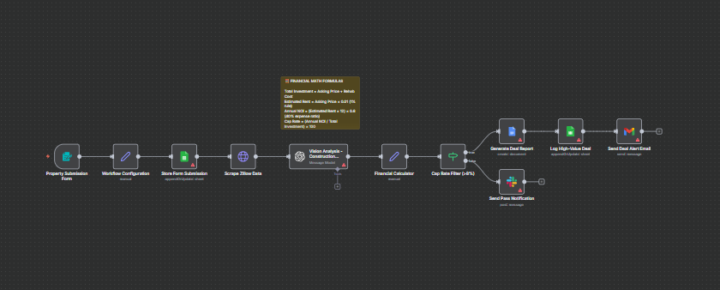
The "AI Investment Analyst" (Vision AI + ROI Calculator)
I’m dropping something special for the Real Estate pros today. The biggest bottleneck in real estate isn't finding deals—it's underwriting them. You spend hours looking at photos, guessing rehab costs, checking rental comps, and building spreadsheets. So I built an n8n workflow that does the entire analysis in 30 seconds. This isn't a scraper. It’s a full-blown financial analyst. The Workflow Logic: 1. Input: You drop a Zillow/Redfin URL into a simple form. 2. The Eyes (GPT-4o Vision): The workflow pulls the listing photos and actually looks at them. It identifies the condition of the kitchen/bathrooms (Dated? Modern? Gut reno?) and estimates a "Rehab Budget" based on the square footage. 3. The Brain (Financial Logic): It pulls area rental comps (via API), takes the asking price + the AI-estimated rehab cost, and calculates the Cap Rate and Cash-on-Cash ROI. 4. The Closer: It generates a formatted Google Doc "Investment Memo" highlighting the pros, cons, and financial projections. 5. The Alert: If the ROI is >12%, it drafts an email to your VIP investor list. Why this is revolutionary: - Visual Analysis: It doesn't just read text; it sees that the cabinets are from the 1980s and adjusts the budget accordingly. - Speed to Offer: You can analyze 50 properties a morning instead of 5. - Standardization: Every deal is underwritten with the exact same math. JSON attached below. Note: This uses OpenAI's Vision model, so it costs a few cents per run, but the time saved is worth hundreds.
3
0
Nov '25 •
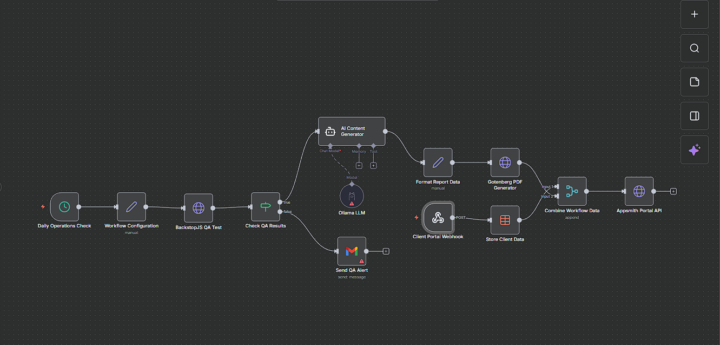
The "Agency Operations Engine" (Automated QA + Reporting)
I’m dropping the big one today. If you run an agency, you know the drill: You have to manually check client sites to see if they’re broken, then write a report, then convert it to PDF, then email it. It’s a massive time sink. So I built a robot to do it for me. This n8n workflow acts as a fully autonomous Account Manager. It runs daily, checks the tech, writes the update, and pushes it to the client portal. The "Stack" (100% Open Source Power): - BackstopJS: Runs visual regression tests on the client’s site (to catch broken layouts). - Ollama (Llama3): I’m running the AI locally. No OpenAI API bills. It analyzes the test results and writes a professional summary. - Gotenberg: Converts the HTML report into a branded PDF. - Appsmith: Pushes the final report directly to the Client Portal. - Gmail: If the QA fails, it bypasses the report and wakes me up with an emergency alert. Why this is a game-changer: 1. Zero Cost AI: Since it uses Ollama, generating these reports is free. 2. Proactive vs. Reactive: I know if a client site is down before they call me. 3. Client Experience: They get a branded PDF report in their portal every week without me lifting a finger. JSON attached below. Note: This is an advanced workflow. You will need endpoints for Backstop/Gotenberg (easy to spin up via Docker).
1
0
1-9 of 9

Active 3d ago
Joined Sep 15, 2025