Activity
Mon
Wed
Fri
Sun
Aug
Sep
Oct
Nov
Dec
Jan
Feb
Mar
Apr
May
Jun
Jul
What is this?
Less
More
Memberships
Weekly Five Recipes
75 members • Free
SBA Model (FREE)
47 members • Free
Ai Automation Business Skool
45 members • $49/month
AI Automation Agency Hub
329.2k members • Free
AI Automation (A-Z)
164.8k members • $7/month
The AI Advantage
126.7k members • Free
AI Automation Society
426.3k members • Free
Claude for Founders
10.4k members • Free
AI Enthusiasts
15.3k members • Free
28 contributions to AI Automation Society

Mar 27 •
I build the custom n8n/Python pipelines. I need a killer Appointment Setter to book the meetings. (Base + Commission)
Hey everyone, I’m Mohamed, the technical founder of Zestflow. We are an AI Automation Agency specializing in custom middleware and data pipelines (n8n & Python) for mid-market US and UK Logistics, Manufacturing, and Supply Chain companies. I am an engineer. I can build complex ERP integrations that save these companies hundreds of hours of manual data entry. What I need right now is a hungry Appointment Setter to partner with me and take over the outbound inbox. I do not want a "lead scraper." I want someone whose only focus is getting Operations Directors and VPs of Supply Chain onto my Calendly. The Role: - Channels: Managing our Cold Email (Instantly/Lemlist) and LinkedIn outbound campaigns. - The Goal: Handling the replies, overcoming objections, and turning a "maybe" into a booked Zoom discovery call. - The Target: mid-market Logistics & Manufacturing executives. The Compensation Structure: Since I only care about results, this is a performance-heavy structure: - $100/month flat base (This covers your time managing the campaigns and inbox daily). - $35 Commission per Qualified Booked Call (Paid out for every prospect that actually shows up to the Zoom). - The math: Book 4 calls a month, you make $240. Book 10 calls, you make $450. It’s completely uncapped. Why work with Zestflow? We aren't selling generic chatbot wrappers. We sell high-ticket, custom engineering solutions. When you book the call, you can trust that I have the technical chops to close the deal and deliver the exact pipeline the client needs. How to Apply: I am not looking for a resume. If you want the role, send me a DM with your exact rebuttal to this prospect reply: "We already use NetSuite for our ERP, we don't need custom automation." If you can handle that objection and pivot it into a booked call, let’s get to work. — Mohamed Arsath
Feb 24 •
No more awkward cold emails: My automated lead-cleaning workflow
Yo everyone! I just finished building a new Make.com workflow for outbound campaigns and wanted to share the sauce. If you do any kind of cold email, you know the pain of scraped data making you sound like a robot (e.g., "Hey! I noticed you work at Elate Staffing Solutions Ltd..."). I built this Growth System to bridge the gap between raw scraped data and perfectly formatted, human-sounding cold emails. Here is the breakdown of how the automation flows: - Trigger (Apify): The workflow kicks off the second an Apify actor finishes scraping a list of target leads. - Validation (Mails.so): It automatically grabs the dataset and runs every email through an HTTP request to an API to check if it's deliverable. Gotta protect that domain reputation! 🛡️ - The Magic Sauce (GPT-4o): Here’s my favorite part. If the email is valid, the data gets passed to GPT-4o. I wrote a prompt that normalizes the company name by stripping out the generic corporate jargon (Inc, LLC, Ltd) and focusing on the most memorable element. So, "Walmart Inc" becomes "Walmart", and "JP Morgan Chase Bank" becomes "JPM". - CRM Push (Instantly): Finally, it pushes the validated email, first name, last name, and the cleaned company name directly into an Instantly campaign. I'm implementing this as part of the backend for my AI automation agency, Zestflow. Honestly, the AI company name cleaner alone is a massive game-changer for keeping personalization looking authentic at scale. Are you guys doing anything similar to clean up your lead lists before sending them to your sending tools? Drop your workflows or tech stacks below!
0 likes • Feb 28
@Stacy Mills Thanks for the notes. You are completely right about the trigger-based personalization being the real needle-mover; the name cleanup is just the baseline to ensure we do not look like a scraped list. The GPT prompt is specifically tuned to just drop the legal jargon rather than creating weird acronyms, to avoid that exact over-optimization issue. Definitely taking the note on adding stricter filters for catch-alls and role emails before they hit the campaign.
0 likes • Feb 28
@Linus Müller Yeah, I am an AI and Data Science engineering student. Most of my time is spent building with Python, LLMs, and automation platforms like n8n. Are you building in the automation space as well?
Feb 28 •
Looking for a founding partner to take over client acquisition and scale our backend systems.
Yo everyone. Now, it's time to pour fuel on the fire. I am bringing on a Founding Member to take complete ownership of the growth side of the agency. I’m not looking for a standard employee to just punch the clock. I am looking for a partner in the trenches who is hungry to build something massive and actually make a difference. What you will own: - Client Acquisition: Taking the leads generated from our outbound systems and closing the deals. - Client Onboarding: Ensuring a seamless transition from closed-won to operational, getting our AI systems integrated into their workflows. Who this is for: This is for someone who wants to be on the ground floor of an AI automation agency. You should be highly self-motivated, eager to shape the direction of the company, and comfortable being part of the core team (and the documentary series as we scale this thing in public). If you are just looking for a comfortable corporate gig, this isn't it. But if you are a builder who wants to own the sales and onboarding processes and directly drive revenue, we need to talk. Drop a message to zestflow@zohomail.in if you are ready to build.

Jan 21 •
Automation Isn’t About Replacing People, It’s About Removing Friction
One thing I’ve noticed across all kinds of businesses is this: Most problems aren’t caused by lack of effort.They’re caused by friction. Friction shows up as: • Missed calls that never get followed up• Leads sitting in inboxes too long• Invoices that need repeated reminders• Clients asking the same questions again and again• Tasks that only get done when someone remembers None of these are “hard” problems. They’re consistency problems. And consistency is exactly where systems and automation shine. Not to replace people —but to support them. When repetitive, predictable work runs automatically, teams get their time and focus back. They move from: → reacting to → thinking From: → chasing to → building The shift usually starts small: Automate one follow-up.Systemize one reminder.Remove one manual step. But those small changes compound fast. And soon, the business doesn’t just move faster —it moves cleaner. So here’s a deeper question: 👉 Where does friction show up most often in your business?👉 And what would change if that friction disappeared? We build automations that remove friction. At our agency, we design smart automation systems that handle follow-ups, workflows, reminders, data flow, and repetitive operations — so your team can focus on growth, customers, and decisions. If you’re exploring automation for your business or startup: 📩 Chat or email us: jeswin1564@gmail.com Let’s turn manual effort into reliable systems.
1 like • Jan 21
Well said!!
Nov '25 •
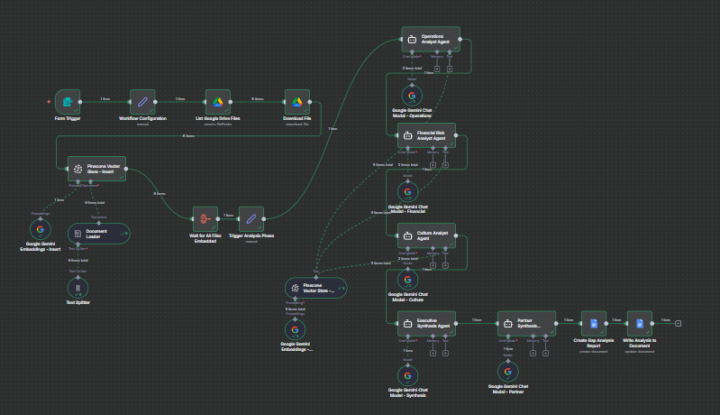
Refactoring from Parallel to Sequential Agents for better context
I recently posted V1 of my Agency Operations Engine, which used a parallel architecture where the Operations, Financial, and Culture agents ran simultaneously. After testing, I realized the final synthesis was weak because the agents weren't learning from each other. I completely rebuilt the flow to be sequential. The Logic Change: 1. Ingestion: Added a "Wait" node to ensure all files are fully embedded in Pinecone before analysis starts. 2. Sequential Chaining: Instead of running in parallel, the data now flows linearly: Operations Analyst -> Financial Risk Analyst -> Culture Analyst. 3. Partner Synthesis: In V1, I just used a Set node to combine the text. In V2, I added a specialized "Partner Synthesis Agent" that acts as a Senior Partner (McKinsey style), taking the previous outputs to generate a "Strategic Business Health Audit" before writing to Google Docs. The output quality is significantly higher when you force the LLM to build context layer by layer rather than trying to stitch three simultaneous outputs together.
1 like • Nov '25
@Denuwan Hitihamilage thanks man!!
1 like • Nov '25
@Hicham Char It effectively tripled the execution time since the latency stacks (Agent A + B + C) rather than being determined by the slowest branch. However, since this is a background "report generation" task and not a real-time chat interface, the extra minute or two is negligible. The previous parallel version was faster, but the final Synthesis Agent kept hallucinating correlations because it didn't have the explicit, step-by-step context from the previous agents. I’d rather have a slow, accurate report than a fast, generic one
1-10 of 28

@mohamed-arsath-5178
The urge to do something is what proves me to myself
Active 51d ago
Joined Aug 26, 2025
Powered by